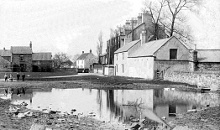
Tudhoe & Spennymoor Local History Society
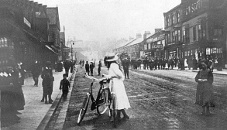
Next Talk - Monday 26th Oct 2026 at 7.30pm - AGM + The First Draft of Local History: The Role of Community Newspapers. by Archie Mackay.
Held at St. David's Church Hall, Tudhoe Lane, Tudhoe, DL16 6LL.
Free Entry.
Please note tea and biscuits will be served from 7pm at a charge of £1.
Click to view our 2026 programme.
October 1930 - Church, Mines, Sport, Weddings, Insurance/ Sample Family/ Rates.
Hosted by DurhamWeb.
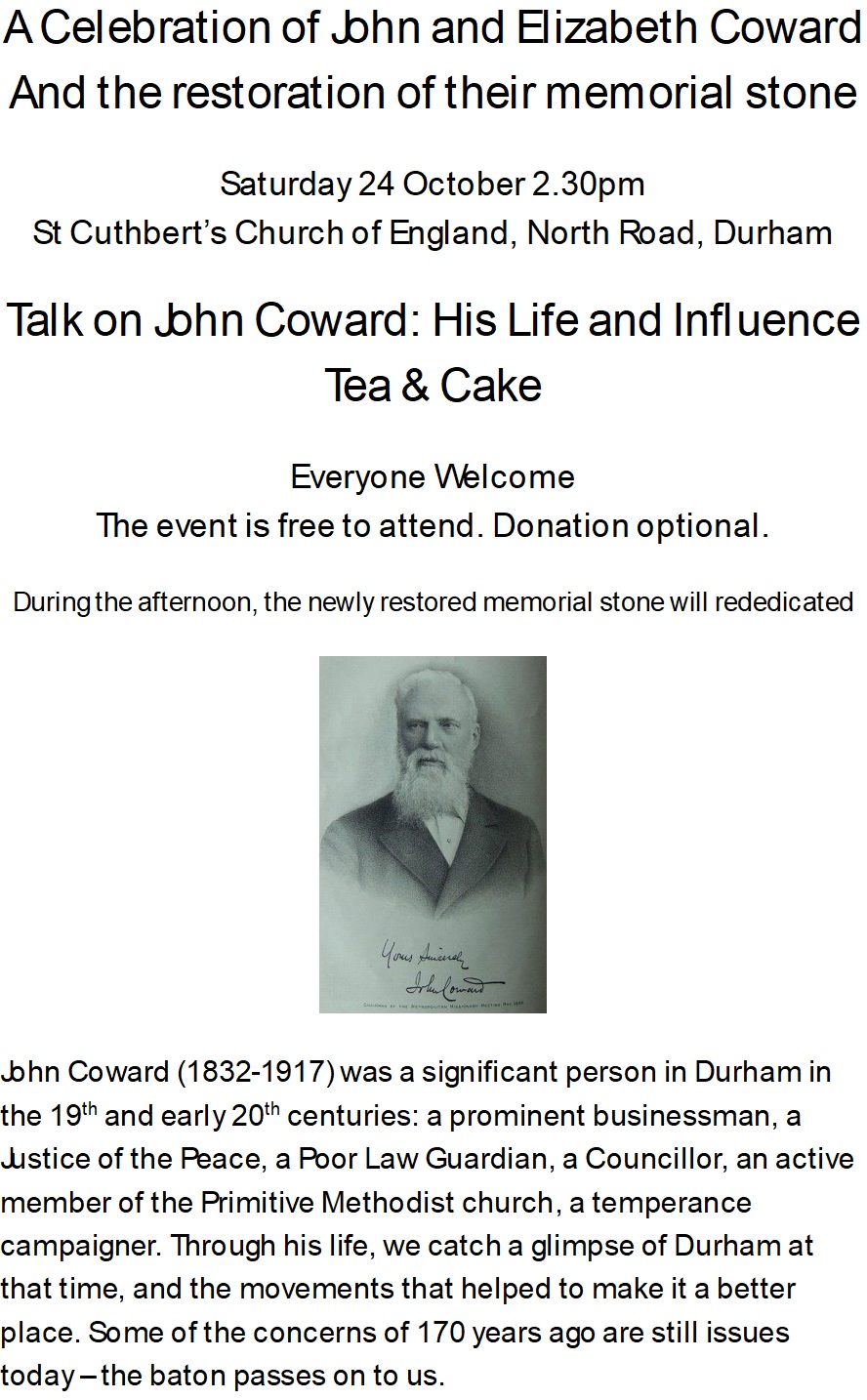
Saturday 24 October 2.30pm
Talk on John Coward: His Life and Influence
Tea & Cake
St Cuthbert’s Church of England, North Road, Durham
A Celebration of John and Elizabeth Coward
And the restoration of their memorial stone
Everyone Welcome
The event is free to attend. Donation optional.
Click poster for more details.
Two Norman Cornish Exhibitions.
Click for details of a refreshed Norman Cornish Coming Home exhibition. at the Bob Abley Gallery at Spennymoor Town Hall.
Click for details of a Norman Cornish exhibition at the Bowes Museum (A life in Sketchbooks).
McGuinness Centenary
Click for details of McGuinness Centenary - New improved edition of the art of an underground miner.To celebrate the centenary of the artist’s birth in 1926, Robert McManners and Gillian Wales have produced a new, improved, edition of their 1997 book. This is on sale for £15.95 at the Mining Art Gallery in the Market Place in Bishop Auckland. For details see: Auckland Project McGuinness Centenary Exhibition.
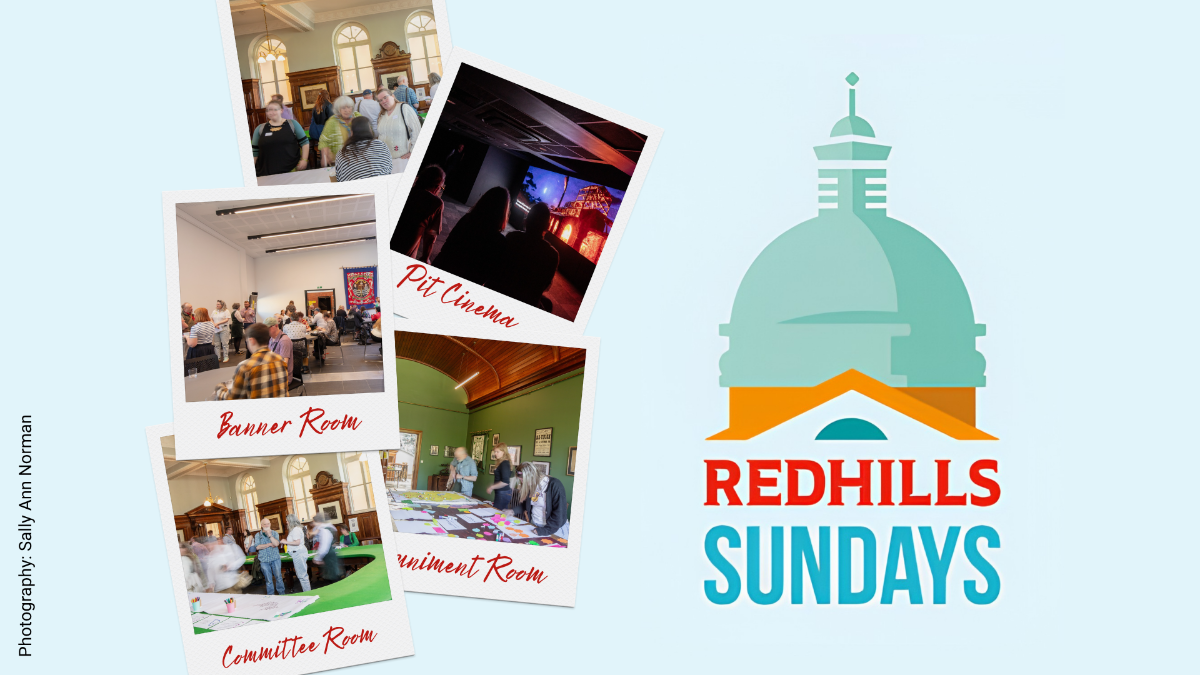 Redhills Sundays and Other Events
For further information go to Redhills Events.
The Society was formed in 1988 and its aims are to organise an annual programme of talks and outings and attend events promoting local history. For more details go to TSLHS History.
Click to view our Time Line. - 2024 is Spennymoor Town Council's 50th anniversary year so we have produced a Time Line covering those years. This started as part of a much longer time line originally compiled by Eric Coombes.
Click to view our Photo Archive - over 1,000 photographs of Tudhoe, Spennymoor and surrounding areas. These images are protected by copyright licensing regulations and are for personal use only, they cannot be copied, published or distributed.
Click to view our Requests for Information If you can help please e-mail tslhs@btinternet.com
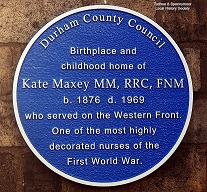
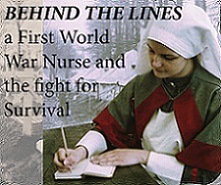 Behind the Lines: a First World War Nurse and the fight for Survival. Our film about medical services on the Western Front and the contribution of Spennymoor people to them is free to view on YouTube under a creative commons licence.
To view the film, see more information about Kate Maxey, photos of the Film Premiere, details of DVDs, Education packs and film presentations go to Behind the Lines.
Situated on the south side of the Wear Valley, midway between the ancient settlements of Bishop Auckland and Durham, Spennymoor only came into existence during the mid 19C. Previously, eight villages, all now satellites of this small market town, surrounded the open common known as the Spenny Moor. Most of these, including Tudhoe, already existed when the Boldon Book, the North East’s equivalent to the earlier Domesday Book, was compiled in 1183.
650 years later, exploitation of County Durham's mineral wealth, principally its huge reserves of coal, began to help satisfy the needs of Britain's industrial revolution. This resulted in the creation or expansion of many towns and villages in the eastern half of the County. Spennymoor is one such example of this change.
By 1840, coal pits were being sunk around the Moor, soon accompanied by houses to accommodate the ever growing number of miners. An iron and steel works quickly followed, established here to exploit the large quantities of coal now being produced around the expanding settlement. While never completely absorbing any of the villages, it is now physically linked to Tudhoe.
By the turn of the 20th Century coal and steel had long given way to service and manufacturing industries while the expanded town now also functioned more widely as a dormitory to the large coastal conurbations set around the mouths of the Tyne, Wear and Tees. For more details go to History.