Tudhoe & Spennymoor Local History Society
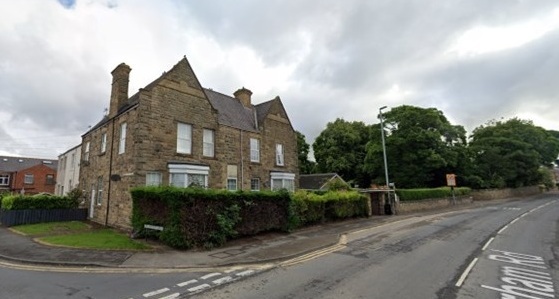
Park Villa / Tudhoe Park House
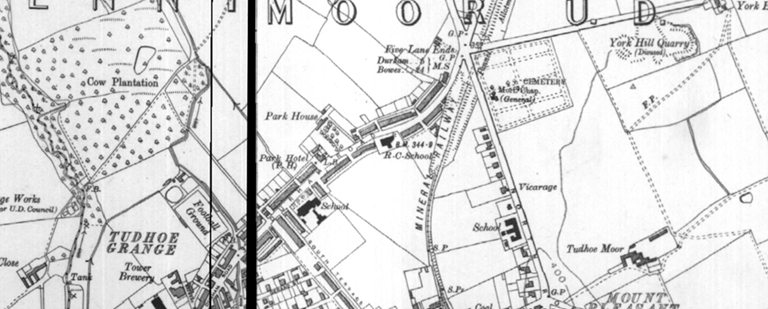 Who built Park Villa/Park House, Tudhoe Grange?
Park Hotel, which was close to Park Villa, was built by Cuthbert Gardner a builder and contractor.
Kelly's Directory 1879 described the Park Hotel as having a pleasant recreation ground, with a large music hall adjoining.
It was intended for cricket, athletics, fives(handball), rugby and quoits.
In 1879 Cuthbert Gardner is living at Park Villa while Henry Gardner is at Park Hotel. In 1879 Cuthbert Gardner was bankrupt. Had he built Park Villa as well as the hotel?
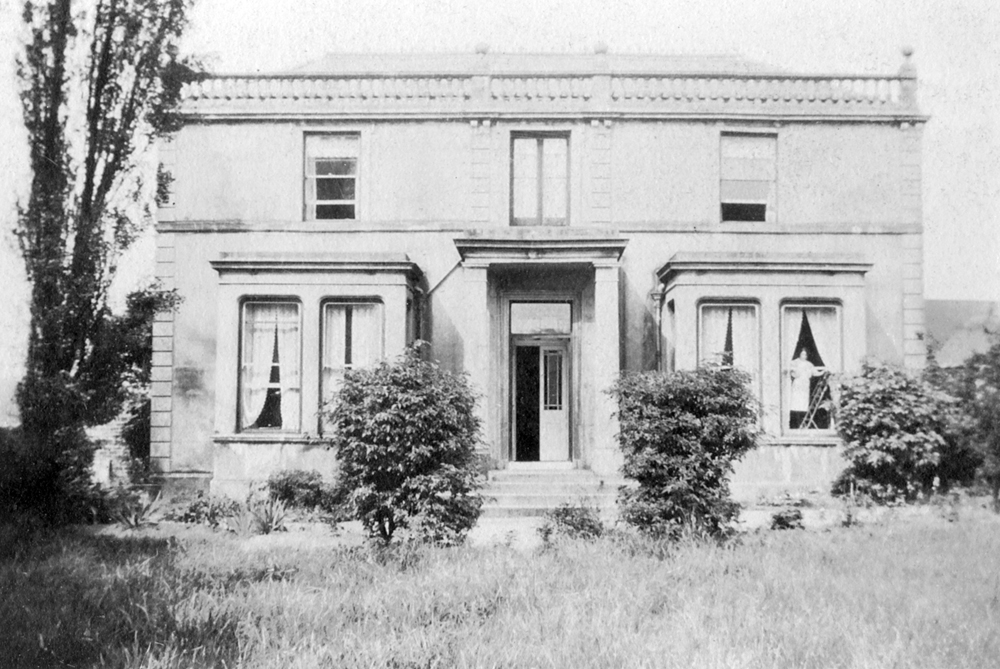 A recent advertisement on Purple Bricks website stated:-
Tudhoe Park House is a beautiful family home offering stunning period features, large manicured gardens and spacious living accommodation. Built by Thomas Harrison (a renowned civil engineer responsible for the construction of the nearby Croxdale Railway Viaduct) as his residence the property has many intricate and ornate features. Although Victorian the property has been built with a more Georgian feel, having symmetrical features and large square living spaces it is a grand and imposing property set within approximately 1.3 acres of private grounds providing a secluded and private home.
I've been unable to confirm that Thomas Harrison built or lived in Park Villa as he had a substantial property at Whitburn with his wife Sophia.
It has also been suggested that it was built by William Fleming, for his younger brother, Andrew. The Flemings were agents for the Salvin family, running the estate for four generations, they mainly resided in Tudhoe Village. Andrew Fleming was a land agent in 1871 living at French Fields, Tudhoe Grange, he died in 1880.
His widow Margaret Fleming was living at Park Villa in 1881 with five of their seven children.
In 1891 an iron worker, Richard Blackhouse with his wife and five children are living at Park Villa, also another daughter, her husband and two children, and a lodger.
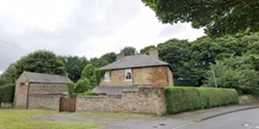 Samuel Edwards
Samuel Edwards, bc1837 at Burt Donegal, Ireland, qualified as a doctor in 1864 at Glasgow. He married Isabella Foster, b1836 Newcastle, in 1868, they lived in Jarrow. They then moved to Frizington, Cumberland where he worked for Winder & Iron Ore Mines and Ashby Colliery.
In the 1870s they moved to Tudhoe and Samuel was made a member of the North of England Branch of the British Medical Association in 1878.
In 1881 the family lived at Front Street, Tudhoe Village with a step-daughter, four daughters and a son.
In 1891 they are living at Oak Tree House, Tudhoe, near St Charles' Roman Catholic Church.
In Kelly's directory 1897 the address has changed to Tudhoe Park House although the 1901 census still has the property as Park Villa where they have a cook, housemaid and groom. Samuel died on 10th March 1905 at Tudhoe Park House, his death was confirmed by Dr W Pattullo and witnessed by his son-in-law from Ballyeglish Rectory, Moneymore, Derry, N. Ireland. Isabella died in 1914 at the Rectory.
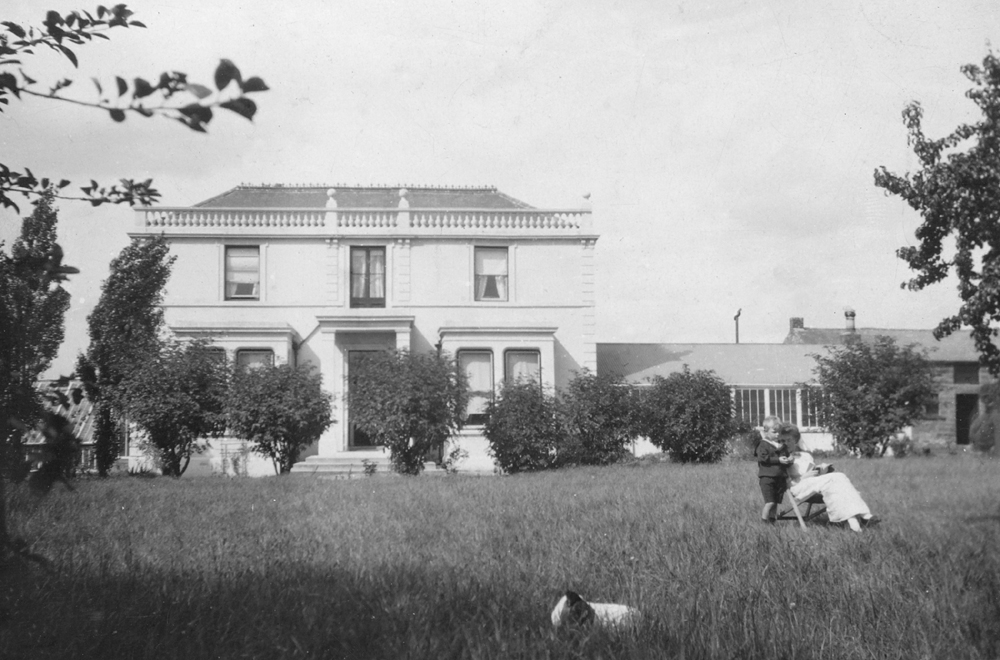 William Pattullo
William Pattullo, b1877 Perthshire Scotland - 1955, was the son of Robert Pattullo and Marian Christison.
In 1901 William, a physician, is boarding at 3 Dacre Street, Morpeth.
1st January 1904 Durham County Advertiser.
Durham Board of Guardians
Tudhoe Medical Officership
Three applications were received for the post of medical officer for the Tudhoe district as follows:-
Dr Pattullo, house surgeon, Durham County Hospital; Dr Hutchin, Tudhoe; and Dr Musslewhite, Tudhoe.
The Chairman briefly stated that Dr Musslewhite was the gentleman who had taken over the practice of the late Dr Drake, whose death the Guardians so much regretted. Dr Pattullo was at present house surgeon at he Durham County Hospital, and proposed starting in practice at Tudhoe, whilst Dr Hutchin had been in practice at Tudhoe Grange for some time.
The three applicants' names wew submitted to the meeting, with the following result:-
Dr Pattullo 19 votes; Dr Musslewhite, 12; and Dr Hutchin 0.
Mr Holliday moved that Dr Pattullo be appointed to the vacant post.
Carried unanimously.
Dr Pattullo was also elected public vaccinator for the same district.
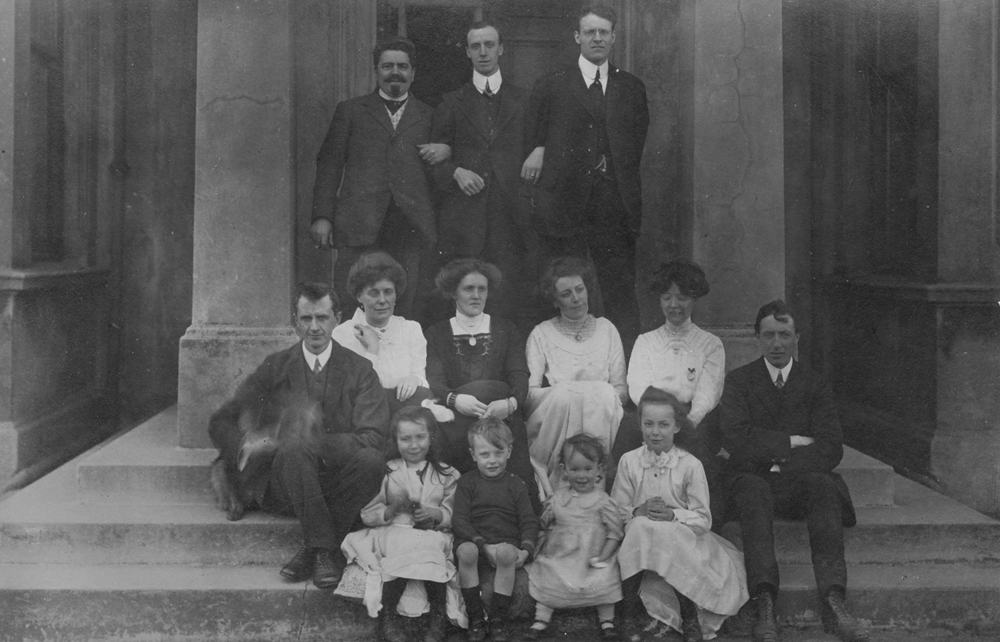 In 1905 he marries Eliza Evangeline Jobling, b1877 Morpeth - 1949, the daughter of Joseph and Charlotte Jane Jobling of Howard Castle, Morpeth who were wine and spirit merchants.
William, now a medical practitioner, and Eva were living at Tudhoe Park House, in 1906 they had a son, William.
In 1921 William jnr. is a boarder at The School, Durham.
Dr Pattullo and his wife were away from home in 1921 but a master marriner James Dunn and his wife were visiting Tudhoe Park House and there were two servants in attendance.
On 3rd January 1930 the Seaham Weekly News reported a "Thrill for Motorist Doctor"
On Wednesday a thrilling experience befell Dr William Pattullo. of Tudhoe Park House, Spennymoor, whilst he was driving his car along the Great North Road at Chester Dene, between Chester-le-Street and Durham. The vehicle skidded on the wet road, and after making a semi-circular swerve, mounted the footpath on the east side of the road and crashed into the wooden fence protecting the Dene. Although the car was damaged, and about 30 feet of the fencing suffered as a result of the smash, the doctor escaped uninjured.
William and Eva Pattullo were still living at Tudhoe Park House in 1939.
In the 1970s the house is linked to Dr J T Roberts and the chemist's shop in Cheapside.
Thank you to Julian Elphick.
Thank you to Robert Pattullo who sent us the photos and his memories of attending Jesmond Preparatory School
Charges Against a Durham Surgeon
At the Durham County Police Court on Saturday, before the Rev A. D. Shafto (chairman) and the Rev Canon Greenwell, Samuel Edwards, physician and surgeon, residing at Tudhoe Grange, Durham, appeared in answer to two summonses charging him with wilfully obstructing the highway at the Boyne Colliery, and also with using threatening language towards Police-constable Hugh McDonald, at the same place, on the 1st May. Mr Wm Brignall, sen., defended.
From the evidence of the officer, supported by three witnesses, it appeared that about eleven o’clock on the morning in question Dr Edwards drove his Whitechapel up to the door of Martin’s public-house, at the Boyne Colliery, where he alighted and went inside. The carriage and horse were seen standing at the door at twelve o’clock, and at one o’clock, without anyone in charge.
At three o’clock the defendant’s carriage was still standing, Dr Edwards in the meanwhile having been seen by Macdonald playing at “putting the stone” in the back yard of the public house.
At three o’clock the defendant began to negotiate for the purchase of a pony which was being put through a variety of exercises on the roadway, causing a large crowd to gather, and the roadway to be obstructed. The officer made a remonstrance, when Dr Edwards came up, and swearing at him told him he had nothing to do with it. Macdonald replied that if Dr Edwards did not use better language he would be compelled to lock him up. The doctor then doubled his fist in the officer’s face, and said “he would knock his -----head off.”
The same evening, Dr Edwards came to Durham, and reported to the Chief Constable that P.C. Macdonald had been guilty of misconduct.
Mr Brignall, in defence, contended that the defendant had not been guilty of any obstruction, and no one had made any complaint as to the roadway being blocked. He called three witnesses, who said that when Dr Edwards used the offensive language imputed to him, he was speaking to a drunken man named Rowe, and not to the officer.
Mr Brignall alleged that the case would never have been heard of if Dr Edwards had not reported Macdonald for misconduct.
The Bench considered both cases clearly proved, and imposed a fine of 10s and costs for the obstruction, and bound the defendant over in his own recognisances for his future good behaviour towards Macdonald.
(13th May 1878 Hartlepool Northern Daily Mail)
 22nd February 1878 Durham County Advertiser
The Suspected Child Poisoning at Low Spennymoor
On Monday afternoon, at the Vulcan Inn, Low Spennymoor, Mr Thomas Dean, coroner, resumed the inquiry into the circumstances attending the deaths of the children, Elizabeth Barrett, and John Holt, on the 15th and 19th of February, 1877, at Low Spennymoor. The case arose out of the proceedings in connection with the recent mysterious death of another child, William James Barrett, belonging to the same parents, at Wingate, a short time ago. The bodies of the children were exhumed on Thursday, the 7th inst., by order of the Secretary of State, and the case has since excited considerable interest in the neighbourhood. There were present on Monday Supt. Scott, of Castle Eden; Supt. Banks, Bishop Auckland; Inspector Liddle, Durham, and other officers.
After the exhumation, evidence of identification was taken. Mrs Jane Ann Hill, wife of Thomas Hill, grocer, Post Office Street, Low Spennymoor, said she remembered the family of Wm. and Ann Barrett, who resided near her house in January last year. The children were Elizabeth Barrett and John Holt, the latter an illegitimate child about four years of age.
Mrs Hill, recalled, stated that on the second visit of Dr Edwards, Mrs Barrett seized the child Holt by the arm and pushed it into the pantry. She quarrelled with her husband about it. That was the reason Dr Edwards would not come any more. In answer to questions put by Supt. Scott, the witness said she was first sent to the house of the Barrett’s on Friday evening, Feb 9th 1877. At that time Elizabeth Barrett was a very stout child, apparently well fed. The boy, John Holt, then looked thin and delicate.
She went into the house about ten o’clock and stayed about two hours. The child Barrett was in a cradle. Its mother washed it while witness was present that night. It did not seem to be badly clothed. Witness went in again on the Saturday morning, about eight o’clock, and the child, Elizabeth Barrett, was then in the cradle. The boy was sitting about. She suggested that a doctor should be sent for the first time she went to the house.
Dr Edwards came on the Saturday, when witness happened to be there. The doctor examined the child and said it was very ill; he did not look at the boy, but he said he would be wanting a doctor next. Witness washed the child frequently. She attended at Barrett’s on the Sunday, and continued to do so until the 15th of February, when the child, Elizabeth Barrett, died.
It took nothing in the shape of food, and witness used to wet its lips with cold water and milk. The mother went about her house business when witness was feeding the child, and never attended to its wants while witness was in.
People used to call Mrs Barrett “daft Hannah.” Afterwards she heard the husband was called “daft Willie.” She also attended to the boy, but he did not seem to have any appetite for food. Witness used to think there was a want in the woman, and that she did not understand about the children; and it was that which made witness go and do so much for them. She heard the instructions given to the mother by Dr Edwards, that the child was to be kept clean and comfortable.
The second time Dr Edwards came, the boy was nearly naked, and his mother “clicked” him by the hand and carried him into the pantry, which witness did not think a proper place to put an undressed unhealthy child in. A day after the boy took ill he passed a large worm. He cried to be put into the cradle in which the little girl died, and afterwards appeared to be held just as she was, excepting that he had no spots. If the little girl had had a stomach to have taken meat, it could not have lived on the nourishment it received from its mother. It did not appear to have any better stomach after taking Dr Edward’s medicine. She did not see the mother give the boy anything, and it only took milk and water at witness’s hands. The mother seemed very careless about her children. The family appeared to have very little food themselves. The purging symptoms from which the child suffered were like those of a complaint prevalent in the neighbourhood.
John Charles O’Hanlon, physician and Surgeon, Tudhoe Grange, said that on Thursday, the 7th inst., he examined the bodies of Elizabeth Barrett and John Holt. They were both very much decomposed. He carefully removed the interiors, but could judge of none of the organs specifically. He removed the intestines, stomach, and all together, put them into separate bottles, sealed them and labelled them “No 1. Elizabeth Bennett,” and “No.2 John Holt.” He then handed them to Inspector Liddle. Witness, examined by Mr Supt. Scott, said he did not remember being called in to attend the boy Holt in Feb., 1877. He was called to one of a row of houses behind the inn, but he could not swear beyond that to the best of his knowledge he used words to the effect “What is the use of sending for me; the child is dying.” It was a hopeless case. He sometimes spoke rather quickly, and he might say he supposed they had just sent for him to get a certificate. As well as he could remember it was Barrett’s child.
Mr Scott: Do you remember me showing you a certificate of the death of the child, John Holt, that the child died from tabes mesenterica? Was that the child? I think so.
I believe you said small doses of arsenic or other corrosive poison would cause this? It would cause symptoms.
Would neglect and starvation cause similar symptoms? It would; the glands which extract nourishment being affected. Sometimes they became affected amongst the poor from bad food, or being fed too early. His certificate would be right either in poisoning, or by neglect or starvation. He had no remembrance how the mother deported herself.
By the foreman of the Jury (Mr Watson): The worm in the boy would cause emaciation. It would be in the intestines, and would show a very bad class of food. He was satisfied he could have done no better if he had been sent for sooner.
Addressing the Coroner, Dr O’Hanlon said that lately, within the last few years, ever since there had been such an enormous canvassing going on amongst insurance companies for insuring infant lives, there had been a wonderful increase in the mortality amongst children.
The Coroner: That suggests very unpleasant things.
Dr O’Hanlon: Yes; it is very suspicious. From being the doctor to the Spennymoor Local Board I get the returns of the death-rate for Spennymoor, and the death-rate amongst children is wonderful, and, as a rule, I find they are always insured.
A Juryman: Were these two insured, doctor?
Witness: I don’t know
Another Juryman: They were both insured.
Dr O’Hanlon:I think any doctor about here would tell you the same. In the case of the death of a child he has to give three or four certificates for these insurance companies. I thought it would be well to mention it to you, Mr Coroner.
Samuel Edwards, surgeon, Tudhoe, was the next witness. He remembered being shown, by Superintendent Scott, on the 30th of January last, the certificate of the death of Elizabeth Barrett, on the 15th February, 1877, from measles and bronchitis. He remembered attending the child, who had been ill some time before he was sent for, and he found it suffering from acute bronchitis, and in a very weak condition. The measles were declining, It was not in a very nice state, was rather dirty, and did not seem as if it had been well attended to. From the first witness had no hope of it. The mother did not seem to be very much put about. He always thought her a very curious woman. He gave instructions for the treatment of the child, as to diet etc, and in all probability would say something about cleanliness. He saw the child every day, after his first visit, until its death.
A neighbouring woman seemed to take a great interest in the child, a great deal more than its mother showed. He thought the witness Hill was the woman. He found fault with the mother each time he was there, he believed, for not attending to the child as she ought to have done. She was neglectful. On one occasion the boy was crying in the pantry, and witness complained about it, and asked her if she wanted to make it bad like the other. Her husband spoke crossly to her on that occasion. Witness did not recollect his words, but they were to the effect that if Mrs Barrett did not mind she would soon have the boy in his grave, as well as the little girl. He refused to attend further, because she did not seem to care much about her children, and, in fact, it was a very filthy house to go to.
Maria McAdam, wife of George McAdam, mason, Thinford Lane, said that in February, 1877, a man named William Barrett was in her house, and told her that one of his children was very ill. She gave him some “essence of composition,” and told him it would be good for the child. She put it in a bottle, which she filled from the one she had, which was labelled. Barrett’s little girl had been very ill, and the other child had taken poorly. Barrett took the bottle away with him. Witness had given the essence to her own children, and a Dr Taylor, then assistant to Mr McNeilage, said she did quite right. A day or two afterwards Barrett said his child was dead. It was never mentioned whether the composition was administered at all.
Inspector Liddle, of the Durham County Constabulary, stationed at Durham, said he was present on the 7th inst, when Dr O’Hanlon made a post mortem examination of the bodies of Elizabeth Barrett and John Holt. The interiors were put in sealed bottles, and delivered into witness’s charge. On Saturday, the 9th inst., he handed them to Mr A G M Edgar, county analyst, Newcastle-on-Tyne. The Inspector produced a letter from Mr Edgar, stating that he could not finish his examination of the contents of the bottles before Wednesday and Thursday.
(22nd February 1878 Durham County Advertiser)
The proceedings continued in March... when the results from the analyst showed no poison had been found.
Thomas Cuthbert, of Coxhoe, agent for the Prudential Assurance Company gave evidence. Elizabeth Barrett, 15 months, was assured for £2 and payment was made. John Holt, four and a half, assured for £3 15s but this wasn’t claimed as the child was illegitimate.
Mr Barrett had been out of work for three weeks so the family were struggling for food.
The jury deliberated for an hour and the verdict was in accordance with the death certificates, they also found that gross carelessness was shown by the parents of the deceased children, but not sufficiently culpable to bring them within a charge of manslaughter. The jury suggested that the parents be severely censured by the coroner. They were unanimous in their expression of approbation of the kindness and humanity shown by Mrs Holt, children’s grandmother, and also in their satisfaction with the action of Superintendent Scott in bringing forward and elucidating the evidence in this intricate case.
Superintendent Scott having thanked the jury for their compliment, the Coroner addresses the parents of the deceased children, stating that they had had a very narrow escape of being sent to take their trial at Durham. He hoped it would be a warning to them, and that if times were bad they would not spend what money they had on drink, but save it and make the best they could for any other children they might have.
Barrett said he took no drink. He and his wife, whose bearing had been very unconcerned during their presence at the inquiry, then left the house.
(2nd March 1878 York Herald)