Tudhoe & Spennymoor Local History Society
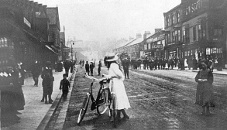
 Prominent Mason - Rev. Dennis William Marsh.
Durham County Freemasons have sustained a severe loss in the death of the Rev. Dennis William Marsh, Vicar of St. Andrew’s, Tudhoe Grange, who was known as “The Masonic Vicar,” and who was identified with the Rose of Raby Lodge at Staindrop, and the Vane Lodge at Bishop Auckland, becoming eventually Chaplain to both those lodges and to the University Lodge, and also a Past Provincial Grand Chaplain of Durham. Mr Marsh was a prominent member of the Durham War Pensions Committee and did a great deal of social work amongst the poor.
His death, in a Newcastle Nursing Home, I widely deplored, not only at Tudhoe, but at St Chad’s, Sunderland, Monkwearmouth, and at Lynesack, in which places he had been vicar.
(8th October 1930 Newcastle Evening Chronicle)
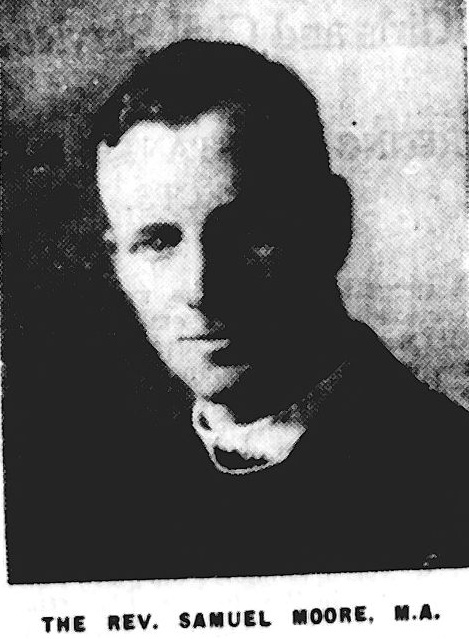 Fishburn Vicar’s Appointment.
The Rev. Samuel Moore, of Fishburn, who has been appointed to the vicariate of Tudhoe Grange, in succession to the Rev. D W Marsh.
Before coming to Sedgefield, with the charge of Fishburn parish church, 3 ½ years ago, he spent two years at Barnard Castle.
(17th October 1930 Hartlepool Northern Daily Mail)
St. Bartholomew’s Church, Croxdale.
The Bishop of Jarrow (Dr S K Knight) opened a new church memorial hall in connection with St. Bartholomew’s Church, Croxdale, on Saturday. The hall is designed to accommodate 200 people.
(27th October 1930 Yorkshire Post and Leeds Intelligence)
 Durham Colliery Adversity.
Temporary Closing of Another Mine.
Dean and Chapter Pit.
Following upon the announcement in Saturday's "Yorkshire Post," of the closing of Seaham Colliery pending a revival of trade, comes news of a similar step in connection with the Dean and Chapter Colliery of Messrs. Dorman, Long and Co., Ltd., near Ferryhill.
Our Middlesbrough correspondent was informed by Sir Holberry Mensforth, a Director of Messrs. Dorman, Long and Company, Ltd., that the closing of the Dean and Chapter Colliery is merely a temporary measure.
"We have not been able to produce coal from Dean and Chapter except at a loss under present conditions," said Sir Holberry, "and as there is a difficulty in disposing of coal at the present time, we have been obliged to curtail output and, consequently, this is being done at the pits where costs are highest." Another factor in the decision to stop coal getting, he said, was the desire of the Company to effect certain re-organisation, and carry out certain development work. This development work had been going on for some considerable time, and when completed would greatly improve the economic working of the colliery. "It has been found, however," he added, "that this development work can be carried out much more speedily if coal working is stopped for a time." Sir Holberry emphasised the fact that the closing of the colliery was of a purely temporary character, and when the demand for the coal improved, coal getting would be resumed.
2,700 EMPLOYEES AFFECTED.
As a result of the company's decision, the whole of the 2,700 employees at the colliery, together with a large number of the officials, have received 14 days' notice to cease work, and the notices will take effect on October 25.
Dean and Chapter is one of the largest collieries in the county, and until quite recently its by-product works were the largest in the country. It was taken over by Messrs. Dorman, Long, and Company, Ltd., at the beginning of the year, when that firm absorbed the undertakings of Messrs. Bolckow, Vaughan, and Company, Ltd. It is also one of the newest collieries in the county, and even during the most acute periods of depression regular employment has been found for the 2,700 employees during the thirty years the colliery has been worked. The average output has been 4,000 tons of coal daily.
All the big collieries in the South Durham area are now either closed or working with a restricted number of men. Of the larger collieries, only Eldon and Crook, belonging to Messrs. Pease and Partners, and Mainsforth, belonging to Messrs. Dorman, Long, and Company, are now working. The town of Spennymoor and the large mining village of Ferryhill will both be badly hit by the closing of the colliery.
(13th October 1930 Yorkshire Post and Leeds Intelligence)
Mighty Moors.
A meritorious performance was that of Spennymoor, who compelled the Sunderland second team to go back pointless to Roker Park. The going was heavy but fast football was served up by both sets of players.
Cooperthwaite (2), Younger, and Reed were scorers for Spennymoor and Wood, Burgess, and Robinson for Sunderland.
(4th October 1930 Football Gazette South Shields)
 Harriers – N Y & S D League.
Spennymoor Runner First Home.
The first run of the season of the North Yorkshire and South Durham Paperchase League was held at Spennymoor on Saturday afternoon. Glorious weather prevailed, and there was an excellent turnout of 94 runners from clubs representing Royal Corps of Signals, Royal Tank Corps, East Surrey Regiment, and East Lancashire (Catterick), Darlington, Billingham Synthonia, West Hartlepool Burn Road, Middlesbrough, and Spennymoor Harriers.
The race started from the Spennymoor and District Harrier’s head-quarters in Tudhoe Grange, Spennymoor. The runners were divided into fast and slow packs, the latter having three minutes’ start. A paper trail was laid by the Spennymoor Harriers over a course of about seven miles.
The first man home was T Willans (Spennymoor); second Lance-Corporal McCullock (Royal Signals); third R Willans (Spennymoor); fourth Signaller Rushnall (Royal Signals); fifth Private Belton (East Surreys); sixth Private Cotton (Royal Tank Corps.).
The muster prize was won by East Surrey Regiment with 17 runners, Middlesbrough (15) , and Royal Tank Corps. (15) also qualified for muster prizes.
The race was won by Middlesbrough with 77 points, the Royal Tank Corps. Being second and Royal Signals third.
(13th October 1930 Hartlepool Northern Daily Mail)
A Hartlepool Bride.
A pretty wedding took place at St. Paul’s Church, Spennymoor, the parties being Mr J H Lowery, son of Mrs Lowery and the late Mr Joseph Lowery, of Spennymoor, and Miss Doris Byrom, eldest daughter of Mr and Mrs Lees Byrom , of Hartlepool. The Rev. F P Bates , Vicar of St. Paul’s, officiated, and Miss Tolson was at the organ. The bride, who was given away by her father, was attired in ivory-satin and lace, with veil and coronet of orange blossom, and carried a bouquet of cream roses and white heather.
The bridesmaids were Miss Constance Byrom, sister of the bride, and Miss Hazel Lowery, sister of the bridegroom. Their frocks were apple green floral silk ninon with black picture hats and black shoes. Both carried bouquets of bronze chrysanthemums.
The best man was Mr H V Hare-Gill, of Hartlepool, and Mr W H Gyllenspetz, of Hartlepool, acted as groomsman. Mr and Mrs Lowey later left for Edinburgh for their honeymoon. Mr Lowery, is a member of the Hartlepool borough police, and is a member of the Hartlepool police cricket team. Prior to joining the police force he played with the Spennymoor cricket eleven.
(2nd October 1930 Hartlepool Northern Daily Mail)
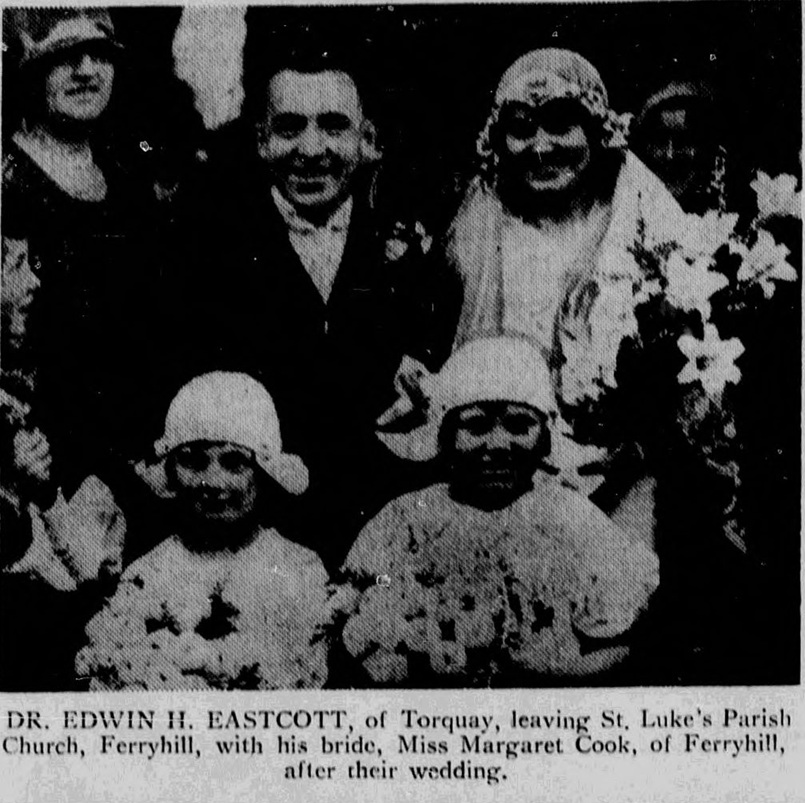 Doctor’s Marriage.
Pretty Wedding Ceremony at Ferryhill.
The marriage took place at St. Lukes parish church, Ferryhill, today, of Miss Margaret Cook, daughter of Mr and Mrs J W Cook, of Darlington Road, Ferryhill, and Dr Edwin H Eastcott, of Probus, Cornwall, son of Mr and Mrs H J Eastcott, of Torquay. The Rev. T L Lomas officiated.
The bride, who was given away by her father, wore a striking gown of parchment ring velvet underlined with softest pink, which gave a new opal effect.
The misses Helen and Rosie Cook (cousins) were her bridesmaids, and wore gowns of vivid rose petal ring velvet trimmed with net. Mr Charles Smyth, the brides brother-in-law was best man.
(8th October 1930 Newcastle Evening Chronicle)
 More Insurance Payments.
The following claims under the “Evening Chronicle” Free Insurance Scheme have been passed for payment:-
£5 Mrs Mary Sample (wife of registered reader), of 8, Duncombe Street, Spennymoor, who sustained a fractured clavicle, when the car in which she was travelling overturned.
Newsagent: Mr Reavley, 22, High Street, Spennymoor.
(2nd October 1930 Newcastle Evening Chronicle)
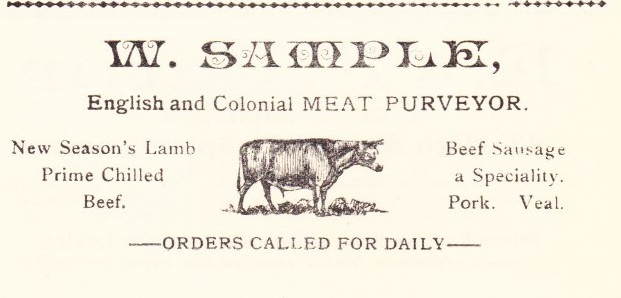 The Sample Family
In 1841 James Sample (b1791) with his wife Isabella were living at Great Smeaton, Yorkshire, James was a saddler, they had four children with them, James (b1821), John, Robert and Edward.
In 1843 James (b1821) married Barbara Taylor (b1823, Staindrop) and in 1851 James is a saddler at Ferryhill, they have three children, George (b1846), Ann (b1848) and James (b1850)
In 1861 they have a shop and are making saddles and harnesses. George is an apprentice saddler and there are four more children Mary (b1852), Thomas (b1856), Sarah (b1857) and Isabella (b1860) and then another child Elizabeth (b1862). James died in 1877.
In 1868 George (b1846) married Mary Jane Peverell (b1850, High Stoop, Tow Law) and they have a daughter Eliza Jane (b1869). They live next door to a beer house called the Saddler’s Arms in Ferryhill in 1871. By 1881 they have six sons, James John (b1871), George Arthur (b1873), Ernest William (b1875), Alfred Peverell (b1877), Edward (b1879) and Thomas (b1881).
In mid 1880s they move to 1 Stratton Street, Spennymoor and by 1891 they have another two sons, Frederick (b1884) and Joseph (b1888), and a daughter, Sarah Jane (b1890). James John and George Arthur are saddler’s apprentices and Edward William is a butcher’s apprentice.
By 1901 George and Mary are at 9 Carlton Terrace with another son Wilfred Gordon (b1896), Thomas is a pork butcher and Edward a painter.
In 1911 they are still at Carlton Terrace with sons Joseph and Wilfred Gordon, Joseph is an elementary school teacher for the County Council. Mary Jane had 15 children, sadly only eight were still alive.
George Arthur Sample (b1873)was a harness maker in 1901 living at 44 Clyde Terrace, he married Caroline Gooding (b1875) and they had four children John William (b1896), Florence May (b1900), Bertha (b1902) and Caroline (b1903). In 1906 they were living in Jackson Street when George was killed in an accident on 30th August 1906, at Dean and Chapter Colliery where he was employed as a greaser on the screens.
Whilst attending to a grease cup on the bearings of a revolving shaft a stud on the collar of the shaft caught in the man's clothing and whirled him round and round. His arm was torn off and the clothes stripped off his body. He was thrown then into a truck beneath. (Durham Mining Museum).
The Coroner queried that the greaser had to lubricate the machine while it was in motion but this was normal practice, they thought he may have folded up the sleeve of his overall as the button had come off the wrist which is why it became caught.
He was admitted to hospital with his left arm torn off at the elbow, a compound fracture of his left leg and of the right arm, and with injuries to his head. He died on the evening, a verdict of "Accidental death" was returned, the Coroner said it was a very sad case.
7th September 1906 Durham County Advertiser
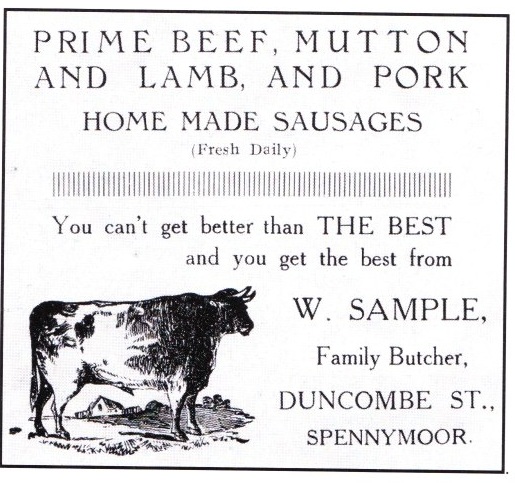 Ernest William Sample (b1875) married Mary Wilkinson (b1875, Hartlepool) in 1898, in 1901 they are living at 6 Duncombe Street, Spennymoor where Ernest is a butcher and they have a daughter Lily (b1900). By 1911 his brother Edward is also a butcher and Ernest and Mary now have five more children, Olive (b1901), Edward (b1904), Ernest William (b1906), Mary (b1908) and Doris (b1911).
In 1921 they are at 6-10 Duncombe Street with another son Harry (b1912) and their older children are working, Olive is a draper’s assistant for F W Snow at 110 Newgate Street, Bishop Auckland, Maud is an assistant in the butcher’s shop and Ernest William is a butcher’s assistant at Duncombe Street.
Ernest died in 1938, aged 63, and his son Ernest William (b1906) was then the master butcher at 8-10 Duncombe Street, he was married to Jennie Gwendoline Card (b1906).
Darlington and Stockton Times article about the Sample family in Great Smeaton.
Rating Appeals
Assessment of Public Houses in Durham.
The People’s Refreshment Houses Association appealed in respect of their house at Croxdale, the Bridge Inn, which was assessed at £150 per annum. The appeal was dismissed.
(17th October 1930 Yorkshire Post and Leeds Intelligence)
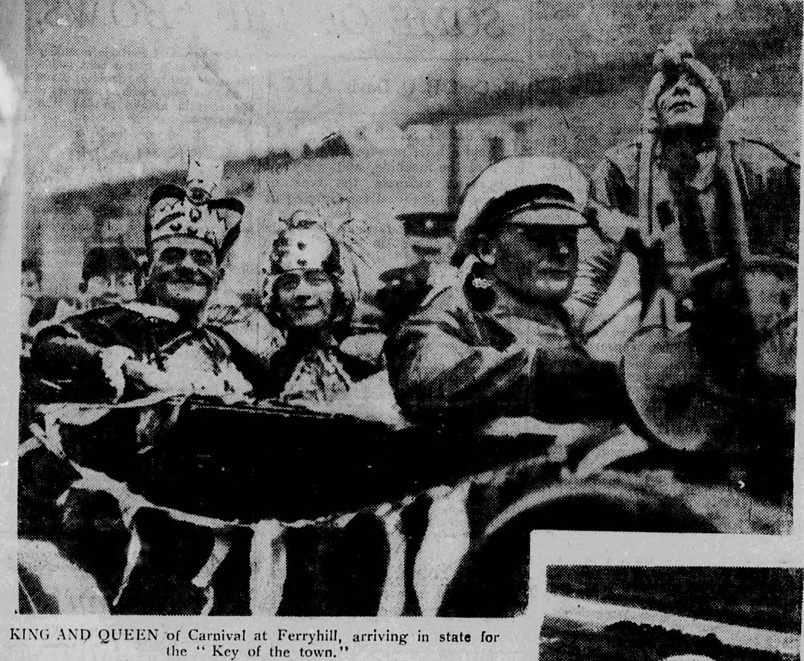 Carnival Awards - Children’s Sports at Ferrryhill.
Ferryhill carnival concluded with children’s sports and other events.
Winners were :-
Baby show (one month and under 6 months)
1 Mrs Robinson, 2 Mrs Groves
Six months to 12 months.
1 Mrs Charles, 2 Mrs Irwin
Best decorated Business Premises – Black Bull Hotel
Best Private Dwelling – Mr Ernest Ramage, 2 West Street, Ferryhill
High Jump 1 Gallagher 2 Hebbett
Long Jump 1 A Ridley, 2 A Medd
Relay race 1 Broom School, 2 Dean Bank School
Sack Race J Heaviside
Skipping (11 to 14 years) Hilda Marriott: 8 to 11 years Rena Flatman
Potato Race (8 to 11 years) Vera Heaviside; 11 to 14 years Maggie Shaw.
(2nd September 1930 Newcastle Evening Chronicle)
Ferryhill Collections.
The street collections by women of the Ferryhill Hospitals Committee, at the Carnival, amounted to £15, and another £15 has been handed in by Messrs. Sowerby, Atkinson and Wells, on behalf of the workmen employed on the Ferryhill housing scheme.
( 4th September 1930 Newcastle Evening Chronicle)
Striking Tribute to Dean Bank Pit Victim.
Only one half of the mourners were able to enter the church for the first part of the funeral service yesterday of Mr Samuel Bellis (b1869), of Dean Bank, Ferryhill.
Mr Bellis, who was killed at Dean and Chapter Pit was choirmaster at Dean Bank Wesleyan Church and leader of the Male Voice Choir for many years.
The singing was led by the combined choirs, with Mr George Cowden as organist. The Rev. G Henderson and the Rev. F B Bywaters, the Wesleyan ministers, conducted the service, and the Rev. J Henderson, primitive Methodist minister, and Mr Robert Willey, parish clerk, attended.
The two choirs headed the funeral procession and four workmates were bearers.
Duncombe Cemetery - In loving memory of Samuel dearly loved husband of Mary Bellis accidentally killed at Dean & Chapter Colliery Aug 28th 1930, aged 60 years also Mary Bellis beloved wife of the above who died March 25th 1931 aged 59 years.
(2nd September 1930 Hartlepool Northern Daily Mail)
 Michael Conroy.
A coal hewer, Michael Conroy (55), lodging in Gordon Terrace, Broom, Ferryhill, was killed by a fall of coal in the No. 2 Busty seam at Mainsforth Colliery, Ferryhill Station, yesterday.
(3rd September 1930 Hartlepool Northern Daily Mail)
Ferryhill Putter Killed. - Week After Uncle’s Death in Same Pit.
Mark Conroy (19), of Council Houses, Ferryhill employed as a putter at Mainsforth Colliery, Ferryhill, was knocked down by an empty tub in the pit last night. He was conveyed to Durham Hospital where he died early this morning.
His uncle was killed in the same pit last Tuesday.
(10th September 1930 Newcastle Evening Chronicle)
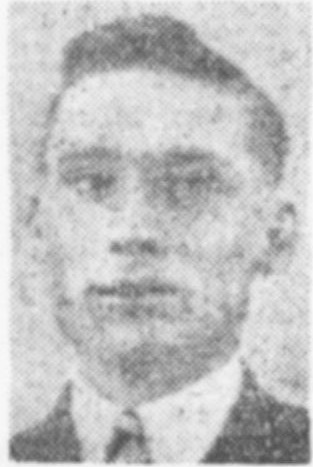 Catholic Herald Scholarship - Co. Durham Miner for Oxford.
Mr George Garrigan, of Ferryhill Station, Co. Durham (herewith), who has been awarded the “Catholic Herald” Scholarship (No. 2), will go into residence at the Catholic Workers’ College, Oxford, on October 6. Until recently he was a miner, and for some time had been secretary of the Miners’ Checkweighman’s Fund. He has been an active worker in the parish of St. Joseph, West Cornforth, and was largely instrumental in establishing a successful branch of the C.Y.M.S., of which he was appointed secretary.
(27th September 1930 Wearside Catholic News)
Vicar of Tudhoe Grange - Rev. Denis W Marsh.
The Rev. Denis W Marsh, Vicar of St. Andrew’s, Tudhoe Grange, Spennymoor, died in a Newcastle nursing home yesterday. He was 58 years of age, and a bachelor.
Mr Marsh was the son of a former Vicar of Tow Law, Co. Durham. He began his career as a bank clerk, but studied for the ministry at St Aidan’s College, Birkenhead, where he earned his fees by playing the organ. He was appointed first vicar of St Andrew’s, Monkwearmouth, Sunderland, in 1907, and remained there until 1914, when he was appointed Vicar of Lynesack, Co. Durham. In 1925 he succeeded Canon Wykes at Tudhoe Grange. He was well known in masonic circles, and was Past Provincial Grand Chaplain of Durham. At the time of his death he was Chaplain to the Vane Lodge, Bishop Auckland, to the Rose of Raby Lodge, and to Durham University Lodge. He was a member of the Durham County Pensions Committee and Chairman of the local Pensions Committee.
(24th September 1930 Yorkshire Post and Leeds Intelligence)
There was a large gathering of clergy, Freemasons, representatives of church organisations and parishoners at the funeral of the Rev. Denis W Marsh, vicar of Tudhoe Grange, on Saturday. A service in church was conducted by Rev. M Bell, vicar of Tudhoe, and the Rev. G Cook, rector of Seaton Carew, and the Masonic rites at the graveside at the York Hill Cemetery were performed by the Bishop of Durham.
(29th September 1930 Yorkshire Post and Leeds Intelligence)
"Degrading Idleness"
Dr Henson Laments Plight of Durham
At St. Andrew's Church, Tudhoe Grange, Spennymoor, last night, the Bishop of Durham (Dr H Hensley Henson) dedicated a carved oak panelling that has been put in the church as a memorial to the late Rev. Denis W Marsh, who was Vicar of the parish from 1925 to 1930.
Dr Henson referred to the difficulties of Christian ministers in the world conditions that had arisen since the War. They had been compelled to watch the distress and dislocation of life caused by unemployment, and has been powerless to help.
"In our own Durham parishes," he said , "we have had to watch at close range the degrading, disintergrating effect of continuous idleness on a great proportion of the people. The distress has told ruinously on the mental and moral state of mankind."
(26th October 1931 Sunderland Daily Echo)
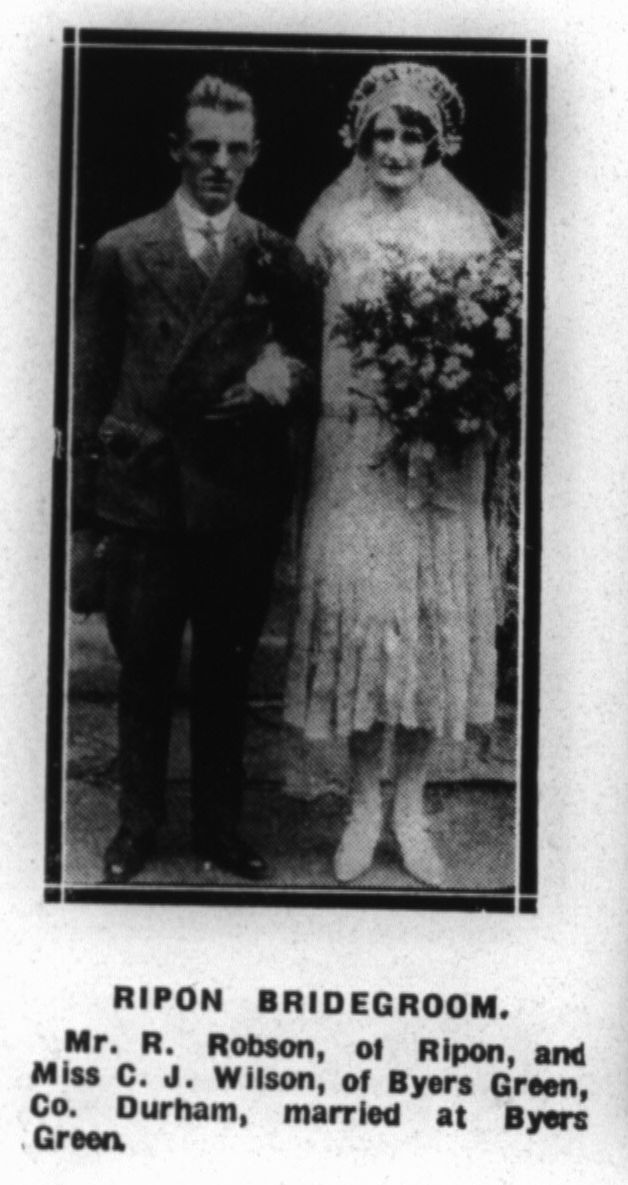 Married at Byers Green
Mr R Robson, of Ripon, and Miss C J Wilson, of Byers Green, Co. Durham, married at Byers Green.
Ferryhill Ceremony.
The wedding took place at St Luke’s Church, Ferryhill, to-day, of Miss Mary Dixon, only daughter of the late Mr and Mrs T Dixon, of Ferryhill, and Mr Ernest Simpson son of Mrs and the late Mr George Simpson, of Parker Terrace, Ferryhill.
The bride, who was given away by Mr Robert Mann, wore an ankle length dress of white satin, a bridal veil with orange blossom, white satin shoes, and carried a bouquet of pink roses. The bridesmaids were the Misses Mary Ann and Madge Mann. Mr A Watson was best man. A reception was held at the I.O.G.T. Hall, Ferryhill. The honeymoon is being spent on a motor tour.
(10th September 1930 Newcastle Evening Chronicle)
 Token Trick - Pit “Partners” Work New Token Trick.
Ingenious Dodge to Defraud Company - Unequal ”Earnings”.
Unusual “token” frauds in the pit were revealed at Spennymoor Police Court to-day, when four miners were fined.
The trick, as outlined in court, is ingeniously based on the operation of the minimum wage.
Two men, working together, place tokens on tubs notifying a considerably bigger output to one man than to the other, Thus, at the end of the week, one has “earned” much above the minimum, and the other’s wage is below.
The colliery company have to make the lower wage up to the minimum, and of the two “partnerships” dealt with to-day one would have netted an extra 11s 8d and the other 15s 8d.
The first pair dealt with were John R Moore (24), of 17, Arthur Street, Spennymoor, and Bernard Jefferson (26), of 145 Gurney Valley, Bishop Auckland. They were charged with attempting to obtain by false pretences from Messrs. Dorman Long, on August 26,27, and 28 the sum of 4s 6d.
“Flinging In”
Mr E V Proud, of Bishop Auckland, prosecuting, said that for the week ended August 30 for four shifts Moore had only 14s, an average of 3s 6d per shift, and had to have 11s 6d added to bring his wages up to the minimum. For the same four shifts Jefferson had £3 6s 4d., an average of 16s 7d per shift.
Moore admitted that eight tubs of his had gone on Jefferson’s score.
Mr J Reavley, a magistrate inquired if this was a new class of offence. Usually, he said, it was a case of a man changing the tokens and defrauding his mate.
Mr Proud said that this was the first prosecution he had had of this kind, but he had read of similar. He understood it was known as “flinging in.”
Mr Brown-Humes, of Bishop Auckland, who defended, pleaded for leniency. Jefferson was a married man with one child, and after the usual deductions were made his average earnings was only 25s 4d per week.
A fine of 40s each was imposed.
On a similar charge Robert Anderson (26), of New Brook Street, Eldon Lane, and Charles Wilkinson (25), of Parkin Street, Merrington Lane, were charged with attempting to obtain by false pretences on the same dates the sum of 5s 8d from Dorman Long and Co.
Mr Proud said Anderson for four shifts had only 11s, an average of 2s 9d per shift, and 15s 8d had to be added to bring his wages up to the minimum. For the same four shifts Wilkinson had £2 2s 2d, an average of 10s 6.5d a shift.
These two defendants were also fined 40s each, including costs.
(16th September 1930 Newcastle Evening Chronicle)
 More Stations to be Closed Down? - L.N.E.R. Considering Newcastle-York Route. OFFICIAL STATEMENT.
“Under Discussion, But No Decision Yet.”
THE “Evening Chronicle” learns that the London and North-Eastern Railway have under consideration, as a further measure of economy, the closing to passenger traffic of a number of stations on the main line between Newcastle and York.
No decision has yet been made by the company pending progress with the £750,000 scheme for widening the main line between York and Darlington, but it is learned on reliable authority that in addition to those involved on the York-Newcastle section, the closing of the passenger traffic of numerous small stations on main lines will ultimately be effected.
Rumours have been current in Newcastle to the effect that the L.N.E.R. propose to suspend passenger services at all stations between Newcastle and York except Durham, Ferryhill, Darlington, Northallerton, and Thirsk, but the company denies that their proposals are on such an extensive scale.
Rumour Denied.
The following official statement was made to the “Evening Chronicle” at King’s Cross to-day:
“In connection with the widening of the main line between Darlington and York, the L.N.E.R. have been considering the possibility of closing to passenger traffic some of the smaller stations on the section affected by this scheme, but no decision has yet been arrived at.
“There is no foundation for the rumour that all stations will be closed between York and Newcastle with the exception of Durham, Ferryhill, Darlington, Northallerton and Thirsk.”
An official of the company explained that in view of the present situation, the L.N.E.R. were reviewing very closely the position at stations which are not extensively used for passenger traffic, especially where alternative road services associated with the railway are available.
Non-Stop Trains.
It was not impossible that a number of subordinate stations on the main lines would be closed ultimately so far as passenger traffic was concerned, thus enabling economies to be affected and providing greater freedom for non-stop trains.
It is learned that the stations concerned between York and Newcastle are those which might have to be rebuilt as a result of the widening scheme, and whose traffic would not justify such reconstruction.
This new proposal on the part of the L.N.E.R. is of special significance in view of the fact that passenger services were withdrawn at the week-end from nearly 30 stations in the North-Eastern area, the whole of the Hexham-Allendale and Alnwick-Coldstream lines being closed for passenger traffic, in addition to a number of stations between York and Scarborough.
(22nd September 1930 Newcastle Evening Chronicle)
 No Compensation - Sedgefield Council and Flood Claims.
Claims for compensation from West Cornforth and the Broom (Ferryhill) residents in respect of flooding of their houses as the result of the storm on August 29 were read at the meeting of Sedgefield Rural District Council yesterday.
The water, it was stated, ran through the low-lying houses and the smell was terrible, for which the condition of the streets was blamed, it being stated that the dirt washed from them clocked up the sewers.
The Surveyor (Mr J Stones) said that the storm was of such extraordinary severity that no provision could be made to deal with it. Altogether about 100 houses were flooded in the Council’s district.
Compensation Motion Defeated.
The Council could not be held responsible if they had taken reasonable care to cope with floods, and nothing that they could have done would have coped with the storm of the night in question.
A motion that compensation should be paid to the claimants was defeated by nine votes to six.
Thrislington Colliery - As to a complaint of the emission of smoke at Thrislington Colliery, it was reported that the agent had been interviewed on tha matter, and had stated that, owing to the uncertainty of the colliery remaining in operation, it was impossible to do anything at present.
The general rate, for the ensuing half-year was fixed at 7s 4d against 8s 10d in the current half-year and 9s 2d in the corresponding half of last year.
(27th September 1930 Hartlepool Northern Daily Mail)
Sensation at Stockton. - Story of Mysterious Night Visitor.
Watchmen's Discovery.
The strange behaviour of a Ferryhill man at Stockton yesterday caused the police some anxiety until the mystery was cleared up.
Shortly before 10 o’clock William Johnson and George R. Robson, watchmen at the Corporation’s housing estate at Primrose Hill, came across a man’s coat and waistcoat, beside which were a set of false teeth, a light walking stick, and a bowler hat, dented and torn.
They notified the police, and plain clothes detectives carried out a thorough search of the houses in course of erection. No trace of any human being was discovered, and the mystery was deepened when the watchman Johnson declared that the clothing had been placed where discovered between 9 a.m. and 10 a.m., as he had passed the spot earlier and it was clear.
Further details were supplied by Mr J. Crabb, who lives in Craigwell Crescent, adjoining the housing estate. He said that at 11.15 p.m. on Saturday his young daughter, who had gone to bed, called to him in alarm, and in going out of the dining room he saw a man clad in shirt and trousers mounting the stairs.
“I got hold of him,” said Mr Crabb in an interview, “and asked him what he meant by entering my house. The man seemed dazed and was holding his head. I could not get any sense out of him for a long time, all he could say was that he had been to Redcar and had had a good day. His condition gave me the impression that he had been waylaid and robbed.
“Later I gathered from him that he lived at Ferryhill, so I took him to the main road and when a bus came along, stopped it, and got him taken on board. Several men in the bus recognized him and called him by name, saying that he lived at Ferryhill. Before leaving he apologized for entering my house.
“This morning I heard of the clothing being found and at once told the police of my previous night’s visitor.”
In a pocket of the coat was the return half of a ticket from Ferryhill to Redcar, and a club book bearing the name of a Ferryhill man whose age was given at 65.
Detective Crossley took possession of the man’s belongings, and they are now at the police station waiting to be claimed.
The local police are in communication with the Ferryhill police on the matter.
(8th September 1930 Hartlepool Northern Daily Mail)
Balls Taken From Billiards Hall. - Two in Wrong Pockets at Spennymoor.
Eric Roper (19), of High Street, West Cornforth, was charged at Spennymoor to-day with stealing a billiards ball valued 12s 6d., the property of Biagio Coia, Spennymoor.
Biagio Coia, billiard saloon proprietor, said he handed three billiards balls to some youths to play with, but when he went to collect the balls later he found that the red ball was missing.
P.C. Lear said Roper declared: “I went to a fish shop, and on putting my hand into my coat pocket I found a billiards ball there. Someone must have put it in my pocket. I intended to return it, but on the Sunday I was playing with it in a field and lost it.”
He was bound over in the sum of 40s and ordered to pay 15s costs and 12s 6d.,the value of the ball.
A 14-years-old boy pleaded guilty to stealing a billiards ball, valued 12s 6d. from the same saloon.
Supt Forster said that in answer to a question, the boy replied: “I wanted to have a game with it on my own table at home.” He was bound over.
(2nd September 1930 Newcastle Evening Chronicle)

 Coia Family
In 1901 Massimino Coia (b1868 Italy - 1926 Rome, Italy) and his wife Constanza Jaconelli(b1869 Italy, m1887 Italy, d1933) were living at 43 Lady Lane, Paisley, Renfrewshire, Scotland with their daughter Maria, Massimino was a confectioner.
In 1904 they moved to Spennymoor, in 1911 they are living at 5 Cheapside. They had at least eight children: Maria (b1890 Italy), Carmela (b1891, London), Anglo (b1893, Glasgow), Biagio (b1895, Glasgow - 1949) a shopkeeper, Pompina (b1899, Paisley), Antoine (b1901, Paisley), Serafina (b1903, Paisley), Angelina (b1906, Spennymoor). In 1921 Massimino is still at 5 Cheapside and is an ice cream manufacturer.
In 1917 Biagio had married Maria J Lanni (b1895, Italy) and they were living at 1 Holborn Street, Spennymoor with their two children, Massimino (b1918) and Angelo (b1920), Biagio was a billiard saloon proprietor.
In 1939 Biagio and Mary are at 13 Cheapside, they had at least seven children, Massimino Biagio Ronaldo Coia (b1917-1959) who became a solicitor, Angelo (b1920), Arturo (b1922), Constance (b1927), Kenneth (b1928), John (b1930) and Anthony (Tony, b1936).
The family business closed down on 11th June 1965.
Tony Coia was a headmaster of St. Charles R.C. Primary School and became second chairman for Tudhoe and Spennymoor Local History Society. Tony and George Teasdale donated their photographic collection to the society and Tony's research was also donated and is now at The Story in Durham.
Set Wagon Amain [word fell out of use meaning: at full speed; with great haste].
Spennymoor Boys’ Prank on Colliery Line.
Three Spennymoor boys saw a loaded 20-ton wagon on the Whitworth Colliery line.
They released the brakes and the wagon ran 150 yards and toppled over the end of the line, embedding the wheels up to the axles.
At the Spennymoor Court to-day, where the boys were charged with having done damage to the extent of £3, it was stated that it took three men three days to put the line in order.
The boys were fined 5s and ordered to pay 10s each towards the damage.
(9th September 1930 Newcastle Evening Chronicle)
To Pay 30/- For Stealing 1/- Post.
Albert Harrison of Dean Road, Broom, Ferryhill, pleaded guilty to stealing a fencing post, value 1s, and was fined 15s and 15s costs at Spennymoor Police Court to-day. The post was in a fence on the Sedgefield Rural Council’s building site.
(30th September 1930 Newcastle Evening Chronicle)
Caught in the Act - Spennymoor Man’s Dash From Behind Hotel Bar.
J W Wood, of Dean Road, Low Spennymoor, was charged at Spennymoor Police Court, to-day, with stealing 6s 6d from the Coach and Horses Hotel, at Croxdale.
Mrs Taylor, licensee, said Wood and two other men came into the bar and were served with beer. Witness left the bar, but later she returned and saw Wood coming from behind the counter.
He rushed out of the door, but two men followed and caught him.
Mr J E Brown-Humes, defending, pleaded guilty, but denied that 6s 6d was taken. He said Wood picked up some of the money, but on finding he was being watched he dropped it.
It was a case, said Mr Brown-Humes, of a man who took a drink and was then not responsible for his actions.
Wood was bound over for two years and placed under the probation officer.
(30th September 1930 Newcastle Evening Chronicle)
 Baby on Doorstep
Leadgate Girl Bound Over.
Ruby Miller (19), of Leadgate, was bound over at Durham to-day on a charge of abandoning a child at Tudhoe on July 31.
Supt. Foster stated that Miss Miller had been keeping company with a man named Bell for some time. She acted very shrewdly in what she did, the superintendent said. So far as her parents knew she was on holiday, but as a matter of fact she went to the Poor Law institution at Lanchester, where she was confined on July 22. She wrote to her parents stating she was having a good time.
Miss Miller arranged to meet Bell in Lanchester, having previously stated to him that the child was dead. On leaving the institution she went to Spennymoor and was seen at Tudhoe in a shop with the child. Shortly afterwards she was observed to board a bus without the child.
The police were informed and the child was found on a door step at Tudhoe.
Accused said she never intended to abandon the baby, and merely left it to be looked after while she went to see Mr. Bell.
It was stated that Miss Miller and Mr. Bell were to be married shortly.
(6th August 1930 Hartlepool Northern Daily Mail)
Rag Buyers Fined.
William Barras (18) and George Robson (27), both of Bishop Auckland, were fined 5s. each at Spennymoor to-day for giving children balloons in exchange for rags.
Spennymoor Street Betting
At Spennymoor, to-day, Robert Gill (42), of Craddock Street, was fined £5 for street betting on August 9.
(12th August 1930 Newcastle Evening Chronicle)
Cutting in Danger.
Newcastle Motorist Fined at Spennymoor.
When David Slater, of Ashfield Terrace East, Newcastle, was fined £1 and £1 9s costs at Spennymoor Police Court, to-day, for negligent driving of a motor-car Superintendent Headen said a motor-lorry was going up the High Street, Spennymoor, and was about to turn into a side street when Slater's car cut in between the footpath and the lorry. Little damage was done, but the practice of cutting in was dangerous and a serious accident might have resulted.
Slater pleaded not guilty, and said he had a clear view of the road for 300 yards. He denied that the lorry driver put out his hand or that he gave him any indication that he intended to turn.
(26th August 1930 Newcastle Evening Chronicle)
Ferryhill Weddings.
Chilton Footballer as Best Man.
Two weddings took place at the Ferryhill Village Primitive Methodist Church to-day.
Miss Edna Hamflett, second daughter of Mr. and Mrs. John Hamflett, of Chilton, was married to Mr. Joseph Farrow, only son of Mr. and Mrs. Thomas Farrow, of Ferryhill. The bride wore a dress of ivory georgette, with lace trimmings, a bridal veil surmounted by a coronet of orange blossoms, and silver shoes.
Her bridesmaids were Miss Freda Hamflett, in pearl satin, Miss Freda Farrow, in pearl suede georgette, Miss Lilly Hamflett and Miss Polly Pearson, in white.
The best man was Mr. James Palmer, the Chilton footballer, and the groomsman Mr. John Boyes.
 Miss Mary Annie Martin, only daughter of Mrs. Martin, of Hiliside, Metal Bridge, and the late Mr. John Martin, of the Broom, Ferryhill, was married to Mr. John William Bell, son of Mr. John Bell, of Metal Bridge.
The bride was attired in a dress of powdered blue lace, trimmed with georgette, and a hat to match.
(4th August 1930 Newcastle Evening Chronicle)
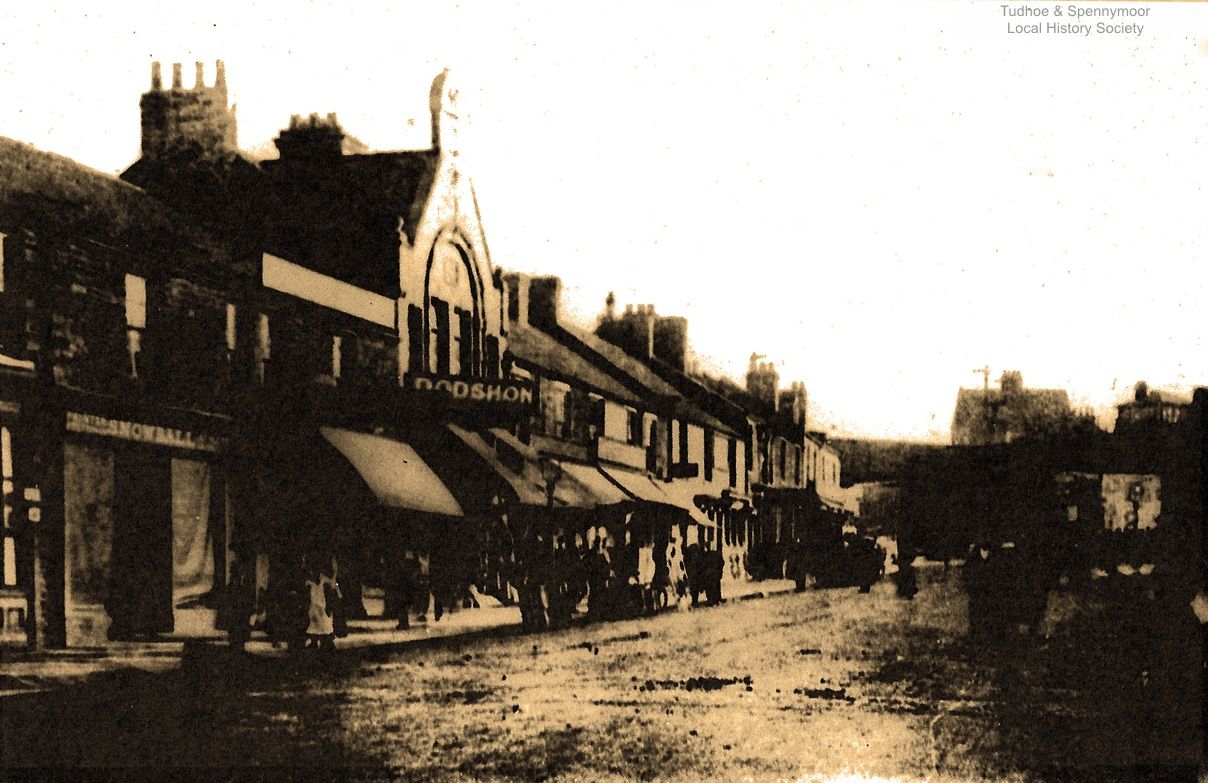
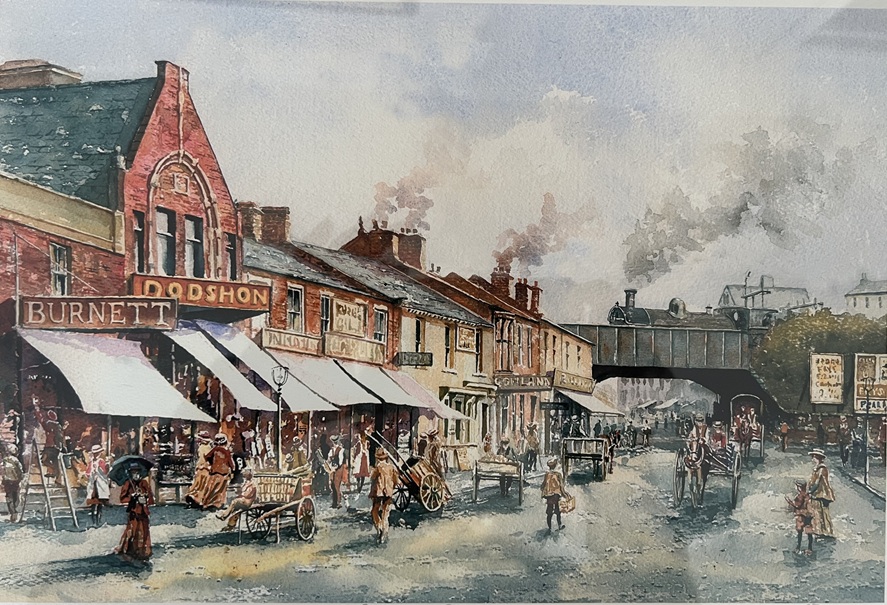 The Dodshon Clothier's shop appeared in many photos and paintings of Spennymoor High Street with its distinctive "Dodshon" sign.
Although Archdeacon, He Would Shoot Them But Only with a Camera.
Exclusive to "The People."
The Reverend Joseph H. Dodshon, Archdeacon of Southern Ohio, is an Anglo-American divine whose hobby is making motion pictures.
He has "shot" the King and Queen, President Hoover, Amy Johnson and countless other celebrities. Last week he obtained a unique coloured "movie" of Oberammergau's Passion Play.
He cherishes a wish to "shoot" some of Prohibition's intoxicated victims—literally reeling reels—for he detests Prohibition. Also he laments America's ever-swelling crime wave. And he deplores America's fanatical women.
Yet, as befits a Freemason, an Elk and a Rotarian—for he is each of these—he is all for the furtherance of international good will.
Yesterday he transported me, pictorially, from the Changing of the Guard in Whitehall a scene he recorded on his cine-camera the day before—via Torquay and delightful yachting scenes in Torbay, through Stonehenge, to a seascape off Larchmont, New York.
"See that shark?" he cried gleefully. "A friend caught it from his boat while I turned the camera-handle. That's safer than shark-fishing," he smiled, "but it's really rather a remarkable picture, because, usually, only financial sharks venture so near our metropolis!"
"America's Curse."
Mr. Dodshon has been Southern Ohio's Archdeacon for over 20 years. In 1913 he married Miss Carsonette Porter of Zanesville, Ohio, having become a naturalised American ten years earlier.
He was born, however, in County Durham, and he is Mus. Doc. of the London College of Music.
During his stay in his native England he has preached to crowded congregations in Brighton, at Spennymoor (where he was born) and at St. Michael's, Chester- sq.
"My theme at St. Michael's," he said, "was 'The Evils of Prohibition.'"
Then he became really eloquent.
"Prohibition is America's curse," he declared. "When it was first mooted, I was a Government lecturer on Liberty Loans. I advocated it—purely as a war-time measure. Like yourselves, we were out to do anything to beat Germany. But, since its enforcement, crime and drunkenness have increased a hundred per cent. I say that deliberately.
"Our new millionaires are—the bootleggers. Wall Street may totter, homes may be ruined, financial derelicts may inhale coal-gas. But the bootleggers go on amassing unbelievable wealth.
"Even young boys and girls drink the doctored filth. Thousands of them are being gradually, but literally, murdered every year. There are secret drinking orgies—Belshazzar's Feasts, I call them. But America, I believe, begins to see the writing on the wall.
"Modern theologians," he added, "denied Belshazzar's existence. The excavations at Ur have proved modern theologians wrong. Bricks with Belshazzar's name inscribed in cuneiform script have been discovered. Science is on the side of God."
"Another social evil—I can call it nothing kinder—are America's fanatical females.
"The country teems with them. They are forever starting some ridiculous cult. One such cabled Queen Mary that she regretted to learn that Her Majesty smoked cigarettes!
"When I preached the other day at St. Michael's, I said that I hope Her Majesty would treat such an impertinent message with the scorn and contempt it deserves."
Archdeacon Dodshon has been a missionary in Wyoming. He built churches at Douglas and Lusk. He was for some time in charge of the English cathedral at Gibraltar. During the war he was Chaplain at Camp Sherman, Ohio. And he was formerly vice-president of the New York "Morning Telegraph."
(17th August 1930 The People)
 Dodshon Family
Joseph Dodshon (b1833 Bishop Auckland) and Elizabeth Wilkinson (b1831 South Shields) were married in 1861 and were living at 44 High Street, Spennymoor with Joseph’s sister Mary Ann (b1837). Joseph was a tailor/draper. By 1871 they had four children, Thomas Wilkinson (b1862-1917), Mary Elizabeth (b1863), Joseph Henry (b1869-1948), and Frederick George (b1871). Joseph was employing one man and a boy. In 1873 they had another child Ernest William.
In 1881 they are living at 3 Belle Vue Terrace, Spennymoor, Thomas Wilkinson was now an assistant tailor, Joseph now employed three men and a boy.
By 1891 Elizabeth has died, Thomas, Frederick and Ernest are all working in the tailoring business. Thomas (b1862) married Jessie Varley in 1891 and they had Mary Elizabeth (b1895), Jessie (b1897-1901) and Charles Joseph (b1899) and are living at 17 Clyde Terrace in 1901 when his father Joseph died and Thomas took over the business.
In 1911 they are at 6 St Paul’s Gardens, Mary Elizabeth is a musical student and they have another child Thomas Wilkinson (b1905). The family moved to 54 Crossgate, Durham about 1914 and Thomas Wilkinson (snr) died in 1917, his service was in Spennymoor Wesleyan Church and he was buried in Spennymoor. Jessie was still living at Durham in 1921 with Mary Elizabeth, now a music teacher, Charles Joseph, a draper’s assistant at Cook, Garroway and Nicholson Drapers, 59 Fawcett Street, Sunderland. And Thomas Wilkinson an electrician at Morgan and Saynor Electricians, Saddler Street, Durham.
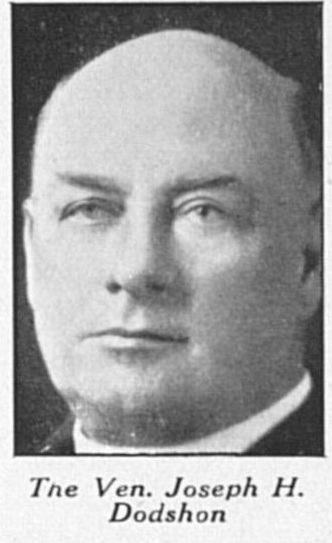 Joseph Henry Dodshon (b1868) studied art and music in Durham and London, gaining musical diplomas from the Guild of Church Musicians, Trinity College, London and the London School of Music. In 1891 he was employed as a school master at Ann Crook’s Endowed School, Moor Street, Hartlepool, which was built in 1871 and had a 50ft schoolroom, school master’s house, classroom and playground for 185 boys. It was demolished in 1963.
He was involved with the Wesleyan Church and when he heard Bishop Talbot, a missionary preacher from Wyoming, preach he emigrated to the USA in 1895 and became a naturalised American citizen in 1900. At St. Matthew's Cathedral, Wyoming he acted as organist and choir-master. He was ordained in the Episcopal Church as a Deacon in 1898 and as a priest in 1900. He became President of the Church Temperance Society of the United States.
He regularly returned to the UK to preach and died in 1948 at the Wirral, Cheshire.
(24th September 1927 The Sphere)
Thrown Under Lorry. - Farmer’s Son Killed at Spennymoor.
A terrible accident occurred at Spennymoor shortly before noon to-day.
A young man – Thomas Gornall (22), a farmer’s son, of High Whitworth Farm, Spennymoor, was driving a milk float belonging to his father and when near the railway bridge in High Street, Spennymoor, the horse shied.
Gornall was thrown from the cart on to the wheels of a heavy lorry laden with sand, belonging to Messrs. Lewins Ross, of Birtley. A wheel passed over Gornall’s body.
He was conscious when picked up and was immediately conveyed to Durham Infirmary where he died this afternoon.
(6th August 1930 Hartlepool Northern Daily Mail)
Thomas Wells (17), of Main Street, Ferryhill, a conductor on an A.B.C. Company’s bus, was injured in an unusual way as his bis pulled up at the terminus at Green Terrace, Sunderland.
He had been washing out the interior of the vehicle with a pail of water and a brush, and as the bus pulled up he stood on the step waiting to get off with the pail of water and brush in his hands.
The brush became entangled between his legs, and he was thrown off and his right leg was caught underneath the back wheel of the bus.
He was taken to the Royal Infirmary and detained with injuries to his knee and ankle.
(8th August 1930 Seaham Weekly News)
Two Women Injured. - Car Turns Over After Skid.
As the result of an accident which occurred on the Spennymoor-Coxhoe road, Mrs Sample, aged about 70, wife of Mr Sample, Duncombe Street, Spennymoor, was removed to Durham Hospital suffering from shock, a dislocated collar-bone, and severe wounds on one hand, and injury to one of her ears.
Accompanied by her two sons, one of whom was driving, and her daughter, Mrs Watkinson, of Spennymoor, they were journeying in a motor-car from Spennymoor when the vehicle skidded, crossed the road, hit the kerbstone, and turned over on the footpath, the occupants being imprisoned.
Assistance was given by three young men who were passing. Mrs Sample and Mrs Watkinson, who was also suffering from severe shock, were conveyed in a passing bus to Coxhoe. The two male occupants of the car suffered from shock but were otherwise little the worse.
(19th August 1930 Hartlepool Northern Daily Mail)
Croxdale Crash - London-Newcastle ‘Bus Driver’s Escape.
The driver of a London to Newcastle bus had a remarkable escape when the vehicle collided with a Durham County Council steam lorry at the dangerous Thinford Cross Roads, the scene of many accidents, on the Great North Road, between Ferryhill and Croxdale.
The bus is owned by the Ideal Bus Co. of South Shields, and driven by Arthur Roston, of 262, Pentonville Road, King’s Cross, London.
As it approached the Thinford Road end, the steam lorry emerged from the direction of Spennymoor, and thy collided.
Escape of Solitary Passenger.
The front portion of the bus and the driver’s cab were smashed in, and the windows on the right hand side of the bus were shattered.
The bus was completely disabled, but the lorry was able to go on its journey.
The bus contained only one passenger, a woman, who was going to Newcastle and who was uninjured. The spare driver also escaped.
(21st August 1930 Newcastle Evening Chronicle)
Ferryhill Escapes - Bus and Hay Rolley in Collision.
Passengers travelling on a bus between Spennymoor and Ferryhill last night had a remarkable escape from injury when the vehicle collided with a hay-rolley drawn by two horses, at Red Hall Farm, about half a mile from Ferryhill, on the Great North Road.
The front of the bus was completely wrecked, but the driver and passengers were unscathed.
Assistance was forthcoming from ambulance men and the police, after which all were able to proceed to their homes. Neither of the horses, which are owned by the Weardale Coal Company, was seriously hurt.
(23rd August 1930 Hartlepool Northern Daily Mail)


 Rebuilt Durham Cinema.
The new Tivoli, erection of which is nearing completion on the site of the old theatre of the same name, at Spennymoor, Co. Durham, for Arthur J. Vasey, is an excellent example of the construction of a modern cinema at low cost and high speed. The old building, which was completely demolished to make way for the new structure, was actually in use as a cinema towards the end of April last, and the end of September, 1930, should see an entirely new and up-to-date theatre completely finished.
The architects are Hays & Gray, FF.R.I.B.A., of Wingate and North Shields, who specialise in inexpensive buildings. Instructions were received by them to design an entirely new building as cheaply as possible, consistent with sound construction, to allow for a maximum outlay on furnishings and equipment.
Advertising Spaces Built In
The building itself is on a site approximately square, with frontage of 69 ft. on the main street. It is a steel-framed structure filled in with plate brick and patent blocks, the main front being designed in plain cream and biscuit terra-cotta, relieved with bands and enrichments in bright colours. A broad marquise runs the full length of the main front, and from the top of this the facade will be flood lit. Advertising spaces form an integral part of the design of the main front.
The auditorium has a circle with a segmental front finishing on each side with two boxes, and is approached from a large foyer and lounge which cover the full width of the building. From this lounge the cloak room and manager’s offices open.
B.T.H. [British Thomson-Houston] Equipment
The proscenium occupies the whole width of the auditorium. This is the principal feature of the hall, and is being treated in an original fashion. The colour scheme throughout will be of a very cheerful character with bands of bright colours relieving the walls, which finish with a deep cove when they meet the lofty single panelled ceiling. The hall accommodates 922, and is seated throughout with upholstered chairs.
B.T.H. "talkie" apparatus is being installed, and the acoustics of the hall have been carefully studied and special materials used to ensure perfect results. Similar care has been given to the heating, ventilation and lighting systems of the building, all of which are on the most modern lines, and are worked into the design. An electrically controlled expanding screen of the latest type has also been installed.
The main contractor is J. J. Walton, of Thornley, while the principal sub-contractors include: Steelwork, Lambhill Ironworks, Ltd., Glasgow; terra-cotta, The Leeds Fireclay Co., Ltd., Leeds; heating and ventilation, J. T. Leake & Co., Newcastle; electrical installation, J. G. Parker & Co., Newcastle; furnishings, E. A. Langrish & Co., Ltd., Newcastle; stage setting and curtains, Gerald Dorman, Newcastle.
(27th August 1930 The_Bioscope)
Spennymoor Hall Opened
The New Tivoli, which has been erected on the site of the old theatre of the same name at Spennymoor, Co. Durham, was officially opened on Friday afternoon, [10th October 1930] the ceremony being performed by Alderman Col. T. F. Brass, O.B.E., J.P., and Shaun Glenville, the well-known stage and screen star. The theatre has been erected for Arthur J. Vasey, who has controlled cinemas in Spennymoor for many years.
(15th October 1930 The Bioscope(
Durham Miners Earnings.
Mr Shinwell (Secretary for Mines) stated in reply to Mr Batey (Labour, Spennymoor) that in July, 1920 , there were 171,000 wage-earners employed at coal mines in Durham, and their average earnings per shift were 16s 71/2d. In July 1924, the figures were 172,600 and 10s 1d. At the present time they are 128,400 and about 8s 1d.
The earniings do not include the value of allowance in kind, now estimated at 1s 1d per shift.
(8th August 1930 Chester-le-Street Chronicle)
Two Lives Lost in Pit Mishap.
Caught By Tubs At Ferryhill - Football leader a Victim.
Two men have lost their lives through being caught by a running set of tubs while working in the Dean and Chapter Colliery at Ferryhill.
The tragic mishap occurred just before midnight, when the men were working in the Brockwell Seam of No. 1 Pit.
The two victims were:—
Frederick Davison (46), deputy overman, of 33, Barrington Terrace, Dean Bank,
Parkinson Ovington (47), stoneman, 78, Weardale Street, Low Spennymoor.
Davison was practically killed outright, and Ovington died to-day in Durham County Hospital.
Davison, who was a native of Tanfield Lea district, leaves a widow and four children. He was a keen football enthusiast, and had been a director of Ferryhill F.C. for many years.
The colliery is idle to-day
Coroner Proud has fixed the inquest on Davison for Thursday afternoon.
(19th August 1930 Newcastle Evening Chronicle)
Double Mine Fatality.
Ferryhill Inquest - Coroner and Irregular Signalling.
A verdict of "Accidentally killed while following their employment," was returned by the Coroner, Mr. J. T. Proud, sitting with a jury, at the inquest yesterday on the two men who were killed as the result of being struck by a set of tubs in the Brockwell Seam at the Dean and Chapter Colliery, Ferryhill, early on Tuesday morning.
It was revealed in evidence that the accident might have been caused by confused signalling in the pit, which would have the effect of tubs being "tightened" instead of "slackened."
Bare Wires Danger
Sam Kirby, a motor braker, said that he received three distinct raps just before the accident occurred. This was a signal to "tighten" the set, and this he did.
Reference was made to the system of signalling in the mine, and, replying to Mr. W. Wainwright (H.M Inspector of Mines), the witness stated that it was possible that by using two uncovered portions of the signalling wire a man might make a mistake in signalling.
Mr. Wainwright explained that if two bare wires were brought into contact with each other they would ring the bell. Any slight vibration, he added, might give three raps instead of two.
The Coroner said that it seemed that some irregularity in connexion with the signalling had taken place. Something had gone wrong in regard to the rapping, but they could only return a verdict of "Accidentally killed."
(22nd August 1930 Hartlepool Northern Daily Mail)
 A Great Scheme For The Miners, Successfully Carried Through.
Twelve hundred mining representatives from County Durham travelled in a fleet of 40 motor coaches for the opening on Saturday afternoon by the Durham County Miners' Welfare Committee of the Conishead Priory Convalescent Home, near Ulverston-in-Furness. It is a fine building, on the crest of a hill, overlooking Morecambe Bay.
They were much impressed with what they saw, and the choice of the committee was warmly praised.
With a history dating back to 1170, the Priory has been skilfully adapted for the purpose to which it is to be applied, and there is at present accommodation for 100 inmates, which will later be extended to 180. It was bought by the Welfare Committee in 1929 for £35,000, and it has cost a further £22,000 to equip.
Every facility has been provided to help forward the convalescence of the inmates, and there are Turkish baths, spray baths of hot and cold sea water, with hot and cold water in every bedroom. Stained glass windows adorn the building, and there are restful lounges, a cloistered corridor, beautiful reception and bedrooms, a library, a wonderful oak room, and all the finest appointments.
Mr. W. Jackson, of Durham, vice-chairman of the Welfare Association, presided, and the opening ceremony was jointly performed by Alderman Thomas Taylor, of Chipchase Castle, Northumberland, who is chairman of the Durham Coalowners' Association, and also chairman of the Durham Miners' Welfare Committee, and Mr. James Robson, president of the Durham Miners' Association.
After a sympathetic reference to the late Mr. W. P. Richardson, general secretary of the Durham Miners' Association, Mr. Jackson declared that the Welfare Fund had provided new avenues for the people, new ambitions and a new outlook. Whatever their view of legislation in general might be they were all agreed upon the legislation which gave them that fund and enabled them not only to provide all the facilities in the coalfield, but that wonderful pile of buildings. Since the fund was brought into existence there had been credited to that county £1,034,131, out of which had been allocated £928,365. In addition to that home there were 136 recreation grounds, institutes, halls, libraries, etc., 43 medical and surgical services and hospitals, and 15 schemes of an educational character provided. In contemplating the erection of a convalescent home some preferred the country and others the sea, and they decided upon Conishead Priory as a blend of the two ideas.
Ald. Taylor, remarking that he had never dealt with anyone more fair and honourable iin the two counties than the late Mr Richardson, explained that the purchase price of that building was £35,000, and the cost of the alterations about £22,000. The amount invested would produce an income of £11,600, and that was amply sufficient to start with 100 beds. In time they hoped to have 170 or 180 beds in use.
It was really a fitting thing that 800 years after a building was erected there by the old monks they should now see it renovated and put to a purpose for which it was used at that early period.
"I do hope that this home will be of real benefit to many of our people," said the Alderman. "So many of them go back to work when they are really not fit simply because they have no place to go to, and after a few weeks' stay here they will be far better men and much better men to do their work."
Mr. Robson, alluding to the great progress that had been made in village life during the last 60 years, said that nine years ago he suggested to Mr. Reginald Guthrie, secretary of the Coalowners' Association, that their work must not cease in providing for the normal life of their people, but that a further and pressing obligation rested upon them to provide for those who, every year, were mangled in the mines. With that in view he readily agreed and they had made deductions from the amounts allocated to Welfare Committees upon their particular schemes.
The purchase of the home was a great achievement and marked a new era in their regard for their suffering companions in a life fraught with risk and danger common in mining life.
"I have stood on the bridge with others of the great organisation of miners," he said, "and faced the worst storms and stresses in our long history, and I declare it has been worth it all." (Applause.)
Lord Chelmsford remarked that the provision of that home had brought a better balance into their administration of the fund because, great as was his admiration for the District Committee of Durham, he still thought that there were some gaps to be filled in what they had to do with the money at their disposal. Their welfare work would be very lopsided if they were merely content with the recreation grounds and things of that sort.
"There are some people who jeer at this fund," he said, "and say 'Here you have these millions when the mining industry is in a parlous condition and spending them on recreation.' " In nine years they had received close on £9,000,000. They had spent £3,700,000 on recreation, £2,400,000 on health, £1,300,000 on education and research, and £1,200,000 on pit welfare. There were 12 convalescent homes in the country.
If the Welfare Fund stopped to-morrow there would still be those homes in existence with endowments enabling them to go on in perpetuity. That in itself would be sufficient justification for the existence of the fund. Two of the finest of the homes, of the Lancashire and Cheshire miners, and one at Skegness, were run respectively at a cost of £1 11s 9d and £1 3s 6d per man.
Lord Chelmsford suggested that if there were vacancies in the Conishead Priory they might offer the beds at £2 per week to miners in those counties near which the Priory was situated. It would be a generous act on the part of the Durham miners.
Mr. A. J. Cook expressed the hope that it would be possible to settle their economic difficulties in the coal industry as easily and as satisfactorily as they settled them in welfare work. He hoped there would be absolute unanimity in the carrying on of such work, and legislation to that end must be introduced in the next Parliamentary session. He further hoped the amount would be increased so that pensions would become possible.
Mr. W. A. Kellett, on behalf of the contractors and himself, presented to Ald. Taylor a silver rose bowl, and to Mr. Robson a silver salver as mementoes of a historic gathering.
Coun. Peter Lee, proposing a vote of thanks, said: "We have been working marrows with the coalowners to-day in the right sense. We have been marrows for over a hundred years." Rights brought responsibilities, and if they could show by their conduct of that home that they were not only out for rights but willing to share responsibilities, then they would prove their fitness for the large field of responsibility and co-partners in the welfare of the nation.
Mr. T. F. Brass, of Sacriston, seconding, described that enterprise as the true and inner spirit of welfare.
During the remainder of the afternoon the visitors went on a round of inspection of the Priory, and were interested not least in the site of the old chapel and in the wonderful stones of ancient origin taken from the chapel and now built into the priory. Coun. Peter Lee was an informing guide.
(30th August 1930 Blaydon Courier)
 St. Luke’s Church.
Members of Ferryhill and Sunday Schools held their annual excursion to Redcar on Saturday. Although the morning was not promising, glorious sunshine prevailed after dinner, and the outing was vet enjoyable.
(16th August 1930 Cleveland Standard)
Croxdale Council.
Croxdale Parish Council last night signed precepts for: Lighting, £120; burial purposes £90; general, £50. From Sept. 1 Gerrards Gill will be open as a public park the Council having completed the necessary arrangements.
(19th August 1930 Newcastle Evening Chronicle)
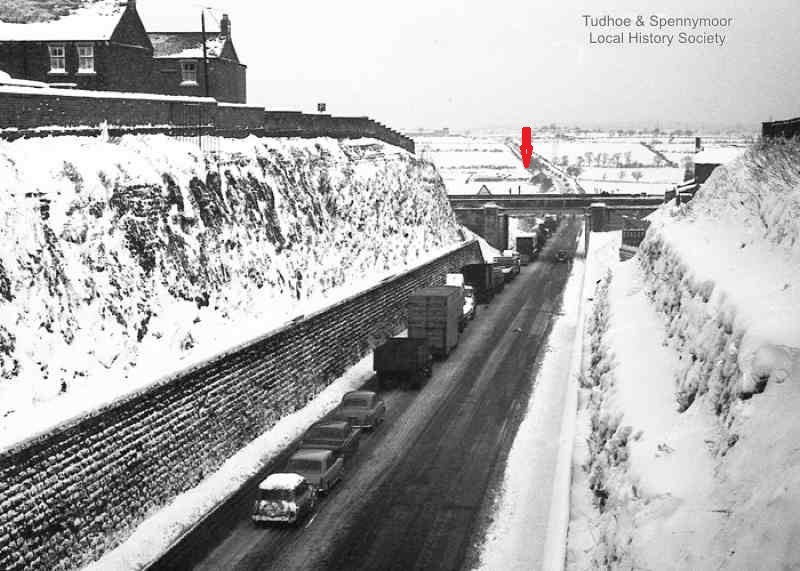 Six Injured. - Motor Bus Overturns Near Ferryhill.
A motor-bus owned by Mr J W Etherington, of Coundon, was being driven from Ferryhill to Spennymoor last night, and when passing Red Hall Farm, on the Great North Road, the vehicle struck the side of the footpath and turned over on its side.
Four of the six passengers were injured. These were:-
John Phillipson, 8 Durham Road, Spennymoor, cut on left arm,
Ellie Phillipson, his wife, shock and bruises,
Albert Edward Phillipson, their son, aged nine, cut on head,
Mattew Craig (20), 11 Duncan Street, Spennymoor, injuries to shoulder.
The driver, Michael McShane, Auckland Park, and the conductor, Norman Maughan, Middleton Village, were also cut about the hands.
The injured were attended to by Dr Brown, of Ferryhill.
The bus was considerably damaged, and the road was blocked for over an hour.
Caused by a defect in the steering gear.
(14th July 1930 Hartlepool Northern Daily Mail/15th July 1930 Shields Daily News)
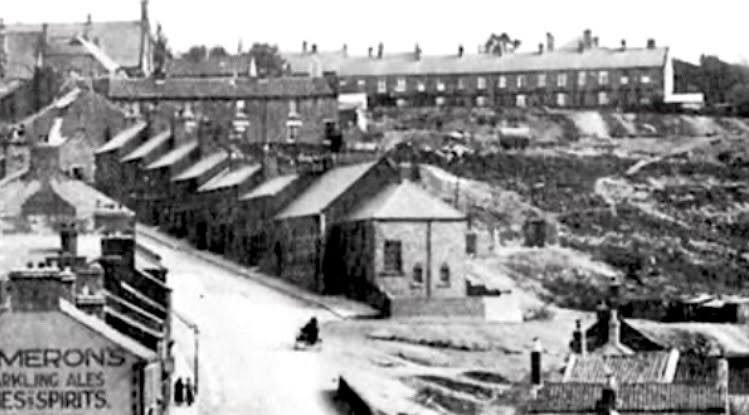
Motorists’ Leap From Car.
Three Spennymoor men, under the impression that the brakes of the car in which they were riding had failed, jumped from the vehicle and narrowly escaped serious injury.
The car was travelling down Newton Cap Bank, Bishop Auckland, yesterday, at a good speed when the men leaped off.
One man hurt his knee in the fall and was taken to the Auckland Cottage Hospital.
(23rd July 1930 Hartlepool Northern Daily Mail)
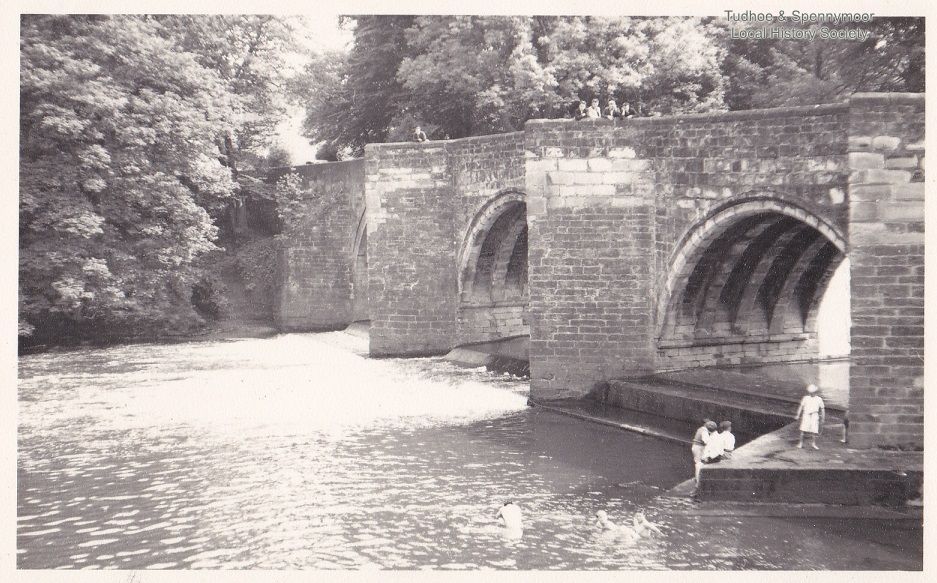 Northern Outlook - Ancient Bridges.
It is to be learned from the report pf the Society for the Protection of Ancient Buildings that, as a preliminary step towards the preservation and maintenance of structures of historical and artistic interest, a survey is shortly to be made of the old bridges in the Northern counties.
There are many of these, and among those that leap to the eye are the familiar structures at Langwathy, the Eamont bridge near Penrith, the bridge at Corbridge, and those at Chollerford and Eggleston.
Can They Be Saved?
Now a rather difficult question is raised. There is not one of these bridges that is not well worthy of preservation either from a sentimental or artistic point of view, or both. But in nearly every case they are incapable of carrying the increasing burden of modern road traffic.
To widen them would in nearly every case involve their destruction as ancient monuments. Would it be easy to build in every case a new viaduct, and leave the old bridge without a utilitarian purpose? Perhaps so. It is, however, a point that will arouse divergent opinion.
At Croxdale.
Croxdale is a case in point, and its example may perchance provide a model for imitation. The old Sunderland Bridge - which, as you know, is near Croxdale, and very remote from Sunderland – has been superseded in the interests of the motor-car.
But the bridge still stands. Hardly anybody uses it. Still it is an ancient and interesting relic of days gone by, and may well be allowed as such to remain. And a like remark may apply to the others.
(3rd July 1930 Newcastle Evening Chronicle)
 Tribute to British Cinephone.
The Arcadia Cinema, Spennymoor, opened with British Cinephone equipment on July 2nd, and according to Gowland & Son, operating the hall, “the set is working splendidly and reproduction is wonderfully clear.” In a wire to Councillor E E Lyons, well-known exhibitor, who is also managing director of British Cinephone, Messrs. Gowland pay a tribute to this “talkie” equipment, which they describe as a triumph of British enterprise.
(16th July 1930 The Bioscope)
12 Osborne Terrace, Ferryhill.
Ferryhill (midway between the station and the village) 12 Osborne Terrace, for Sale at £395, dwelling-house, suitable for carrying on small drapery or general business. Full particulars from Wm. Harland and Son, 42 High Street, Stockton-in-Tees.
(24th July 1930 Yorkshire Post and Leeds Intelligence)
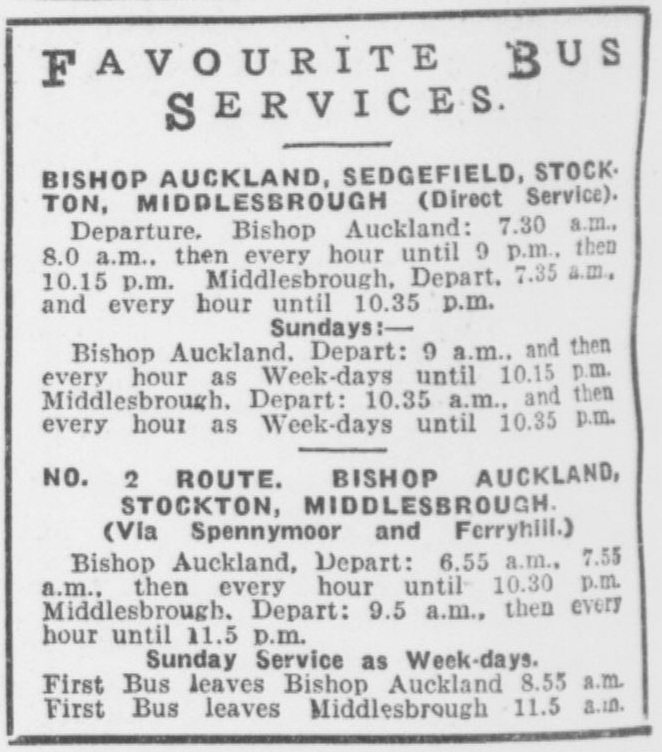
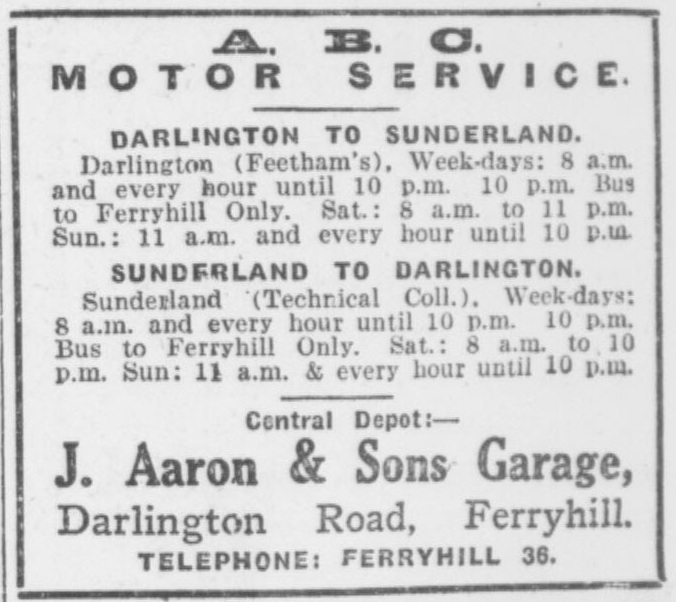
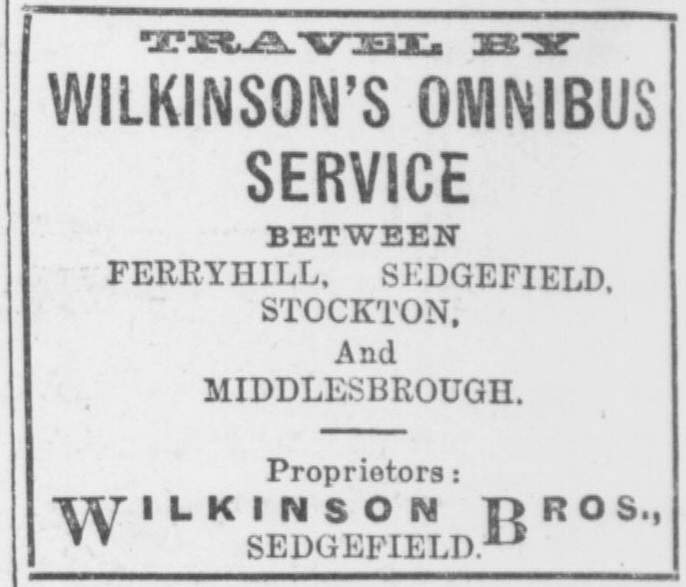
Bus Advertisements - 5th July 1930 Wearside Catholic News.
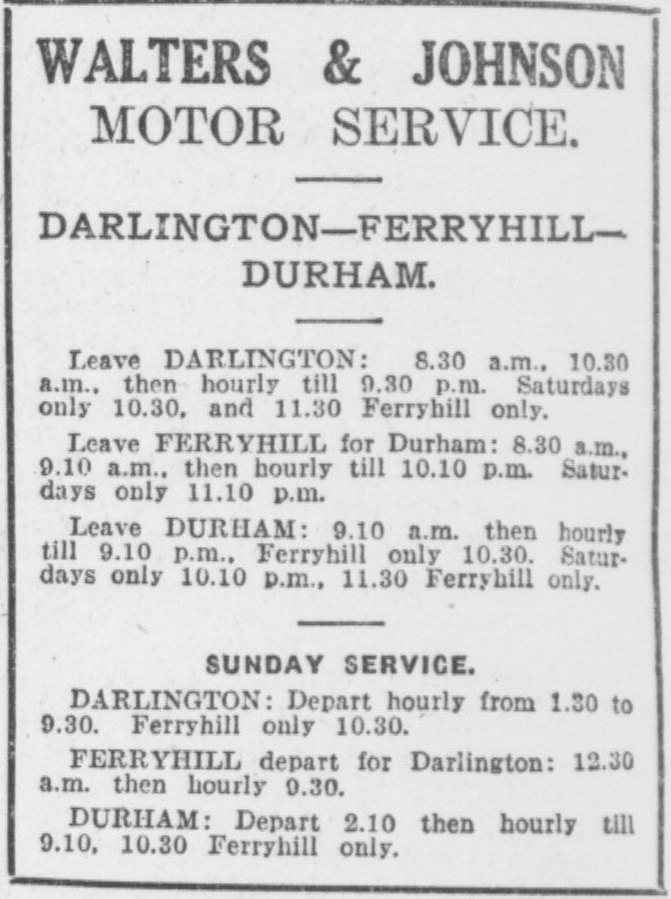
 Back to Reformatory.
Leeds Boy Stopped in Car Stolen from York Doctor.
The escapade of a Leeds youth was related at York to-day, when Leonard Poole (16), of 27, Clarence Road, Leeds, was charged with stealing a saloon motor car, value £300, the property of Dr Ian McPherson, on June 24. There was a further charge of stealing four gallons of petrol.
The Chief Constable said that Poole had been examined by the Governor of Hull Prison, with the object of ascertaining if he was a fit subject for Borstal treatment. The Governor’s report showed that he was.
Sergt. Phipps, of the Durham Constabulary, said that he was on duty on the Darlington Road, near Ferryhill. He saw a car approaching which answered the description of the stole car. He signalled the driver to stop, but he drove straight on, and the sergeant was forced to jump out of the path of the car. The car, however, was stopped by a constable who had been placed further along the road by Phipps. When asked if he was the owner of the car, Poole said “No.”
The Chief Constable said that in 1929 Poole was sent to Adel Reformatory for three years for stealing a motor car in London. Owing to family troubles, he was released after being their only five months, and the head master asked that he might be sent back if the magistrates did not send him to be tried at the Assizes. The Leeds police had a warrant for his arrest on a charge of stealing £6 from his mother.
The magistrates sent Poole back to the reformatory until he was 19.
(3rd July 1930 Leeds Mercury)
 Debtor’s Denials - Ferryhill Butcher Refutes High Living Charge.
A strenuous denial that he drank to excess, and had expensive tastes, was made by Thomas William Turner, a butcher, of Ferryhill, who appeared for his first public examination at Durham Bankruptcy Court to-day.
The Official Receiver (Mr W A Elis) mentioned that he had been informed that debtor was subject to such practices, but he refused to accede to Turner’s request for his source of information.
Debtor attributed a deficiency of £142 9s 1d to the closing down of collieries in his district, and the resultant difficulty in collecting accounts, and also to increased competition in the butchering line in Ferryhill.
He was formerly manager for an insurance company, he said, and since he started business in 1922 the number of butchers in Ferryhill had increased by 75 per cent. He declared he had lived meagrely the last two years, and last year spent only £126 in living expenses.
The examination was adjourned until August 19.
(8th July 1930 Newcastle Evening Chronicle)
Thomas William Turner (b1886 Willington) was living at 13 Belle Vue Terrace, Willington in 1911, he married Florence Ann Pickles (b1878 Batley, Yorks.) in 1909 and they had a daughter Annie (b1910 Willington).
In 1921 they are living at 19 Windsor Avenue, Ferryhill and have sons George (b1911 Birstall, Leeds) and Thomas (b1913 Birstall, Leeds) and also his mother-in-law Mary Ann Pickles living with them. Thomas William is an Assistant District Manager for Pearl Assurance, Ferryhill District.
In 1939 Thomas and his wife are at 6 Vyner Street, Spennymoor, his prospects don’t seem to have improved as his occupation is “unemployed butcher.”
Runaway Bogey
Spennymoor Boys Fined For Reckless Play.
Twelve boys, of ages ranging between nine and twelve, admitted at Spennymoor Police Court to-day that they had been riding on a bogey containing half a ton of metal that smashed gates on the Dean and Chapter Colliery railway siding at Merrington Lane.
Someone shouted “Police,” they said and they ran away, while the bogey ran half-a-mile down the line into the gates.
They were fined 7s 6d each.
(22nd July 1930 Newcastle Evening Chronicle)
 Killed in Ferryhill Pit.
While engaged as a hewer in the Brockwell Seam at Dean and Chapter Colliery, Ferryhill, this morning. William Harrison (55), of Stephenson Street, Dean Bank, was killed by a small fall of stone.
Ferryhill Tribute
The funeral of Mr William Harrison, who was killed at Dean and Chapter Colliery, Ferryhill, took place at Ferryhill Station Cemetery. The funeral procession, which was fully a quarter of a mile long, halted at the Dean Bank Primitive Methodist Church for the first part of the service, which was taken by the Rev, J Henderson. Representatives were present form the Dean and Chapter Miner’s Lodge, Coke Oven and By-product Association, Ferryhill Village Workmen’s Club, British Legion, Ferryhill Athletic Football Club, and Allotments Association.
(1st/7th July 1930 Newcastle Evening Chronicle)
Trade Depression in the North
Notices to Over 900 Men & Boys.
Over 900 men and boys at pits and coke ovens in Northumberland and Durham have received their notices.
All the officials and men, 80 in number, employed at the coke ovens at Dean and Chapter Colliery, Ferryhill, belonging to Messrs. Dorman, Long and Co., received their notices on Friday. This is the oldest portion of the coke ovens at that colliery. Rumour to the effect that the main coal seam in No. 3 pit was to be closed has not yet materialised.
(18th July 1930 Chester-le-Street Chronicle)
Blow to Ferryhill
Eighty Affected by Closing of Coke Ovens.
By the complete closing down of the copper coke ovens at the Dean and Chapter Colliery, Ferryhill, yesterday, all hopes were dispelled of further activities in that direction.
Eighty more men are added to the list of unemployed. Foremen, chemists, engineers, and oven workers are included, and it is feared that further additions may be made in the near future.
(21st July 1930 Newcastle Evening Chronicle)
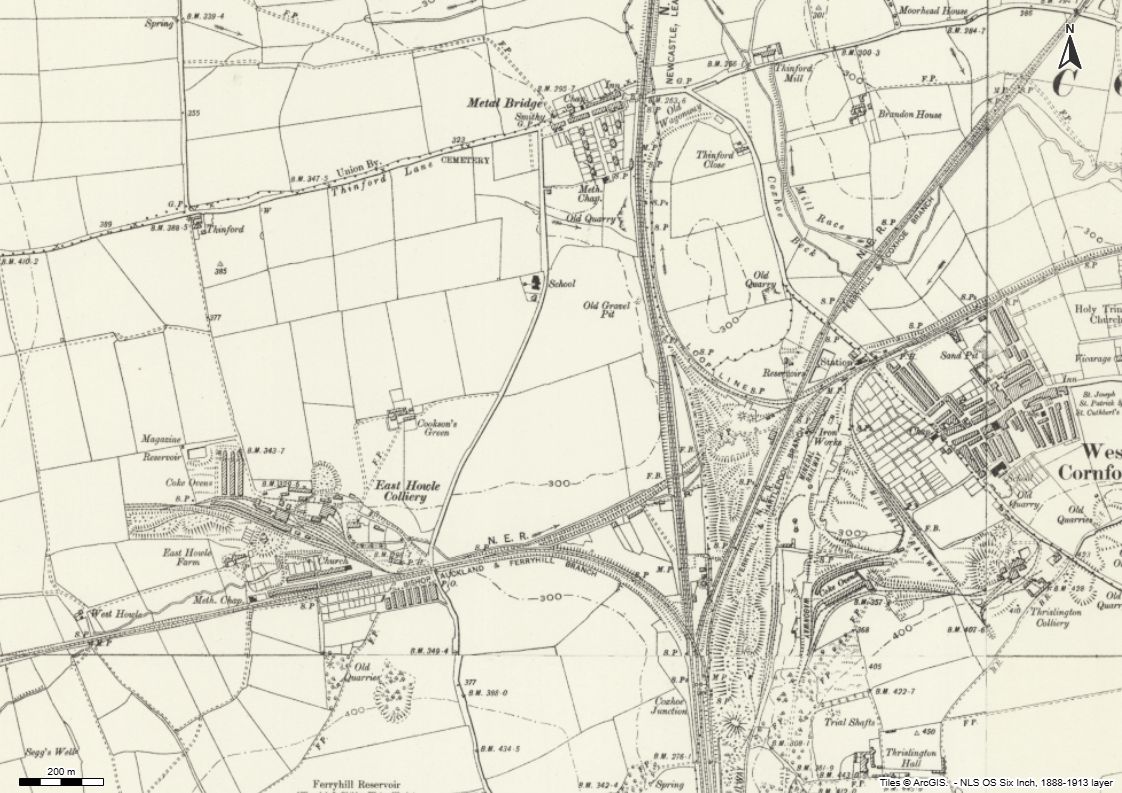 Ex-Miner Undergraduate
Award of Durham County Exhibition.
Mr Walter Brunskill, a Ferryhill man, who was a miner before he went to college, was at yesterday’s meeting of the Durham County Education Committee awarded a special exhibition towards his fees at Bede College, Durham, equal in value (£35) to a Training College Exhibition.
As a boy he attended the East Howle Council School, and leaving before he was 13 continued his studies at evening classes and with the help of a correspondence college. He passed the Durham Matriculation Examination, and as a result he was admitted to Bede College for a three years’ course leading to the B.A. degree and the Board of Education Teacher’s Certificate.
Albert Dowdell - The Committee also decided to continue a special exhibition of £50 to Albert Dowdell, of Spennymoor, to aid him in reading for an Honours Degree at Oxford.
Last session Mr Dowdell’s scholarships amounted to £250, in addition to £150 for home maintenance for his wife and two children. His tutor has written from the University stating that Mr Dowdell was working hard and making splendid progress.
(17th July 1930 Yorkshire Post and Leeds Intelligence / 25th July 1930 Chester-le-Street Chronicle)
For more information about the Dowdell family go to July 1931.
 Spennymoor Trader’s Will.
Mr William Buck, of Carlton Hill, Spennymoor, hardware dealer, left gross estate valued at £6,734 with net personalty £4,068 4s 7d. He gives all his property to his wife absolutely.
(16th July 1930 Newcastle Evening Chronicle)
Joseph Mounsey.
A verdict of “Death from misadventure” was returned at an inquest yesterday, at Spennymoor (Co. Durham) on Joseph Mounsey, aged 17, coal miner who was drowned on Thursday whilst bathing in a pond. He was unable to swim, and he got into difficulties and sank before his companions could get to him.
(5th July 1930 Yorkshire Post and Leeds Intelligence)
Ferryhill Institute.
Ferryhill Village Women’s Institute held their monthly meeting in the Town Hall, at which Miss Moore, from the Women’s Migration Hostel, Newcastle, spoke on her personal experiences in Canada respecting the scheme, and assured her audience that it had been a great success.
(3rd July 1930 Newcastle Evening Chronicle)
Croxdale Hall Garden Party.
In the grounds of Croxdale Hall, the residence of Colonel and Mrs Salvin, a garden party was held in aid of the Durham Catholic Women’s Club, there being present about one thousand women from all parts of the county. Mrs Salvin, who is president of the Durham branch, C.W.L,, carried out the arrangements. An open-air whist-drive was included in the programme. Benediction was given by Bishop Thorman at an alter erected in the grounds, and an address was given by Bishop Godric Kean.
(19th July 1930 Wearside Catholic News)
 Spennymoor Urban Council Election.
By a majority of two votes Mr Joseph Bates, of Spennymoor, a Moderate candidate, has been returned as a member of the Spennymoor (County Durham) Urban Council. Owing to a split in the local Socialist party two Socialist candidates were run.
(26th July 1930 Yorkshire Post and Leeds Intelligence)
Gymkhana Winners.
Spennymoor and District Motor Club held a gymkhana in the Brewery Field, Spennymoor, last night.
Results:- Plank riding, 1, H Williams; 2 R Hodgson;
Surf Riding, H Williams, R Hodgson;
Big Game Hunting, H Williams.
Musical ride, H Fatham and Miss M Fatham.
Obstacle race, A Kenmir, R Rothey.
T.T. Race, T Coulson, H Williams.
(31st July 1930 Newcastle Evening Chronicle)
Fire at The Broom, Ferryhill.
A brief but fierce fire at The Broom, Ferryhill, on Saturday resulted in a garage being burned down and a 14-seater bus destroyed. The garage belonged to Messrs. Ingle and Gibbs, whose two buses ply between Ferryhill Station and Spennymoor.
(9th June 1930 Hartlepool Northern Daily Mail)
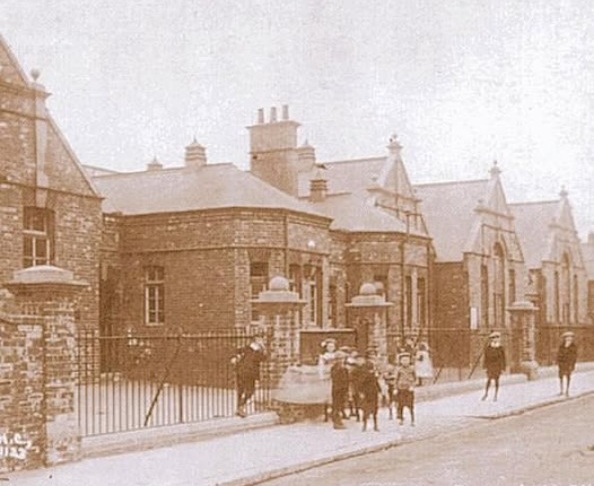 Killed Leaving School.
As the children were leaving Dean Bank Council School, Ferryhill, yesterday afternoon, Elsie Dodd (10), daughter of Mr John Dodd, of Steelworks Street, Dean Bank, ran on to the road in front of a lorry and was run over.
Medical aid was quickly summoned, but the child died shortly after being conveyed to her home.
(14th June 1930 Hartlepool Northern Daily Mail)
Does anyone know where Steelworks Street, Dean Bank was located?
In 1921 the family are living at 57 Darlington Road, John (b1888) and Lauretta Dodd with daughter Elsie. John is a colliery clerk at Dean and Chapter Colliery. He married Lauretta Young in 1918.
In 1939 they are living at Brewery House, South Burns, Chester–le-Street with their daughters Connie (b1922), a shorthand typist, and Marjorie (b1925), also living with them is Lauretta’s father John G Young, aged 70. John is a brewers manager and special constable.
Through Windscreen
Spennymoor Child’s Injury in Car Collision.
On Saturday afternoon a two-seater car driven by Mr H Derdle, of Carlton Terrace, Spennymoor, accompanied by Mrs Derdle and her six year old son, was passing St Paul’s Gardens when a front tyre burst and caused the car to collide with a stationary saloon car. The force of the collision threw the child through the windscreen, and he received severe cuts on the face.
(23rd June 1930 Hartlepool Northern Daily Mail)
 Doctor Thrown Clear.
Escape After Collision with Long Distance ‘Bus.
A Spennymoor doctor, named Frankland, to-day escaped death in a collision with a Primrose Service ‘bus which operates between Blackpool and Newcastle.
The ‘bus was passing under the railway bridge at Spennymoor as the doctor’s car came out of a side street. An almost head-on collision took place, and the bus carried the car across the road. The two vehicles were wedged against the wall, the ‘bus stretching right across the road. When the ‘bus struck the car the door flew open, and Dr Frankland was thrown out.
He was picked up badly cut about the head, and taken to his surgery nearby. After being attended by Dr Farquarson, he was conveyed home.
(25th June 1930 Leeds Mercury)
Lost and Found
Ninepence for Seven Words (Prepaid).
Brewer’s Empty Beer Barrel. No 48,172, Lost between Bishop Auckland and Newcastle, via Spennymoor.
Finder rewarded on communicating with McEwan and Co., Ltd., City Road, Newcastle.
(4th June 1930 Newcastle Evening Chronicle)
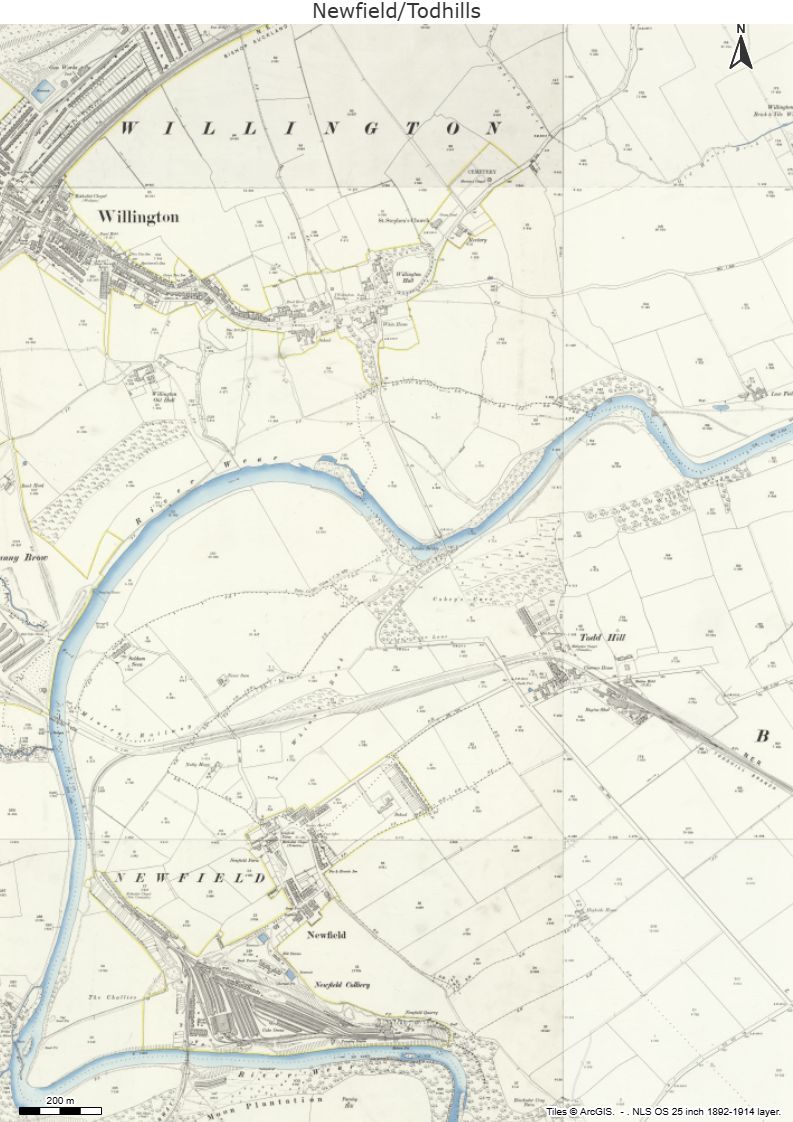 Gravel Beds
Probably to be Worked on Large Scale.
The discovery of what are believed to be important gravel beds, adjoining the River Wear banks, at Newfield (County Durham) will, it is anticipated lead to the erection of washing plant and other machinery to work the beds on a large scale.
According to tests the gravel is of a very fine quality for road-making, and negotiations are now proceeding to determine the royalty rights after which the project will be carried further. A number of men will be provided with employment over an estimated period of five years.
The land on which the gravel beds are situated belongs to Mr R Hutchinson, of Newfield Farm. Those who are intending to work the beds are Mr John Graham, of Todhills Farm, Newfield, Mr A Golightly, managing director of the Spennymoor Slag Works, and Mr Proctor, of Durham, who is associated with the latter.
The average yield per day will be in the region of 100 tons.
(5th June 1930 Yorkshire Post and Leeds Intelligence)
 Dean and Chapter Officials.
The ballot of the officials for the Dean and Chapter Colliery Miners’ Lodge, Ferryhill, has resulted as follows: chairman , Mr W Hirst; delegate, Mr H Welsh; secretary, Mr J W Patterson; compensation secretary, Mr J Robson; and treasurer, Mr S Watson.
(6th June 1930 Newcastle Evening Chronicle)
Head Crushed
Shocking Accident at Ferryhill Pit.
An elderly Croxdale man was killed in a shocking accident which occurred at the Dean and Chapter Colliery, Ferryhill, yesterday.
Thomas Shaw (53), who resided in Foster’s Buildings, was returning to his work after lunch. At the coke oven he was stepping from the coal press when he slipped and fell on the coal ram, which was in motion. His head was completely crushed.
(30th June 1930 Shields Daily News)
 Ferryhill Schools Success.
The boys of Ferryhill Station Council school has just completed a successful season, during which they have won the three principal competitions in the district the Dean Bank Aged Miners’ Homes Cup, the Markham Cup, and the Spennymoor and District Schools League Championship Shield.
Their championship success in the league was the first in the history of the Ferryhill Station boys, and was achieved by the following record:
P24, W 20. L2, D2, goals for 100, against 23. Pts 42.
The following members of the team represented the Spennymoor District boys in the English Schools Shield and the Teesside Shield.
W Duggan (left back) who played in all five games, E Lamb (centre half), E Robson (left half), and C Cousins (outside left).
(2nd June 1930 Newcastle Evening Chronicle)
Ferryhill Athletic Profit.
Ferryhill Athletic, members of the Northern League, although not winning any trophy, are one of the few clubs in the league to show a credit balance on the year’s working. Although the balance is small the management have to be congratulated on overcoming their many difficulties.
The slight profit was due mostly to the efforts of the lady supporters who raised £29, and to the Carnival, whereby they obtained £24.
The club has again entered the Northern League Cup competition, and also the English Cup, the Amateur Cup, the Benevolent Bowl, County Challenge Cup, Ferryhill Nursing Cup, and the Durham Auxiliary Cup.
Under the new scheme of the Football Association, £500 is to be asked for on loan to assist in buying the ground, etc.
The majority of last season’s players have signed up, with some new ones.
(30th June 1930 Newcastle Evening Chronicle)
Housebreakers Aged 10 and 12.
Thefts of Two Boys at Spennymoor.
Two boy housebreakers, aged 10 and 12, were bound over for thefts by the Spennymoor magistrates to-day.
The boy of 12 appeared on three charges of theft. In the first case he was charged with breaking into the house of Hannah Marley, of Rosa Street, Spennymoor, and stealing a luminous watch, fountain pen, toy pistol, and purse containing 1s, a total value of 15s.
In the second case he was charged jointly with a ten year old boy with breaking into the house of Winifred Kennedy, fruiterer, of Craddock Street, Spennymoor, and stealing a purse containing £2 4s 21/2d. In this case entry had been effected by breaking a window in the scullery.
Subsequently some of the money was recovered from a hole in a wall near St. Paul’s Church, Spennymoor, to which the elder boy had taken the police after he had admitted the theft.
Stole a Bicycle
In the third case the 12 year old boy was charged with stealing a bicycle worth £2 10s., belonging to James Gowland, of Middlestone Moor. This cycle was stolen from outside a shop in Vyner Street, Spennymoor, and was found abandoned at Mount Pleasant.
The boys pleaded guilty to each of the charges. The 12 year old boy was bound over, with his father, in the sum of £5 for two years, placed in the care of the Probation Officer, and ordered to pay 15s costs.
The ten year old boy was bound over, with his father, in the sum of 40s for one year, and ordered to pay 5s costs.
The Chairman warned both boys that a further appearance would result in them being sent to an industrial school.
(3rd June 1930 Newcastle Evening Chronicle)
Juvenile Crime “Encouraged.”
Court Excuses for Children.
Alleged Gang of Young Wrongdoers.
When five Ferryhill boys were charged at Spennymoor to-day with warehouse breaking, Supt. Foster said he regretted to find that the attitude taken by the parents of these boys tended rather to encourage than to check them.
There was an epidemic of this sort of offence at Ferryhill, continued the superintendent, and a number of similar cases were known, although they had not been actually reported to the police.
These boys, if not checked, were on the right way to becoming criminals.
He was satisfied that there was a gang and while he did not wish to incriminate any particular boy he was satisfied that one of these boys was the ringleader, ably assisted by another.
The Chairman (Dr A Beresford Kane) said they regretted the attitude taken up by the parents, and the Bench was undecided whether it would not be better to order the birch, so that the boys might realise what punishment was.
Mr J Reavley, another magistrate, said that for weeks past most of the time of the court had been taken up dealing with juvenile crime. Parents coming to the court nowadays, he said, rarely expressed regret for what their children had done, but instead made excuses for them.
Birch Warning
The ages of the five boys in Court to-day ranged from 9 to 14.
Superintendent Forster said that the warehouse of a fruiterer was entered and 12 oranges stolen. The padlock had been broken and entry effected by the door.
A new padlock was fitted but was again broken, and PC Walker, hearing a noise, made towards the warehouse and caught the boys running away.
The same warehouse was broken into last year, and 450 oranges and 28 lbs. of nuts were stolen. Four of these boys had pleaded guilty to this offence.
The Bench ordered the boys to be bound over with their parents in the sum of 40s for two years, and ordered to pay 9s each costs. The chairman said that if they appeared again on a similar offence four strikes of the birch would be ordered.
(10th June 1930 Newcastle Evening Chronicle)
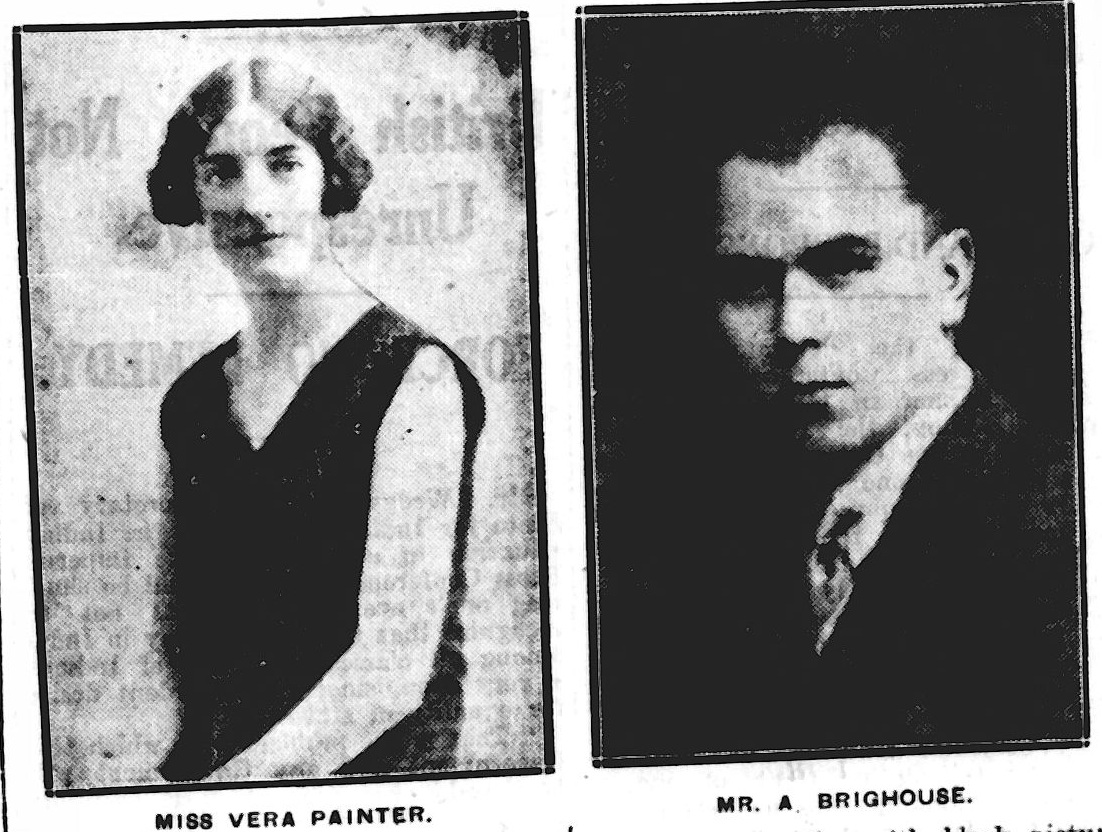 Coxhoe Bridegroom
Bride Who Formerly Lived at West Hartlepool.
The wedding took place this afternoon, at the RC Church, Tudhoe, the Reverand Father Gregson, Tudhoe officiating, of Mr Albert Brighouse, youngest son of Mrs Brighouse, The Bungalow, Coxhoe, and the late Mr Albert Brighouse, manager of Steetley Lime and Basic Works, Coxhoe, and Miss Vera Painter, only daughter of Mrs C Painter, Durham Road, Spennymoor, and the late Mr Duke Robertshaw Painter, formerly of Coxhoe and West Hartlepool.
The bride, who was given away by her brother, Mr Thos. Painter, was charmingly dressed in ivory georgette, with overdress of lace, and spray of orange blossom. She wore a veil with a Russian headdress of pearls, edged with lace, and carried a bouquet of roses and lilies of the valley.
Her bridesmaids were: Miss Vera Brighouse, niece of the bridegroom, who was dressed in shell pink taffeta and georgette, with wreath of leaves to tone, and carried a mid-Victorian posy, Miss Joy Anderson, Coxhoe, who wore mauve satin, and black picture hat, and had a bouquet of sweet peas, and Miss Irene McNeill, West Hartlepool, who was in green satin, with black picture hat, and also had a bouquet of sweet peas.
Mr J W Brighouse, the bridegroom’s brother, was best man, Mr Claud Oldfield, the Bridegroom’s brother-in-law, being groomsman.
Mrs Painter, the bride’s mother, wore a navy georgette and beige dress, with hat to tone, and carried a bouquet of red roses, Mrs Brighouse, the bridegroom’s mother, was in navy and lemon ninon, with hat to match, and had a bouquet of tea roses. A reception was afterwards held in St Andrew’s Mission Hall.
The honeymoon is being spent in Scotland, the bride travelling in a silk marocain costume, with hat to match.
The bride’s present to the bridegroom was a gentleman’s companion, and the bridegroom’s present to the bride a silver fitted travelling case. The bridegroom’s presents to the bridesmaids were: Miss Vera Brighouse, mother of pearl comb and brush; Miss Anderson, tortoise shell manicure set; and Miss McNeill, mother of pearl travelling clock.
(3rd June 1930 Hartlepool Northern Daily Mail)
Vera Stephenson Painter (b1906 West Hartlepool) was the daughter of Duke Robertshaw Painter (b1873 Stockton) and Catherine Cavanagh (b1879 Yarm). They married in 1905 at Hartlepool, in 1891, aged 18, Duke is a marine engine fitter and then becomes a merchant seaman.
In 1911/21 Catherine is living at 12 Wharton Terrace, West Hartlepool with their three children, Vera Stephenson (b1906), Thomas (b1909) and Owen (b1918). In 1921 Duke is 1st Engineer onboard the Clearpool, a steamer, for the Pool Shipping Co., West Hartlepool.
By 1924 the family have moved to the Anchor Inn, Coxhoe where Duke is licensed victualler. Sadly Duke died in January 1927. By 1929 Catherine and the family have moved to 35, Clyde Terrace, Spennymoor, then in 1930 30, Durham Road, Spennymoor, which is where Vera is living when she marries Albert Brighouse. By 1931 Catherine and her son Thomas have moved to Blackgate, Coxhoe, so their time in Spennymoor was only two to three years.
Albert and Vera married in 1930 and had a son Albert in 1931 who sadly died. In 1937 they had another son John Chesney Brighouse.
In 1939 Catherine with her children Thomas, Owen, Vera Brighouse and grandson John Chesney Brighouse are living at 25 The Grove, Coxhoe, Thomas is in the merchant navy, sadly he is lost at sea in 1942. Owen is working as a shunter at a dolomite quarry. John Chesney Brighouse goes on to be a policeman in Spennymoor.
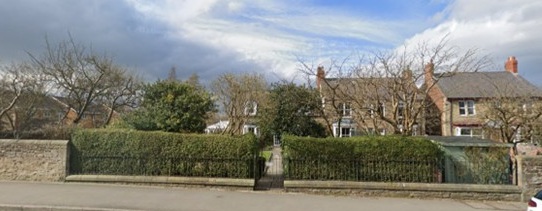 Tursdale – Bride’s Six Bridesmaids.
There were six bridesmaids at the wedding which took place at Old Elvet Wesleyan Church, Durham, yesterday, of Miss E Golightly, youngest daughter of Mr and Mrs T Golightly, of 57 Ramsay Street, Tursdale, and Mr S Donaldson, of Horswell House, Spennymoor. The bride, who is an active worker in connexion with Tursdale Wesleyan Church, wore a dress of ivory georgette trimmed with pearls, and a bridal veil. She carried a bouquet of lilies.
Her bridesmaids were Miss M Richardson, of Bishop Auckland; Miss M Sutton,of Coxhoe; Miss M Claughan, of Tursdale; Miss L Willy, of Gateshead; Miss D Donaldson, of Spennymoor, and Miss E Price, of Tursdale. Mr J Donaldson, the bridegroom’s brother, was best man, and Mr W Golightly, the bride’s brother, groomsman.
(10th June 1930 Hartlepool Northern Daily Mail)
The Donaldson Family
John Donaldson (b1809 Scotland) married Margaret Nevison (b1812 Barnard Castle) in 1840. They lived in Newgate Street, Bishop Auckland where John was a hosier, laceman and dealer in marine stores employing two people. They had five children by 1861, Catherine, William, Anne, John (b1851) and Margaret. John died in 1867, his sons William and John took over the business at 91/2 Newgate Street and were living there with a housekeeper, servant and apprentice.
John Donaldson (b1851) married Isabel Wilkinson (b1848 Easington) in 1877. In 1881/91 they are living at 46 High Street, Spennymoor (between the Old Town Hall and the Vane Arms (Quinns)), with a daughter Margaret (b1878), John is an ironmonger. In 1883, a son, John William was born.
John died in 1896 and Isabel took over the business. In August 1900 there is a robbery at the shop for further details go to Old News August 1900.
In 1901 Isabella, with Margaret and John W., are living at 5 St Paul’s Gardens.
John William Donaldson married Florence Louisa Smelt (b1884 Westerton) in 1904, in 1911 they are living at 6 Osbourne Road, Spennymoor with three children, Sidney (b1905) John (b1907), and William (b1910). John William enlisted as a gunner in the Royal Garrison Artillery in November 1916.
In 1921 they are living at Horswell House, Spennymoor with another daughter Dorothy (b1919), John William is an ironmonger at 20 High Street, Spennymoor and Sidney is his assistant.
Sidney Donaldson married Elizabeth E Golightly in 1930. Sidney appears to be running an ironmonger’s business at Redcar in 1933, however, there seem to be problems:-
Receiving Orders and Adjudications - Sidney Donaldson of 37 Stanley Road, Redcar, formerly 224 Laburnam Road, Redcar, in business as an ironmonger at 54 High Street, Redcar. (11th November 1933 Yorkshire Post and Leeds Intelligence)
In the Cleveland Standard on 16th December 1933:-
Ironmonger’s Failure. – The examination of Mr. Sydney Donaldson, who carried on business as an ironmonger at 54, High Street [Redcar], was adjourned till Jan, 12. When he appeared before the Official Receiver (Mr C L Townsend), at Middlesbrough Bankruptcy Court, he attributed a deficiency of £266 to profits from the business being insufficient to cover household and personal expenses, bad debts, interest on loans, costs of proceedings by creditors, and depreciation of mortgaged property. It was mentioned that debtor had had 34 County Court judgement summonses taken out against him, and costs in connection with these had amounted to about £40.
In 1939 Sidney, his wife and daughter Mary (b1933), were at 57 Ramsay Street, Tursdale with his in-laws Thomas and Susan Golightly, and his sister-in-law’s family. Thomas was a colliery powder man and Sidney a handicraft teacher working as a joiner.
Was Sidney visiting his in-laws or living there, his parents John William and Florence Louisa and John’s older sister Margaret were living at 35 Stanley Grove, Redcar, John was a hardware salesman. Had they all moved to Redcar in the early 1930s?
Mr Harry Smith.
Mr Harry Smith, a hewer at Dean and Chapter Colliery, Ferryhill, is to assist Harton Colliery Band as solo cornetist during a 12 weeks’ tour of the South Coast and also at the championship contest in September.
(4th June 1930 Hartlepool Northern Daily Mail)
Ferryhill Nursing.
Reports submitted at a meeting of the Ferryhill District Nursing Association, at which Mr Jos. Langley presided, showed that £60 had been raised as a result of the Farmer football cup competition, and that the receipts for the month totalled £106, with expenditure £71.
The nurses attended 44 ordinary cases and 11 maternity cases.
(18th June 1930 Newcastle Evening Chronicle)
 Good Templary.
The members and friends of the James Rewcastle Lodge, Hartlepool, journeyed by bus to Spennymoor to pay their annual visit to the Triumph of Hope Lodge. An enjoyable musical programme was arranged by Coun. Chambers, consisting of piano and violin duets, songs, recitals, and reading.
The following took part: Miss Brown, Masters Boswell and Corner, Coun. Chambers, Mr Tom Hopper, Mr H A Bell, Mr James Mitchell and Master Boswell (accompanist).
Mr J Fleming and Mr J Kennier, on behalf of the Spennymoor Lodge, spoke of the value of these visits, and thanked the visiting friends for their concert. Refreshments were served at the close by the ladies’ committee. The members of the Spennymoor Lodge will visit Hartlepool on July 10.
(19th June 1930 Hartlepool Northern Daily Mail)

Glooper’s Club.
Allan Rutherford has just gone to live at another home called Laburnham House, Tudhoe.
He says that the house is very old and is supposed to have secret passages, but so far he has not been able to find any.
He has just received his birthday card which he has framed and hung in his room.
He says although he has only been at Tudhoe a very short time he has made a great friend who is also a Glooper.
(21st June 1930 Newcastle Evening Chronicle)
People are still searching for these secret passages!
Gloops Club - For The Sunshine Fund.
Lavender bags have been the means of Isabel Nutter helping the fund. She sold them to her friends at Spennymoor and has sent a welcome postal order for two shillings.
(3rd May 1930 Newcastle Evening Chronicle)
Five Generations All “Girls” - Durham Octogenarian’s Record
The head of a family of five generations, all of whom are living, and all are females.
This is the record of Mr Hannah Marshall of Prospect Terrace, Neville’s Cross, Durham, who to-day celebrates her 88th birthday.
Mrs Marshall’s daughter is Mrs Mary Ann Johnson, 62, of Chapel Cottages, Durham, who has a daughter, Mrs Hannah Pearce, formerly of Low Spennymoor and now living in Sussex, whose daughter is Mrs Lydia Garside, aged 20, of Church Street, Low Spennymoor, and this young mother has an 18 months old baby girl, Jane.
To-day Mrs Marshall is having a birthday party but all five generations cannot be present. She has living four daughters and one son, 24 grandchildren, and a large number of great-grandchildren.
Born at Durham, she is in full possession of her faculties and travels regularly without the aid of a stick to Bensham, where loves one of her married daughters. Mrs Marshall’s husband died 20 years ago.
(28th May 1930 Newcastle Evening Chronicle)
Ferryhill Golden Wedding
Mr and Mrs Thomas Hodgson, of Gordon Terrace, Ferryhill, will celebrate their golden wedding on Friday. They were married at Barnard Castle, Mr Hodgson is 74 and Mrs Hodgson 72, and both enjoy good health. Of five children three remain, one son being killed on the war. There are 14 grandchildren and one great grandchild. Nineteen years ago Mr Hodgson was employed by Sedgefield R.D. Council until he retired last year.
(28th May 1930 Newcastle Evening Chronicle)
Spennymoor Theatre to Cost £10,000
The Spennymoor (Tivoli), Ltd., has made a start on the erection of a new kinema on the site of the old Tivoli in Cheapside, Spennymoor. The building, which is estimated to cost over £10,000, is expected to be completed by the middle of September.
Hays and Gray, of Central Chambers, Wingate, Durham, are the architects.
(15th May 1930 Kinematograph Weekly)
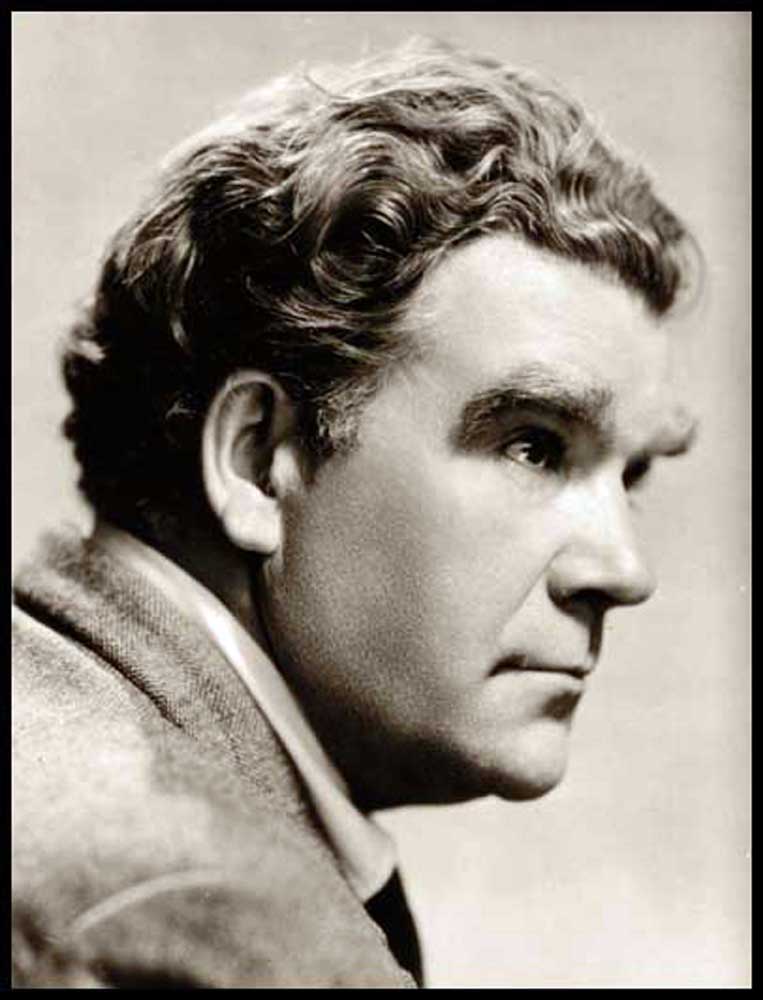 From Spennymoor to Stardom
Gibson Gowland, who plays the role of “Morgan”, pseudo descendant of the famous Mexican pirate in “Hell Harbour”, hails from Spennymoor. He it was to whom Von Stroheim gave the role of McTeague in “Greed”. Before he was 30 he toured in melodrama throughout the British Isles, South Africa and Canada, but early in 1914, he deserted the stage to make his way to Hollywood where, after a month’s fruitless efforts, he finally got a job from a lady. The lady was Bebe Daniel’s mother, and she got him a part in a picture with Carlyle Blackwell. David Wark Griffith saw him, signed him to play in “The Birth of a Nation,” and later “Intolerance.”
From Spennymoor to Stardom
Gibson Gowland, who plays the role of “Morgan”, pseudo descendant of the famous Mexican pirate in “Hell Harbour”, hails from Spennymoor. He it was to whom Von Stroheim gave the role of McTeague in “Greed”. Before he was 30 he toured in melodrama throughout the British Isles, South Africa and Canada, but early in 1914, he deserted the stage to make his way to Hollywood where, after a month’s fruitless efforts, he finally got a job from a lady. The lady was Bebe Daniel’s mother, and she got him a part in a picture with Carlyle Blackwell. David Wark Griffith saw him, signed him to play in “The Birth of a Nation,” and later “Intolerance.”
Gowland appeared in “The Climbers,” and “The Fighting Shepherdess,” in which Anita Srewart starred, and then Von Stroheim’s eyes fell upon him and he was featured in “Blind Husbands,” one of the earlier Von Stroheim revolutions.
While making his picture, Gowland was intrigued by a line in a Hollywood paper which asked simply. “Where is Gibson Gowland?” Gowland answered the question by returning to England to discover that his family had been trying to find him so that the estate of his father might be settled, and while in Durham the present writer met him, a fine upstanding man with leonine head.
(28th May 1930 Newcastle Evening Chronicle)
Gibson appears to be born as Thomas Henry Gowland in 1877 and used his father's middle name when he went to USA. He died in 1951 (aged 74) in London.
In 1881/91 the family are at 11 Flora Street, Spennymoor, his father, Thomas Gibson Gowland, a fruiterer born in 1851 at Byers Green, and his mother Jane Harrison, born in 1851 at Kirk Merrington.
There were sibling George William, b1876, Mary Elizabeth, b1879, Robert Frederick, b 1880, Ernest Edward, b1882 and Edith Annie, b1885. In 1891 Thomas is an apprentice clothier.
By 1901 the family are at 5 Summerhill Street, Newcastle-upon-Tyne but Thomas Henry is not with them, he appears to have gone abroad at this time.
In 1911 they are at 41 Elswick Row, Newcastle-upon-Tyne where Thomas Henry is an ironmonger at Crosling & Co. He left for the USA soon after this.
Spennymoor Carnival
Spennymoor Carnival Committee held a whist drive and dance in the New Town Hall, Spennymoor, last night. Mrs S J Slade presented whist prizes to Mrs Fryatt, Miss S Jones, Mrs Rose and E W Waterworth. The stewards were Messrs. E W Waterworth, W Hurst, and Foster Walton.
Mr S Hamer and Mr N Lewis, of the “Evening Chronicle,” arranged a number of competitions which were thoroughly enjoyed.
Prizes were awarded as follows:
Spot waltz: W Raitt, James Cooper, G Walker, L Dawsett, F Croft, C Robinson.
Statue dance: Gladys Crane, Annie O’Neill, M Booth, and S Jones.
Lucky numbers: H Watcham, Hugh Addleton, J Seymour, and Henry Compton.
(3rd May 1930 Newcastle Evening Chronicle)
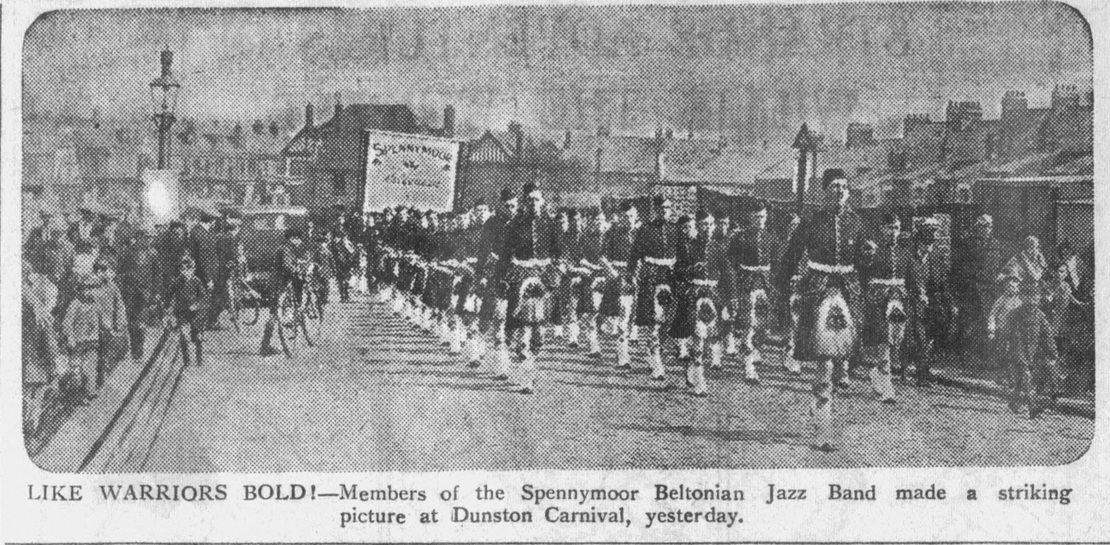 Spennymoor Beltonian Jazz Band
Members of the Spennymoor Beltonian Jazz Band made a striking picture at Dunston Carnival, yesterday.
(11th May 1930 Sunday Sun Newcastle)
Jazz Bands Success - Assistance in Newcastle Carnival
Local jazz bands turned out in force at the carnival held at Newcastle on Saturday, in connection with the Cancer Campaign Fund, and won a number of the prizes.
The event attracted thousands pf people from all over the Tyneside district.
Estimated to be 2.5 miles long, the procession was a wonderful spectacle of brilliant colour and ingenuity.
There were many and varied competitions run through the medium of the procession and among the results were:-
Afternoon Parade - Best Jazz Band en route
1. Spennymoor Scotch Warriors
2. Woodhorn Colliery “Knuts”
3. Ashington Coronation Sports
4. Birtley Stars
(30th May 1930 Chester le Street Chronicle)
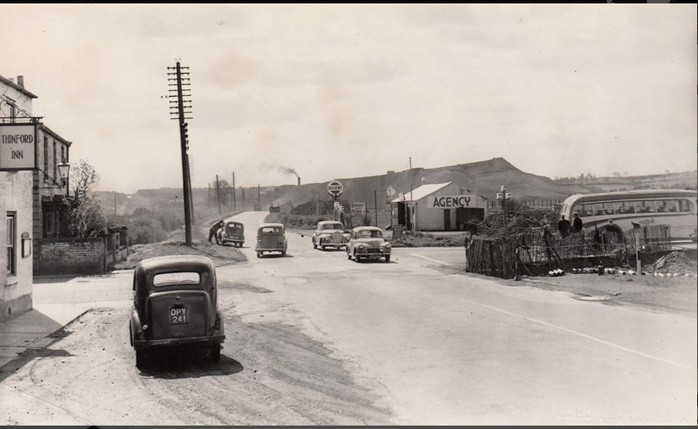 Fatal Stumble Against Motor-Bus
When a small motor bus, driven by James Greatham, of Chilton, was returning on Saturday night from Chilton to Ferryhill Samuel Ingleby (62), a stoneman of Dean and Chapter Colliery, residing at 44, Faraday Street, Dean Bank, stumbled and fell on to the bus as it was passing.
He was taken to the surgery of Dr Brown at Ferryhill, and it was found that he was suffering from head injuries. Later he was admitted into Durham County Hospital, where he died yesterday morning.
(5th May 1930 Hartlepool Northern Daily Mail)
Death in Hospital
The death occurred at Durham County Hospital yesterday of Mr William Stephenson (62), a fitter, employed at Dean and Chapter Colliery, and residing at 9, Parker Terrace, Darlington Road, Ferryhill. On the night of April 3 Mr Stephenson, when returning from his work, was knocked down and run over by a bus on a steep incline on the Ferryhill to Spennymoor road. Severely injured, he was taken to Durham Hospital, where he had been a patient ever since.
(19th May 1930 Hartlepool Northern Daily Mail)
Car-Cart Crash Near Ferryhill
While travelling between Thinford Lane Ends and Metal Bridge, near Ferryhill, a horse and cart driven by Mr J Kitching, who was accompanied by his daughter, Maud, was struck by a private car travelling in the same direction.
The impact upset the cart and Mr Kitching received slight injuries, and his daughter was conveyed to Durham County Hospital suffering from a fractured arm and bruises to the head.
(23rd May 1930 Newcastle Evening Chronicle)
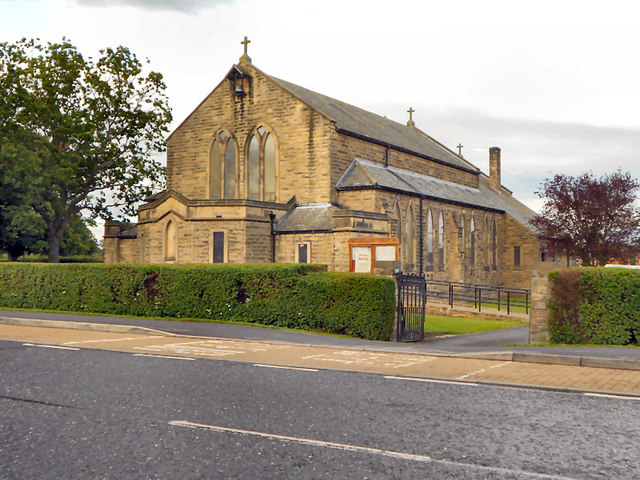 New Chilton Church - Bishop to Consecrate £5,000 Building Tomorrow
The new parish church of St Aidan’s, Chilton, will be consecrated by the Bishop of Durham, Dr H Hensley Henson, tomorrow afternoon.
The church will accommodate 350 and has been erected at a cost of £5,000.
The architect was Mr Stephen Wilkinson, LRIBA, of West Rainton, and the work was executed by Messrs. G W Lazenby and Co., Ltd.
The church is situated at the Chilton Road end of the main road between Ferryhill and Rushyford. The vicar is the Rev. L Wilkinson.
(9th May 1930 Newcastle Evening Chronicle)
The church had been destroyed by fire on 12th March 1928 during a heavy snowstorm. Parishioners managed to recover the organ and the war memorial tablet. Crook fire brigade were summoned but their engine skidded at Howden-le-Wear and at Newton Cap Bank the skid chains broke, they became snowbound and had to return home. (13th March 1928 Hartlepool Northern Daily Mail)
On 29th June 1929 Dr Henson, Bishop of Durham, laid the foundation stone of the new St Aidan’s Church which was to cost £5,700. There was a procession of Scouts, Guides, public officials and members of non-conformist churches followed by a service in the church hall. Dr Henson was presented with a silver trowel by the daughter of Mr J W Lazenby, of Ferryhill when the foundation stone was laid. He then inspected the local Girl Guides and Boy Scouts. (1st July 1929 Hartlepool Northern Daily Mail)
Good Templars Rally at Birtley
The “Sobriety” Lodge-room at the Co-operative Small Hall was crowded last Thursday when a visit was paid by the members of the “George Patterson” Lodge Tudhoe. The visitors were welcomed by Bro. J Knox PDCT, PGAS, and they gave an excellent programme of songs and monologues, etc. A short address was given by the District Chief Templar, Bro. W Gimblett of Gateshead.
Visitors were also present from the “Borough” Lodge Gateshead and a very enjoyable evening was spent. A hearty vote of thanks was accorded the visitors on the motion of Bro. Stan Curran, D. Sec, seconded by Sis. Mrs Richards, VD after which refreshments were served.
(16th May 1930 Chester-le-Street Chronicle)
Ferryhill Pageant
At St Luke’s Parish Hall, Ferryhill, last night, the children of the Guild gave a pageant representing scenes in foreign lands, the performers being in native costumes. The pageant included “ The Rainbow,” “Flower Chorus,” “Slumber Town,” and an Indian play.
(20th May 1930 Newcastle Evening Chronicle)
 Miners’ Wage Dispute - Arrangement Reached at Byers Green
After being laid off work for one week, nearly 400 of the 550 employees of Messrs. Dorman Long and Company resumed work at Newfield and Byers Green collieries yesterday. Negotiations broke down a week ago when the owners expressed a desire to dispense with about 150 men and retain the remainder upon a lower tonnage rate basis. The men refused to accept the terms in the first instance, and notices were given to all workmen, but by a subsequent arrangement and agreement was arrived at and Messrs. Dorman Long and Company’s terms were agreed to.
(13th May 1930 Yorkshire Post and Leeds Intelligence)
Another Blow to Durham Miners - Chilton Pit Closes Through Bad Trade
Chilton Colliery, near Ferryhill, has today closed down indefinitely owing to lack of orders, and about 1,200 men and boys have been thrown out of work.
The “Evening Chronicle” learns, however, that the by-product plant, where improvements were recently carried out, will remain working.
The colliery, which is owned by Messrs Pease and Partners, has been working slack time for several weeks, and it is in consequence of the prevailing depression in the coal trade that the owners have reluctantly decided to take this step.
Approximately 1,000 of the employees are surface and underground workers, while about 50 men are employed at the coke ovens.
Lack of orders is becoming more widespread, and in consequence several collieries throughout the county are working short time, while others are temporarily reducing hands.
(19th May 1930 Newcastle Evening Chronicle)
Fatal Seizure in the Pit
A coal hewer named Thomas McAdam (26), of George Street, Spennymoor, was taken suddenly ill whilst following his employment at Dean and Chapter Colliery, Ferryhill. He was conveyed to Durham County Hospital, where he died.
(21st May 1930 Hartlepool Northern Daily Mail)
“Liar and Thief” at 10.
Spennymoor Boy Who Told Different Tales.
A 10-year-old Spennymoor boy who proved himself an accomplished liar, was charged at the local police court, today, with stealing a purse containing £11 16s 6d from the shop of James Daley, in George Street.
Supt. Headen said Mrs Daley left the shop unattended for a few moments and later found the purse was missing. The boy was traced to Stockton, where he was interviewed by the police, and told them endless lies.
Sergt. Dunn said he interviewed the boy several times regarding the theft and each time he told a different story.
The boy had gone to Bishop Auckland where he purchased a cap, pair of braces, trousers, stockings, shoes, jersey, flash lamp and ball, all of which were produced.
He repeatedly contradicted himself in Court, and was told by the chairman that he had proved himself to be a liar and a thief. He was bound over in the sum of £5 for two years, and placed under a probation officer.
His father promised to repay the stolen money by instalments.
(6th May 1930 Newcastle Evening Chronicle)
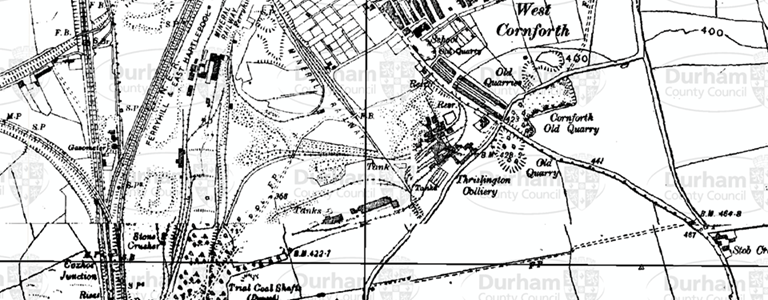 Dangerous Act - Three Youths Fined for Riding on Tubs.
At Spennymoor Police Court today, John Courtney (21), of Brewery Cottages, Ferryhill, Thomas Bradley (16), and John Laidlow (21), of West Cornforth, were charged under the Coal Mines Act of 1911, with riding upon the set at Thrislington Colliery.
Mr E B Proud, of Bishop Auckland, prosecuting on behalf of the North Bitchburn Coal Co., said the bench would remember a similar case on April1 when a stern warning was issued against this dangerous practice.
The road upon which the set ran at parts had a clearance of less than a foot.
During the past three weeks there had been two serious smashes with this set. In one case a coupling broke and 10 tubs were reduced to matchwood.
Defendants were each fined 40s, the chairman remarking that they were endangering their lives and the lives of others.
(27th May 1930 Newcastle Evening Chronicle)
“Short of Cash” - Spennymoor Painter’s Plea in Court.
At Spennymoor Police Court today, John Morgan (70), painter and decorator, of 16, Cheapside, Spennymoor, was charged with failing to pay National Health and Unemployment Insurance contributions in respect of an employee named Bradford.
Mr A R Farlam, divisional inspector, of Darlington, prosecuting on behalf of the Ministry of Health, said that the arrears were incurred last year. Repeated applications had been made to defendant and in November last he signed a declaration agreeing to pay £5 per month. Actually £9 had been paid, leaving a balance of £9 19s 6d. Applications had been made for payment of this amount without result.
Morgan in defence said he had been short of cash, but if given time he would pay. An order was made for Morgan to pay the amount £9 9s 6d, and £1 5s 2d costs, within one month.
(13th May 1930 Newcastle Evening Chronicle)
John Morgan (b1861 Tow Law) was the son of John Morgan (1834-1900 Staindrop) and Jane Johnson (1833-1899). He had six siblings Thomas (b1857 Wolsinhgham), Jane (b1859 Wolsingham), William (b1867 Tow Law), Robert (b1870 Tow Law), Annie Elizabeth (b1873 Tow Law) and Florence Edith (b1875 Tow Law). In 1861 the family are at High Stoop, Wolsingham where John snr is a master painter.
By 1871 they are living at High Street, Tow Law where John snr is employing one man and a boy who is apprenticed and living with them.
In 1881 they are at 39 High Street, Tow Law, John snr is a painter, plumber and publican, his son John (1861) is a painter and plumber.
In 1888 John (1861) married Margaret Mason (b1861 Spennymoor), he had followed his brother Thomas to Spennymoor to set up in business at 27 King Street, Tudhoe Grange. John and Margaret had four children, Lilian (b1890 Tudhoe Grange), John (b1891), Florence Annie (b1893), and Olive (b1895), sadly Margaret died in 1896.
 Business seemed to be expanding and the family moved to 16 Cheapside, John advertises for a painter in 1896 and six painters/paperhangers in both 1898 and 1899.
Click on the photo to see Cheapside in 1900s, it appears to match the 1901 census: John Morgan's shop at 16 Cheapside is on the left, Noah Bennett, general dealer at 17, Alfred J Corbett, jeweller, at 18, John Simpson, fruit merchant, at 19, John Boustead at the Grand Hotel. (Tony Coia & George Teasdale).
John remarries in 1899 to Minnie Maddison and they have four children Thomas (b1900), Minnie (b1901), Eleanor (b1904) and Ethel Mary (b1905).
Kelly’s Directory in 1902 states:- 16 Cheapside - John Morgan, registered plumber, gas and water fitter, hot water engineer, electrician and telephone. Bell fitter, decorative painter, gilder and sign writer etc.
In 1921 John and Minnie are still at 16 Cheapside, John is a registered plumber, painter and decorator. Their son John is away at school in Aberdeen and daughter Minnie is a clerk at a solicitors in Bishop Auckland.
John died in 1935 and Minnie in 1937.
In 1913 John (1891), a painter and decorator, married Elizabeth Jane Walker and had two children Wilfred and John Thomas. In 1921 they are living at 2 Belle Vue Terrace, and they have three more children, George (b1922), Olive (b1924), and Doreen (b1926).
-----
Thomas Morgan (1857) - In 1881 John’s brother, Thomas (1857), had already set up as a painter in Spennymoor. He married Mary Alice Henderson (b1859 Lanchester) in 1880 and they were living at Durham Road, Tudhoe Grange (Spennymoor).
Bennetts Directory 1888 - Thomas Morgan, 49 High Street – House and church decorator, paperhanger, glazier, sign and ornamental writer, plumber, gas and water fitter, bell-hanger, etc. Wall papers in great variety.
By 1891 they have one son Thomas and three daughters, Mary Jane, Annie, and Maggie, a further daughter Alice was born in 1893.
25th March 1897 Daily Gazette for Middlesbrough
Signwriter (good) Wanted; grainer, paperhanger; constant work steady man. Apply Thomas Morgan, 49, High-street, Spennymoor.
Sadly Thomas died in 1899, aged 41.
Sudden Death of Mr Thomas Morgan of Spennymoor
We regret to record the death of Mr Thomas Morgan, plumber, painter, and decorator, Spennymoor, which took place on Saturday morning at his residence, 47, High-street, Spennymoor. Mr Morgan appeared to be in his usual health till two or three days ago, but nothing was thought serious about him, and the end was never dreamt of being so near. Death is said to have been caused by a paralytic stroke. Deceased was highly respected, and was noted as a first-class workman in every branch of his profession. He leaves a widow and family of one son and four daughters.
(30th January 1899 Northern Echo)
In 1901 Mary Ann and Thomas jnr are running the painting and plumbing business. Thomas has the contract as painter and plumber for the new Working Men’s Club in Tudhoe Grange.
Household Recipes
Swiss Pancakes
Ingredients: Half a pint of milk, 1oz flour, 1oz sugar, two small eggs.
Method: Beat eggs, add sugar and flour, then milk. Well butter saucers, pour in mixture, bake in quick oven 15 minutes, or until set, place on dish, add a little jam and fold over.
Mrs T Robinson, Low Spennymoor.
Granny Loaf
Ingredients: One pound flour, 1/4lb butter, 1/2lb demerara sugar, 1/4lb peel, 1/2lb currants. 1/2lb sultanas, two eggs, two tablespoonsful treacle, two teaspoonsful of baking powder.
Method; Mix dry ingredients, rub in butter, add beaten eggs, treacle and a little milk, bake in slow oven; makes two nice-sized loaves.
Mrs T Robinson, Low Spennymoor.
(12th April 1930 Northern Weekly Gazette)
 Joy of Dance
“Chronicle’s” Help at Spennymoor
Competitions promoted by the “Evening Chronicle” which were thoroughly enjoyed were a feature of a successful dance held in the New Town Hall, Spennymoor, last night, by the Spennymoor Kit-Cat Club.
Over 250 people were present and the proceeds were in aid of Durham County Hospital.
M.C.’s for the dancing were Mr J Vester and Mr R Kitching, and music was provided by the Fearnley Mitchell Band.
The prize winners in the “Evening Chronicle” competitions, which were arranged by Mr N Lewis, were:-
Paul Jones Mystery Dance – Miss D Kelly and Mr W Hall.
Spot Waltz – Mr J Freeman, Miss E Wilson, Mr R Dixon, Miss N Cuttle, Mr A Kenmir, Miss S Wardle.
Lucky Numbers – W J Goundry, M Pennent, J Coleman, J Howe, M Enderby, W Joyce, W Robinson, C Groves, H Williams, and P Smith.
(3rd April 1930 Newcastle Evening Chronicle)
Tudhoe Comic Opera
Tudhoe Amateur Operatic Society gave the first of five performances of the comic opera “The Count of Como,” in the Parochial Hall, Low Spennymoor, last night.
Mr N D Stitt was a success as Rudolph Count of Como, his baritone singing being a feature of the evening.
Other parts well taken were: Duke Otto, Geo. Sutton; Baron Stomboli, J S Drake; Alexsis, T Cummings; Capt. Grasso, G Kerry; Kropp, G Winter; Flammetta, Miss M Smith; Princess Silvia, Miss N Gilmore.
(30th April 1930 Newcastle Evening Chronicle)
 Clergyman in Crash
Motor-cycling at Ferryhill, yesterday afternoon, the Rev. S P Bywater, the Wesleyan Minister, came into collision with a boy who was playing with a top.
The minister was thrown from his cycle and received a bad wound on the temple. Unconscious, he was taken to a house in West Street. Dr Brown was sent for, and he took Mr Bywater to his home at Dunning Road, Ferryhill.
(6th April 1930 Sunday Sun Newcastle)
Ferryhill Fatality
A fatal accident occurred in the crowded streets at Ferryhill when people were returning from the jazz band contest at the carnival. A ‘bus, driven by R Williams, of Leeholme, had left Ferryhill on its way to Bishop Auckland, and when on its way through Lightfoot Terrace and Westcott Terrace at Dean Bank, swerved to miss some children who were crossing the road.
One of the children, Vera Johnson (4), of 14, Lightfoot Terrace, Dean Bank, a daughter of Mr John Johnson, a miner at the Dean and Chapter Colliery, was struck by the ‘bus and run over. She died before she reached the surgery of Dr Brown at Ferryhill village, to which she had been taken in a private car.
(28th April 1930 Newcastle Evening Chronicle)
Collision at Cross Roads - Darlington Man Badly Hurt.
A collision between a motor-bus and a moto-cycle occurred this afternoon on the Durham and Darlington Road at Thinford cross-roads. The bus, which was owned by the North-East Coast Co., of Spennymoor and driven by Allen Tolley, was proceeding to Coxhoe, and had almost crossed the junction at the road end when the motor-cycle, which was travelling from Ferryhill to Durham approached.
The bus struck the cycle, and the latter, with its driver, was pushed about 20 yards along the road in front of the bus, the rider’s face being dragged along the ground. He received severe injuries to the head and face, and was attended to at Sr Brown’s surgery at Ferryhill, afterwards being taken to Durham Hospital, where, from papers in his possession, he was identified as Frank Hammond, of Darlington. He was suffering from concussion and laceration of the face and head. The front wheel of the cycle was badly damaged.
(16th April 1930 Hartlepool Northern Daily Mail)
A Day With The Miner
This article is prompted by the question of the 7 1/2 Hours’ Act. Miners follow the most arduous and dangerous work of any class of workers. When a miner leaves the daylight and fresh air of the surface and descends into the mine workings he does so knowing only too well that, regardless of all the precautions he himself may take, he may not return to the surface again safe in limb and wind.
Many are the disastrous accidents caused alone through cages of men crashing to the bottom of the shaft. It makes one shudder to gaze down into that great yawning black hole into which miners have to descend daily to get to their work. When they step out of the cage into the level of the mine workings they have to traverse anything from half a mile up to three miles of dark, low, tortuous tunnels before reaching their working places.
The travelling is very bad, as the bottom is rough and uneven, and the height often less than four feet, and their only illumination is the feeble light from their safety oil lamps, which cast great shadows beyond the props and baulks of timber used for supporting the roof. In old collieries the coal seams are honeycombed with these tunnels, which all turn off from the main tunnel or “winning”, as it is called by miners, and each of these minor tunnels sub-divide into less tunnels, which in turn are called “gannings”. These “gannings” each terminate in a coal face, and it is here that the miner works his shift.
In places near the shaft the air is pretty good for the men to breathe and work in but when it reaches the far-off workings it has become dank and warm, and is permeated with gas and black damp, which poisons the miners’ lungs and half drugs their senses before they have been in the workings any length of time. So great is the want of oxygen their lamps will hardly burn, yet these miners have to work a shift hewing amongst it, to earn sufficient to feed and clothe themselves and their families.
Many of the coal seams are only two feet thick and some are even less. Here the coal hewers have to wield their pick-axes while lying on their sides or sitting cramped and crouched on small wooden stools or “crackets”, as they are called. They present weird spectacles stripped to the waist, wearing only a pair of short pants, their boots, and stockings; their bodies gleaming with sweat and showing great corded muscles, their legs grimed with coal dust, and their eyes glowing like burning orbs as they reflect the flickering light from the lamps hung on a prop about three feet from the coal face.
The air in places while the men are at work hewing or shovelling is filled with flying coal dust, which settles at the back of the throats of the men, making them continually long for a drink of water. Most of the coal hewers are tobacco-chewers, a habit which, when one sees the reason for it, is not so bad as it at first seems, the continual chewing of the tobacco and expectoration prevents the coal dust from getting into the miners’ mouths and settling in the back of their throats.
At the end of their shift, tired and weary, these miners are again faced with that tortuous journey through those long, low, dark corridors before they again reach the shaft bottom, where they are able to enter the cage, and return to the surface again.
“Soxi” Williams, Ferryhill
(26th April 1930 Northern Weekly Gazette)
 M.P. on Expensive Hairdressers - “Glad to Get Out as Cheaply as I Did”
A Bill for the compulsory closing of hairdressers’ and barbers’ shops on Sunday to-day came before a Standing Committee of the House of Commons.
After one or two minor amendments had been agreed to, the committee stage was concluded, and the measure was ordered to be reported to the House for third reading.
Mr Stewart moved am amendment to enable a hairdresser or barber to attend residents in hotels on Sunday as well as persons “in any place” who are suffering from bodily or mental infirmity.
Mr Anthony Somervill (C., Windsor) suggested that the Bill, even with this amendment, would create inconvenience. “If” he said, “the member for Bridgeton (Mr Maxton), returning on Saturday night from an enthusiastic internationalist meeting on the Continent, wanted his locks attended to on Sunday, he would have to book a room at an hotel.” (Laughter)
Mr Batey (Lab., Spennymoor) declared that the public needed protection against the “sharks” who ran some of the hairdressing establishments in London. “You can’t get out of them unless you have a pocketful of money,” he remarked, amid laughter.
Durham M.P.’s Experience
Recounting a personal experience, Mr Batey said: “It cost me 3s 6d, and I was glad to get out as cheaply as that”.
Mentioning the case of a Scotsman who visited a Soho hairdresser’s, he said: “He came back to the hotel all in a sweat, and said he had had a devil of a job to get out of the shop.” (Laughter)
Mr Womersley (C., Grimsby) suggested that the proposed exemption should be extended to ships, and Mr Glassey (L., Dorset) asked that clubs also should be included.
Mr Stewart said he was willing to include ships, but he drew the line at clubs.
Eventually the amendment was altered so as to include seagoing ships, and it was the agreed to.
(8th April 1930 Hartlepool Northern Daily Mail)
 Relief From Two Unions
“Downright Fraud on Ratepayers”
Gaol For Byers Green Man.
“This is nothing but a downright fraud on the ratepayers.” Declared Mr H E Ferens at Durham to-day, when George Temperley (29), was sent to prison for three months for obtaining relief by false pretences.
Temperley admitted having been committed to prison for 28 days for a similar offence in 1928.
Mr Ferens explained that Temperley was living at Back Lodge Street, Byers Green, and his parents resided at Bessemer Terrace, Spennymoor. In December he went to the Bishop Auckland and Durham Unions, gave the respective addresses at Byers Green and Spennymoor, and drew money for his wife and three children from each union. He continued to draw the money for at least five consecutive weeks, receiving 18s per week from the Auckland Union and 18s from Durham.
Separated From Wife
Mr Ferens said Temperley’s wife had obtained a separation on March 11 and Temperley had continued to draw money in respect of her.
Temperley’s appeal for a chance to pay back the money at the rate of 20s per week was met by a stern “No, not at all” from the chairman (Brig. General H Conyers Surtees).
The wife and children were at present being looked after by the Auckland Union.
(2nd April 1930 Newcastle Evening Chronicle/Hartlepool Northern Daily Mail)
Ernest Dee Hanson (17), of Hagg Road, Byers Green, was charged at Spennymoor to-day with stealing 3s 6d., the property of the London and North Eastern Railway Company, from Byers Green station. It was taken from the ticket office when the man in charge was out. Hanson was stated to have said to P.C. Mann. “I went to Bishop Auckland and had a good feed, and bought some cigarettes with the money.”
He was bound over for 12 months and ordered to pay 5s towards the costs.
(22nd April 1930 Newcastle Evening Chronicle )
Betting Slips - Pensions Hospital Patient Fined
A Dunston Hill War Pensions Hospital patient who, to oblige his fellow-patients, took a packet of betting slips to Newcastle with him on his afternoon out, was fined £5.
George Charles Griffiths, 38, of Byers Green, was accused of receiving bets at Dunston Hill on April 3rd.
A police constable said he was waiting outside the hospital with another officer when he saw Griffiths walking in the hospital grounds with another patient following him. A few minutes later the patient handed Griffiths a piece of paper and what appeared to be money.
He continued his watch and Griffiths again came down the hospital grounds, followed by a patient.
Once more something was passed to Griffiths and they separated.
A few minutes later Griffiths came out of this hospital grounds and walked down the road.
The officer stopped and questioned him and told him he would be taken to the police station and he answered “Just as you like.”
It was stated that 16 betting slips and a sum of money were found on Griffiths.
“I did it to oblige the boys,” was Griffiths’ plea. “As soon as I knew I had done wrong I told the authorities and I was sent out of the hospital.”
(26th April 1930 Blaydon Courier)
Ferryhill
A Boy’s Theft – The state of a boy’s mind came under discussion at Durham Police Court to-day when Bertie Pocklington (16), of Chilton, was sent to prison for three months for stealing a bicycle from the Miners’ Institute at Ferryhill on April 21. The chairman (Mr T F Brass) remarked to the father: “Unfortunately we can’t give him more. I hop when he comes out you will play the man with him.”
Pocklington said he only borrowed the bicycle. Supt. Foster stated that the doctor reported that Pocklington’s case was on the border line. He was of low intelligence and appeared to have been affected by his own home conditions and surroundings. The doctor, however, did not think he was certifiable. He was one of 11 children.
(30th April 1930 Hartlepool Northern Daily Mail)
 Fined at Spennymoor
The Spennymoor magistrates yesterday imposed a fine of 20s including costs, on David Wren (25), of Derby Street, West Hartlepool, for having caused an obstruction of the highway at Manor Corner, in Broom Road, Ferryhill, on April 18, by leaving his motor-bus unattended for 20 minutes. It was stated that the obstruction caused considerable inconvenience to passing motorists, as the road at this particular point was not very wide.
(30th April 1930 Hartlepool Northern Daily Mail)
 Tub Riding in Pit - Spennymoor Branch and a Dangerous Practice.
Arthur B Smith, of Bessemer Terrace, Mount Pleasant, Spennymoor, was fined 40s at Spennymoor Police Court to-day for riding on a tub at Thrislington Colliery.
The chairman (Mr A Beresford Kane) said the Bench looked on this breach of the rule as serious. Smith had endangered not only his own life but that of others, and they imposed a severe penalty as a warning.
Mr Proud, of Bishop Auckland, prosecuting, said leniency had been shown in a similar case brought recently before the Durham Justices, but it had not been taken advantage of.
Smith said he was a run rider and, as such, was allowed to ride on the set.
(1st April 1930 Newcastle Evening Chronicle)
Died at End of Shift
The death occurred in the mine at Tudhoe Colliery early to-day of Mr Stephen Amos (56), shifter, Upper Church Street, Low Spennymoor. He had completed his shift and was on the road outbye when he complained of being ill and died immediately. Mr Amos leaves a widow and a grown-up family, one of whom is Mr Glen Amos, a “North Mail” scholarship winner last year, and who is now in Canada.
(14th April 1930 Newcastle Evening Chronicle)
Imprisoned by Fall of Stone - Timely Rescue in Ferryhill Pit
Many acts of heroism in the mine occur which are not heard of at the time of happening. At Dean and Chapter Colliery, Ferryhill, there was a case in point last Thursday when a fall of stone took place fully 30 yards long in the Harvey seam, by which three men were imprisoned, the air being completely cut off.
Strenuous efforts to rescue them were made, but with small progress until two overmen, Wrightson and Welsh, began working their way through an old road, pushing their lamps before them and pulling themselves along on their stomachs. They came to a place near the imprisoned men, which they broke through, and effected a rescue, just in time.
The three men were gasping for breath and very much exhausted when reached by the overmen, whose clear insight and quick action saved their lives.
(21st April 1930 Hartlepool Northern Daily Mail)
Robert Whitehead
Whilst repairing the shaft at Dean and Chapter Colliery at Ferryhill, yesterday, a shaftsman, Robert Whitehead, aged about 60, slipped from the cage upon which he had been standing and fell to the bottom of the shaft. He was killed instantly.
(3rd March 1930 Blyth News)
Ferryhill Pit Lad Killed
Samuel Hardy (17), of Newton Street, Dean Bank, was killed by a fall of stone in No2 Pit at Dean and Chapter Colliery, Ferryhill, today. The colliery was laid idle for the remainder of the day in consequence.
(26th March 1930 Newcastle Evening Chronicle)
Spennymoor Cyclist Injured
While cycling to his work at Thrislington Colliery, West Cornforth, Wm. Nutter (21), of Church Street, Spennymoor, in order to avoid colliding with a child, put his brakes on sharply, and he was flung over the handlebars of his machine, and his face and ands were lacerated. One of his eyes was also injured.
(5th March 1930 Newcastle Evening Chronicle)
Ferryhill Fatality
Benjamin Dixon (74), a retired miner, who had been lodging with his daughter, Mrs Buston, of Bessemer Street, Dean Bank, left his home to-day in a dazed condition. Not returning for breakfast a search was made, and his body was found in the reservoir at Dicky Pit, near Dean and Chapter Colliery, Ferryhill.
(5th March 1930 Newcastle Evening Chronicle)
 Workmen’s Narrow Escape - Vehicle Wrecked
Bus Smash Near Spennymoor
A number of workmen narrowly escaped serious injury in a bus smash near Spennymoor early this morning.
A bus containing 22 workmen, owned by Messrs. Hodgson and Son, of Tindle Crescent, and driven by George Bradley, was proceeding from Spennymoor to Mainsforth Colliery, and when near Red Hall Farm, at the foot of Ferryhill bank it skidded on the snow-bound ground, crashed into some stone pailings and iron rails at the side of the road, and overturned on to the Ferryhill road below, coming to rest within four feet of some railings beyond which was a drop of twenty feet.
The bus was wrecked, and the force of the impact was so severe that the front wheels were completely wrenched from the chassis.
Another bus, which was following, pulled up, and the men were rescued from the rear of the bus. They were conveyed in te second bus to Mainsforth Colliery, where they were attended to by Dr Aitken. He ordered Frederick Curl/Keirl (17), of George Street, Spennymoor, suffering from scalp wounds, and A E Carling (49), of The Cottages, Tudhoe Village, suffering from injuries to the shoulder, to the Durham County Hospital.
Carling was detained and Curl/Keirl was allowed to proceed home after treatment. The rest of the workmen returned to their homes.
(11th March 1930 Hartlepool Northern Daily Mail)
Town Hall Boxing Ban - Petition to Spennymoor Urban Council
A petition, signed by over 600 local boxing enthusiasts, has been placed before the Spennymoor Urban Council asking for the removal of the ban on boxing contests at the Town Hall.
The Council allowed the use of their hall for weekly contests for a period of two or three months, but permission has now been withdrawn. The Council have decided to reconsider the matter in committee.
(1st March 1930 Yorkshire Post and Leeds Intelligence)
 Ferryhill Musician - Noted Bandmaster Who Scored Many Successes.
Mr John Hutchinson, who has died at Ferryhill, aged 62, was in the early “Eighties” very successful as a cornet player, winning many honours in the three Northern counties.
As a bandmaster he led three local bands Mainsforth Colliery, Coxhoe, and Spennymoor Temperance, to success.
His son William bids fair to follow up the successes of his father, as he has already won several prizes, and is solo cornet in the Pavilion Theatre, Ferryhill.
(13th March 1930 Newcastle Evening Chronicle)
Ferryhill Musician’s Golden Wedding
Mr Thomas Snowdon, who with his wife will celebrate his golden wedding at his aged miner’s home at Ferryhill tomorrow, early gave signs of being a musical prodigy.
As a child he showed remarkable musical ability and was made conductor of the Tudhoe Colliery Band when little more than 18. That was in the early seventies and for many years every band in the Ferryhill district sought his aid.
Twenty-five years ago Mr Snowdon had an accident at Tudhoe Colliery in which he lost all his teeth, and he has been unable to play an instrument since. He is now in his 78th year, Mrs Snowden being a few years younger.
Mr Snowden went to Dean and Chapter Colliery 22 years ago and worked in the lamp cabin for 20 years. He is now retired. The couple have no family.
(15th March 1930 Newcastle Evening Chronicle)
Ushaw Moor Concert
“The Vagabonds” a Spennymoor concert party, including W Jameson, A Pratt, W Claughlan, M Charlton, B Readhead, G Button, pianist and F Reavley, secretary, gave a humorous entertainment in Ushaw Moor Primitive Methodist Church last night. Mr E Mordecai, of Bearpark, presided. The proceeds were in aid of Trust Funds.
(27th March 1930 Newcastle Evening Chronicle)
Spennymoor Plans
Plans for a new Kinema at Spennymoor, Co. Durham, are being prepared by Hays and Gray, chartered architects, of Central Chambers, Wingate, Durham. The seating capacity will be in the neighbourhood of 1,000.
(27th March 1930 Kinematograph Weekly)
Stole 94 White Mice - Boy’s Escapade at Spennymoor
The story of a boy of 13 who stole 94 white mice, sold them. And paid for a music lesson and treated his friends to a feed in a café, was told at Spennymoor Police Court to-day.
The box containing the white mice was on a table in court.
The boy was charged with stealing the mice from a hut on an allotment belonging to Joseph Laws.
It was stated that the boy’s father gave him the money for his music lesson, but he spent it, and stole the mice with the intention of selling them to replace the money. In addition to paying for the lesson he treated his friends.
The boy was bound over for two years in the sum of £2 and placed under the care of the probation officer.
(4th March 1930 Newcastle Evening Chronicle)
 Spennymoor ‘Bus Overloaded
At Spennymoor Police Court, today, Jon Shaw (24) of West-End Farm, Byers Green, was charged with having overloaded a ‘bus. Sergt. Dunn said a ‘bus driven by the defendant contained 29 passengers, though it was only licensed to carry 14. A fine of 20s was imposed.
(11th March 1930 Newcastle Evening Chronicle)
Rate Defaulters at Spennymoor.
Thirty-five persons were summoned at Spennymoor Police Court, today, for nonpayment of rates. The amounts owing ranged from £4 to £70. Distress warrants were issued. In some cases, the warrants were held over so long as a fixed weekly payment was made.
(11th March 1930 Newcastle Evening Chronicle)
Guardians to “Pass Over” at Midnight - Dawn of New Poor Law Era After 100 Years Service
Farewell to a passing Poor Law age! At the strike of midnight tonight, the 635 Boards of Guardians throughout the country will cease to exist after a useful “life” of nearly 100 years, and their duties will pass to county and county borough councils.
(31st March 1930 Newcastle Evening Chronicle)
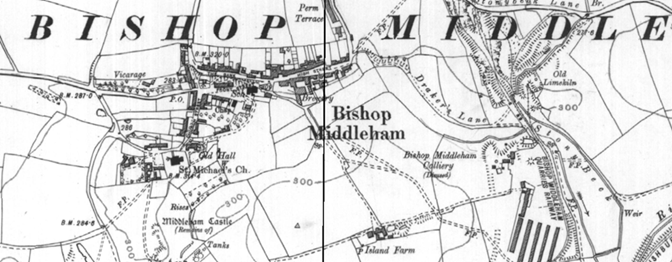 Wife’s Premonition of Ferryhill Explosion.
Husband Escapes, But Son Injured in Mystery Pit Accident.
Banksman’s Cabin Hurled From Shafthead
A Remarkable story of a dream premonition was told to-day by the mother of one of the four men injured in the mystery explosion during the night at Bishop Middleham Pit, Ferryhill.
She had persuaded her husband to stay away on account of the dream, but her son went to the pit as usual and was hurt.
Only six men fortunately were at work on recovery duties at the time of the explosion, which hurled the cabin at the top of the shaft bodily 12 yards away.
Recovery Work
Pit Lying Idle for 50 Years
The men injured were:
William Hodgson, chargeman, Insular Cottages, Bishop Middleham;
Thomas Spence (25), stoneman, Craddock Street, Spennymoor;
Arthur Coulson (17), putter, 2, Council Houses, Bishop Middleham;
Thomas Cook, banksman, Railway Cottages, Ferryhill Station.
Hodgson, Spence and Coulson were admitted to Durham County Hospital suffering from burns to the face, hands, and legs. Cook, who was working at the top of the shaft when the accident occurred was injured by flying splinters, but was able to go home after receiving first-aid.
Coulson and Spence, it is stated. Are the more seriously hurt. Mrs Hodgson told an “Evening Chronicle” representative that her husband had had his moustache, eyebrows, and part of his hair burned off.
Complete Mystery
None of the men can offer any explanation of the accident. They say there was a flash and a terrific explosion followed by dense and pungent fumes.
The pit is a small one owned by Messrs. Dorman Long and Co. and attached to the Mainsforth Colliery. It has lain idle for fifty years, but about two years ago, recovery work was begun, and is still proceeding. No shot firing was being carried out, which makes the explosion more puzzling.
The six men working in the pit-the three treated at the hospital and others named Thomas Adamson, Val Ebden and Joe Nicholson, all of Bishop Middleham-descended the shaft at about 11 o’clock leaving Cook, the banksman, at the pithead. The report of the explosion, which startled the whole neighbourhood, being heard as far as Coxhoe, five miles away, came about half an hour later.
Rescue Parties’ Rush
There was at once a rush to the pithead. It was found that a cabin had been hurled for a distance of about 12 yards, and woodwork at the top of the shaft thrown in all directions.
Fortunately, when the cage was lowered, it was found that the six men below were able to get to bank without ny outside assistance.
The local rescue brigade at Crook was called out, to be joined later by those from Houghton-le-Spring and Scotswood, but happily their services were not required.
The injured men were hurried off to Durham in the ambulances and were admitted to the hospital there within two hours of the explosion while the others were taken home.
Later Mr F P Mills, the Chief Officer of the Rescue Brigades, descended te mine to investigate the possibility of a fire but reported that there was no danger on that head.
Hodgson, Spence and Coulson were all stated at Durham Hospital to-day to be progressing favourably.
The story of the premonitory dream was told by Coulson’s mother. “On Friday night,” she said, “I dreamed of a pit explosion, and persuaded my husband, who also is a miner, not to go to work. He did not, but I little thought that my son would be the victim of an accident I dreamed about.
Coulson said that with Hodgson and Spence he was going away from the pit bottom when the explosion occurred.
“I was going in-bye to have a look at the big drift,” he continued, “and the next thing I knew was a flash. I was knocked against the wall, and picked myself up. It seemed to me as if there had been a fall of stone.
Cabin Lifted Bodily
Cook, the banksman, told an “Evening Chronicle” reporter that shortly after 11.30 he was working at the pit head chalking numbers on the board when there was a loud explosion.
“I was lifted right off my feet,” he said, “and flung to the ground among a pile of fallen woodwork. I was severely bruised on the right arm and the left shoulder. The banksman’s cabin, a wooden structure, was lifted bodily from its position, and thrown on to its side.
“When I pulled myself together I saw smoke pouring from the shaft. We sought help, and in a few minutes people who had heard the explosion were on the scene giving their aid.”
Spence is understood to have stated that he noticed a smell of gas at the time of the accident.
Since 1909, the year of the West Stanley disaster-when 168 lives were lost-colliery explosions in Durham on a large scale have been infrequent. After that disaster Colonel W C Blackett. Of Durham, the mining expert, along with three other investigators, conducted experiments in various drifts, and a coal dust theory was hit upon. Working on it, stone dust is scattered over the coal face, particularly at points where explosions are likely to occur, and has proved effective in keeping down disasters.
(3rd March 1930 Newcastle Evening Chronicle)
Sadly Joseph Spence died on the 6th March, his inquest was reported.
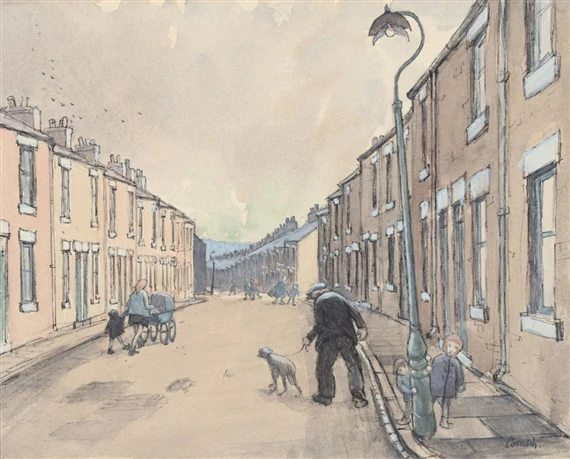 Painful Scene at Durham Inquest.
Injured Miner Collapses in Court.
The inquest on Joseph Spence (24), of Craddock Street, Spennymoor, who with three other men, was injured in the explosion at the Bishop Middleham pit on March 2, and who died four days later, was resumed to-day.
Spence and the other men were engaged in the workings at the time of the explosion, and were thrown down by its force. Spence, Arthur Coulson, stoneman, and Wm. Hodgson, chargeman were taken to the County Hospital, Durham, where Spence died.
Whilst Mr Frank Widdas, of Mainsforth, who was manager at Bishop Middleham Colliery until January last, was giving evidence, William Hodgson, who had been in hospital since the accident, and who was still wearing the hospital dress, was carried by two police officers into the room where the inquest was being held. He bore traces of his alarming underground experience, and seemed in considerable pain.
“Ought not to have been here”
Later he appeared to collapse, and Mr James Robson, President of the Durham Miners’ Association, who was attending the inquest, exclaimed, “That man ought not to have been here. Who asked him to be present?”
The Deputy-Coroner (Mr Boulton): I asked him to be present.
Mr Robson: The doctor ought not to have authorised it.
Mr Boulton: He would naturally not leave the hospital before he was examined by a doctor.
Mr Robson: Was the doctor asked to examine him?
Mr Boulton: That I don’t know.
Hodgson was then carried out of the room in a state of collapse, his burnt hands trembling, and, after being seen by the Deputy-Coroner, was conveyed back to hospital.
(27th March 1930 Hartlepool Northern Daily Mail)
Bishop Middleham Pit Fatality - Adjourned Inquest. - Negative Tests for Gas.
Adjourned several weeks ago because of the sudden collapse of an important witness, the inquiry was renewed by Mr A E Bolton and a jury at Durham this afternoon into the death of Thomas Spence (24), a miner, of Craddock Street, Spennymoor, who received fatal injuries in an explosion which occurred at Bishop Middleham Colliery on March 2.
At the previous hearing William Hodgson, one of three other men injured, collapsed in court while waiting to give evidence. It was stated in evidence that one of the safety lamps forwarded from the colliery to the mining testing station at Sheffield was discovered to be defective.
The first witness to-day was Frederick J Ford, a master shifter, of Commercial Street, Chilton Lane, who stated that the whole Hutton Field Seam was exposed on March 1. He tested for gas, but found none.
Lamps Examined.
Witness said the fan was working when he left on Saturday morning, but he knew it would be stopped at the weekend. The ventilation was splendid.
Valentine Ebdon, Durham, gave evidence that at the time of the explosion he was working as stoneman. He descended the mine with Deputy-Overman Hodgson, and at the first bottom both safety lamps were examined. Witnesses’s lamp was properly locked and in order. Hodgson tested for gas at the next bottom, but there was none. The other men also came down the shafts, and their lamps were examined also. The explosion occurred seven or eight minutes afterwards.
Spence was found under the West cliff, where Hodgson was badly hurt.
The jury returned a verdict that Spence died from internal congestion brought about by burns accidentally received while following his employment.
The Coroner, in reply to Mr Robson, said there was evidence of neglect of duty, and he asked the jury to say whether or not the ventilation was adequate, and whether they were satisfied that no examination was made of the rising drift before the men went into that place.
The jury answered both questions in the affirmative.
(22nd May 1930 Hartlepool Northern Daily Mail)
Joseph was buried in Rock Road Cemetery.
For further information about Joseph Spence and the explosion go to Durham Mining Museum
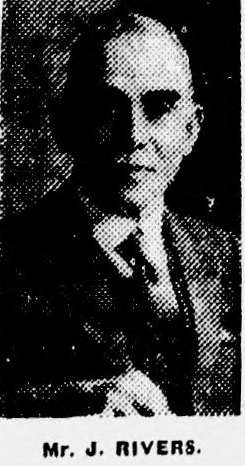 From Pit Boy To Manager - Thornley Official Who is Retiring
Acting on medical advice, Mr John Rivers has decided to retire at the end of the present month from his post of manager of Thornley Colliery.
Mr Rivers has been manager for nine years, succeeding to the appointment on the death of Mr G A Curry. Previously he was under manager at Thornley Colliery.
Mr Rivers is the son of a miner, and started his pit life as a trapper boy at Tudhoe Colliery. Attending night schools and science classes as opportunity afforded he eventually obtained his colliery manager’s certificate, and was transferred to Thornley Colliery, owned by the same company.
At Thornley Mr Rivers has taken a deep interest in public affairs, having sat on the Parish Council and the Easington Rural District Council. He is now chairman of the Thornley Miners’ Welfare Committee and the Thornley Aged Miners’ Homes Committee. He has also been closely associated with the Thornley Primitive Methodist Church.
(27th March 1930 Newcastle Evening Chronicle)
E Siddle Recipes - Baked Haricot Beans
Ingredients: One pint of haricot beans, 1/2lib. Of pickled pork, salt and pepper to taste.
Method: Soak the beans in cold water over night, then boil them for about half an hour until they begin to split. Drain the water off, then put a good thick layer of beans at the bottom of a quart earthenware jar. The fix 1/2lb. of pickled pork, and then surround it with the rest of the beans. Sprinkle with salt and fill up the jar with boiling water. Place in a medium oven all day. By evening the dish will be ready. Add a little boiling water-as the liquid in the jar dries up-but not during the last hour and a half, as it will spoil the colour of the beans. Serve pork with the beans piled up around it.
E Siddle, Spennymoor.
(22nd March 1930 Northern Weekly Gazette)
Liver Pie
Ingredients: 1lb. of pig’s liver, 1lb. of potatoes, one onion, quarter of teaspoonful sage, some apple sauce, pepper and salt to taste.
Method: Wash and dry the liver, then cut it into slices, then peel and cut the onion into small discs. Slice potatoes. Place a layer of potatoes in a greased pie-dish, cover with slices of liver, and sprinkle on top with sliced onion and sage.
Repeat layers until the dish is full, making the top layer one of potatoes. Fill up the dish with water and cover with grease-proof paper, and cook in a moderate oven slowly for about two hours. Towards the end of cooking remove the paper so that the potatoes may turn brown. E Siddle, Low Spennymoor.
(29th March 1930 Northern Weekly Gazette)
Miner Transferred Into Farmer - Ferryhill man’s Quest in Canada.
A Ferryhill miner, Mr Thomas Hopps, has already achieved notable success as a farmer in Canada, even though he went there only two years ago.
“I write now as a Canadian farmer, and one who is making good progress,” he writes in “Winning Through”. The magazine of the Migration Department. “Two years ago, however, I was a miner in the Durham coal mines.”
“My wife said ‘Just think how hard it is to pay our way, and if all we hear is true, and we do get what the Government says we will get, well then I say let us pack up and go.’”
So the couple decided to venture forth to Canada, and after describing the journey there Mr Hopps says:
“At last imagine our delight at seeing, not the old shack we expected, but a comfortable place that could be made into a real home.”
“I cleared and broke 21 acres last year and cleared about 20 acres this fall.”
Mr Hopps says they had only £14 when they landeed in Canada.
Wife’s One Regret
Mr Hopps’ wife also writes:- “My only regret is that I did not come years since. My children are healthier and there are always plenty of good things to eat-good butter, fresh milk, eggs, plenty of home-grown vegetables, also a plentiful supply of canned fruit in the winter and fresh fruit in the summer.”
“Perhaps if some of our old country friends could see our table at meal time, it woul mean thousands of more immigrants.”
“We have made 200 dollars from four cows, also kept the house in butter and cream, sold 270 dollars’ worth of pigs and got 40 dollars for two steers I hand fed.”
(19th March 1930 Newcastle Evening Chronicle)
 Village for Sale - Durham Colliery Lease Extended
The whole of the mining village of Page Bank, Spennymoor (County Durham) is to be offered for sale this month by Messrs. James Turnbull and Son, of Chester-le-Street.
Village for Sale - Durham Colliery Lease Extended
The whole of the mining village of Page Bank, Spennymoor (County Durham) is to be offered for sale this month by Messrs. James Turnbull and Son, of Chester-le-Street.
The property to be disposed of comprises 170 dwelling houses, occupied by miners and their families, all of whom were formerly employed at the colliery belonging to Messrs. Dorman, Long and Co., in connexion with which the village was erected. It was announced some time ago that the colliery was to be closed definitely, as the original term of the colliery company’s lease had expired, and that the colliery, brickworks, and farms would be included in the sale.
It is now known, however, that the lease has been extended, and that nothing except the dwelling-houses will be offered for sale. This is regarded as a favourable sign that the colliery may yet again resume operations of a more or less normal basis.
(7th March 1930 Shields Daily News)
 Colliery Village Sold - Four-Roomed Houses at £17 each.
The Durham County colliery village of Page Bank-or practically the whole of it, according to the auctioneers’ catalogue-was sold at Durham on Wednesday.
The 170 house, the great majority of which were occupied by colliery employees, realised the total sum of £6,912 10s., or an average of slightly more than £40 per dwelling.
The houses were generally offered in lots of from 3 to 13, but there were instances of single dwellings being put up, and one of these, a five-roomed house in East Terrace, realised £110-the top figure. The lowest price realised was £225 for 13 four-roomed houses in Old Row, the average being slightly more than £17.
Many of the present occupants purchased the houses.
Originally the colliery, colliery brickworks, and farm were included in the sale but they were withdrawn owing to an extension of lease having been obtained.
The auction was conducted by Messrs. James Turnbull and Sons, of Chester-le-Street, under the direction of Mr J C Fenwick, the well-known Weardale landowner, who resides at Embleton Hall, Longframlington.
The auctioneer, Lt.-Col. J Turnbull, alluded to the toll bridge of the village, and said it was hoped in the event of the colliery closing down that negotiations might be entered into by a private concern to acquire the bridge. It must be presumed that the toll would be continued so long as Messrs. Dorman, Long and Co., the owners of Page Bank Colliery, and the railway company retained their interest.
There was no truth in the rumour, added Col. Turnbull, that the colliery was being worked at present for the purpose of the sale. The colliery would be carried on for an indefinite period-certainly for one year-and they were not without hope that it would be continued for a longer period, although no guarantee could be given.
There was a large attendance at the sale, which was held in the Three Tuns Hotel.
(28th March 1930 Chester-le-Street Chronicle)
In 1931
Durham Colliery to be Dismantled - Village Loses Only Source of Employment
It has been decided to close down Page Bank Colliery, near Spennymoor (County Durham) during the next few days, and the reduced staff of workmen employed there are already working out their notices.
The colliery has been worked during the last twelve months on a short lease extension, granted last year when the long-term lease on the colliery and the village of Page Bank expired. At that time the whole of the village, comprising about 170 houses, was sold to a number of different purchasers, and the position now is that the village community of several hundred people will be almost entirely destitute of any sort of employment. In effect it will be a village existing almost entirely upon unemployment benefit.
It is understood that the original intention arrived at a year ago to dismantle the colliery will now be proceeded with.
(2nd May 1931 Grimsby Daily Telegraph)
 Proposal to Demolish Bridge Over Wear - Willington Effort to Save It.
The owners of the bridge over the Wear at Page Bank Colliery, Messrs Dorman, Long and Co., propose to demolish it now that the colliery is being dismantled.
This would be a great loss to the district as the bridge connects the township of Willington and Page bank with Spennymoor and the Willington Urban District Council on Tuesday night decided to ask Messrs. Dorman, Long and Co. what price they would take for it.
It was also decided to ask Spennymoor and Bishop Auckland Urban District Councils to share the cost of the purchase.
(14th August 1931 Seaham Weekly News)
 Page Bank Colliery. - Offered with Farm, but Only Fitting Shop Sold.
Page Bank Colliery, near Spennymoor, with Low Field Farm, small buildings etc., was put up for public auction ay the Three Tuns Hotel, Durham, yesterday, and of the 10 lots offered, only one was sold, this being the fitting shop, which went to Mr H Dixon, of Page Bank, for £40.
Page Bank Brickworks, which comprises the colliery, brickworks and a brickfield, was withdrawn at £280.
Liet. Colonel J Turnbull (auctioneer), of Chester-le-Street, said they were endeavouring to clear up the sale of all properties belonging to Mr J C Fenwick in that vicinity. There were several attractive lots, in spite of depressed conditions, and he was optimistic enough to think there would be an improvement in industry.
It may be recalled that many dwelling-houses in the village of Page bank were disposed of some time ago.
(25th September 1931 Newcastle Daily Chronicle)
The village did continue, with employment being found in the surrounding area. However Durham County Council designated it a Category D village and after floods in 1960s the community moved away.
For more photos go to Page Bank photos.
 Bishop’s Advice - Dr Henson and the Candle of the Lord.
At the Annual speech day of the Alderman Wraith Secondary School at Spennymoor, on Friday evening, County Councillor T W Penfold presided.
Bishop’s Advice - Dr Henson and the Candle of the Lord.
At the Annual speech day of the Alderman Wraith Secondary School at Spennymoor, on Friday evening, County Councillor T W Penfold presided.
The Bishop of Durham (Dr Henley Henson), who presented the prizes, said he wa pleased to see so many young faces full of life and vigour. He was now really getting to be an old man. In three and a half years he would be 70, and he was looking back on a life nearly ending., whereas theirs was just beginning. He could not help tinking that the world would be a harder place to live in, but he was quite sure that the world would be, in some ways, a juster and freer place, and that boys and girls might count upon having a chance of playing a bigger part for their country and generation.
Life, he said, was a much bigger thing than money-grabbing and pleasure seeking, and the great things of life never failed. He urged them to pay attention to character. One of the finest sentences in the Holy Bible was in Proverbs, Chap. 20 “The spirit of man is the candle of the Lord”. Everyone should strive to get that spirit, and remember that it was the best thing that lasted te longest. He hoped that the success and good influence of the school would continue.
(3rd March 1930 Blyth News)
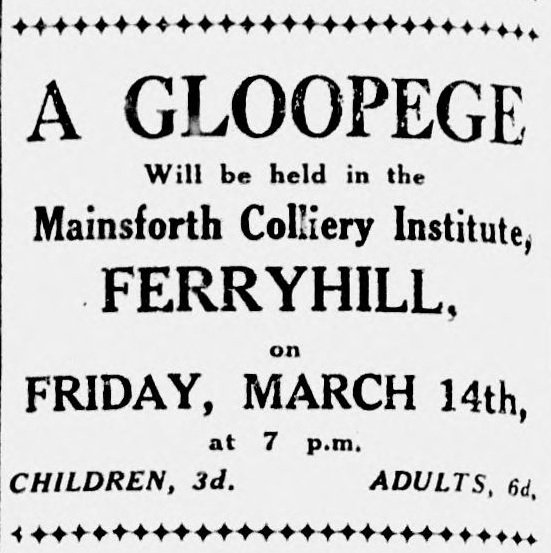
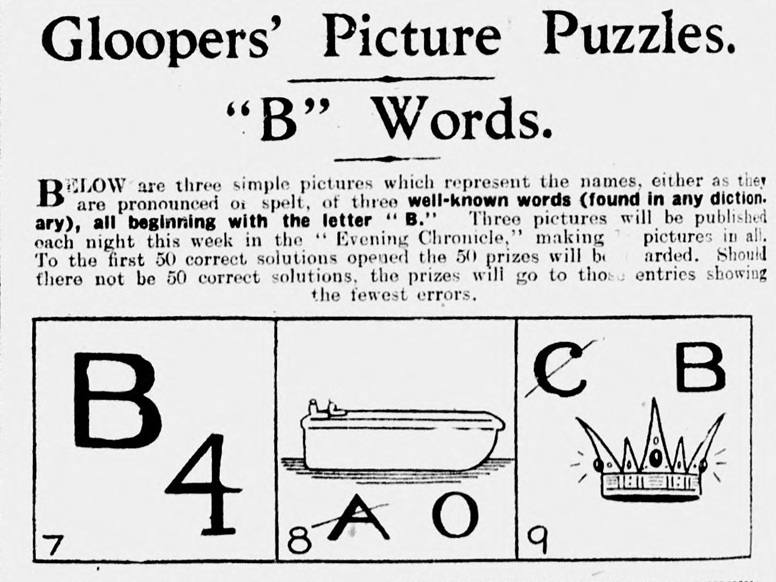 The Children’s Hour Gloopers Club in the Newcastle Evening Chronicle organised by Uncle Nick provided competitions and meetings for members.
(12th March 1930 Newcastle Evening Chronicle)
Gloopege Joys at Ferryhill - Medals For Winners In Scholarship Scheme.
The first Gloopege held at ferryhill, in the Mainsforth Welfare Institute, last night, was a tremendous success.
Nearly 500 Gloopers packed the hall, and Uncle Nick, with his famous four-foot long cigarette holder, was greeted with rousing cheers.
Auntie Deb was also present, and, commencing with the Maze march , led by Uncle Nick, an evening of great enjoyment was spent.
Bill-the-Bandmaster leed the musical joys, and there were great performances by the choir, and ballet dancers, concluding with dancing and tip-top community singing.
Swelling Gloops’ Roll
The Enrolment Bureau did brisk business, and altogether, a rollicking jolly evening was spent.
Medals of honour were presented to Albert Berrisford, winner of £25 (divided prize) “Evening Chronicle” scholarship scheme; Esme Durham, winner of £50 “Evening Chronicle” scholarship; Winifred Green, finalist in “Evening Chronicle” scholarship scheme; David Clough (also a finalist); Amy Davison, Ivy Emery, and Dorothy Fairs.
(15th March 1930 Newcastle Evening Chronicle)
Our first visit to Ferryhill was voted by those attending, a great success. It was a jolly little hall with a splendid stage and footlights, and everything, and, after it was all over, both parents and kiddies were saying they had never had a night like it in Ferryhill-never since the hall was built.
They were just brimming over with happiness and “thmiles” and I guess that from now on Ferryhill will be a stronghold for Gloopers.
17th March 1930 Newcastle Evening Chronicle
 ‘Bus and Lorry Smash - Passengers’ Escape Near Ferryhill - Ticket Girl Hurt
About 30 passengers in a United ‘bus running from Darlington to Durham had a remarkable escape from serious injury to-day when the ‘bus came into collision with a fruit merchant’s lorry at Thinford crossroads, on the main road north of Ferryhill.
The lorry owner by Messrs. Edwards and Sons, Spennymoor, and driven by Joseph Pumford, a Low Spennymoor youth, turned into the main road to proceed to Ferryhill and the driver of the ‘bus, Albert Guy, of Darlington, swerved to avoid a collision.
The ‘bus mounted the pavement and crashed into the front of the lorry.
Flying Glass Splinters
Miss Pearson, of Geneva Road East, Darlington, the conductor of the ‘bus was cut by broken glass, but the passengers and the drivers of both vehicles escaped injury apart from shock and some minor cuts from splintered glass.
The front part of the ‘bus, including the entrance door, was badly smashed, and the radiator of the lorry was damaged.
Thinford cross roads is known as a danger spot on the Durham section of the North Road, and has been the scene of many accidents.
(1st February 1930 Newcastle Evening Chronicle)
Lamp-Posts Smashed - Spennymoor Doctor’s Car in Amazing Mishap
The occupants of a two-seater coupe had a terrifying experience late last night on the main road north of Chester-le-Street, the car knocking down two lamp-posts and being badly damaged.
The driver was Dr John Gordon, of Clyde Terrace, Spennymoor, who had a woman passenger. They were travelling from Newcastle, and when about 20 yards past Blindy Lane the rear near-side mudguard struck a lamp-post and uprooted it.
Second Crash
It then mounted the pavement and after continuing for about another 60 yards struck another lamp-post and broke it off from the base. Part of the second lamp-post was lodged underneath the car, and was carried for 44 feet, tearing up the footpath for some distance.
The top of the lamp-post fell over the car, and dropped on the cover of the dickey seat, which was damaged.
Both Dr Gordon and his passenger escaped injury. The near side front wheel of the car was buckled and pushed beneath the vehicle, the front axle was bent, and the mudguards severely damaged.
(8th February 1930 Newcastle Evening Chronicle)
Bachelor’s Club
The Bachelor’s Club at Ferryhill is achieving success as an educational institution. Meetings have been held in the Council Chamber under the chairmanship of Mr. Fred Hewitt, and various subjects have been discussed. On Friday night the club is holding a carnival dance. A summer programme has been arranged.
(25th February 1930 Newcastle Evening Chronicle)
Cornforth “Knights” (KGH)
West Cornforth Camp of the Knights of the Golden Horn held a special session of investiture last night, when Sir Knight Councillor Moodie, of No. 65 S J Slade Camp, Spennymoor, invested Knight J Nicholson with the K.O.S. degree and presented him with his golden shield. Sir Knight Hardy, from Trimdon, also presented attendance bars to 14 of the Comrades of No. 70.
(21st February 1930 Newcastle Evening Chronicle)
Spennymoor Operatics’ Dance
More than 200 people were present at the Spennymoor Amateur Operatic Society annual whist drive and dance in the new Town Hall, Spennymoor, last night. Mrs Kinsley presented prizes to the successful whist competitors. Stewards for whist were Mr G W Gibson and Mr George Sutton and the M.C.’s for dancing were Mr G W Gibson, Mr J Soulsby and Mr E Sutton.
(6th February 1930 Newcastle Evening Chronicle )
Ferryhill Nursing
Ferryhill Nursing Association reported last night that during December 66 cases were visited 938 times, and in January 60 cases involved 929 visits. The Association decided to engage, as third nurse, Miss Bendin, of Saltwell Road, Gateshead, who had been acting as temporary nurse.
(5th February 1930 Newcastle Evening Chronicle)
Overdraft Decreased by Over £3,000 - Durham Hospital’s Better financial Position.
The pleasing fact that the bank overdraft of Durham County Hospital had been decreased during the year from £11,530 to £8,390 was mentioned at the annual meeting of the Workmen’s Committee of the institution, at Durham , on Saturday.
The financial position, however, it was stated in the report, was still critical, and it was urged that the special efforts to raise funds be not curtailed. The management was still faced with a formidable task.
The contributions from the workpeople for the year, including contributions to the Convalescent Home at Harrogate, amounted to £4,063, an increase of £825. In addition three grants of £1,000, £300 and £100 respectively were made from the local Welfare Funds, and over £800 was received from carnivals, whist drives and other functions promoted by miners’ lodges and local committees.
The report further recorded that the hospital had been maintained to its fullest capacity, and that the Convalescent Home had again proved a great boon, 205 patients having been treated there.
The Chairman (Mr James Bailey, of Oakenshaw), moving the adoption of the report, said “The hospital needs your help to-day. You may need its help tomorrow. In order to meet the requirements of the Nursing Council extra medical beds will have to be provided. This provision can be made by having a new children’s wing completed and equipped.”
Referring to the increased contributions the Chairman explained that the Tudhoe Welfare Committee had contributed £1,000, the New Brancepeth Committee £300, and another committee 3100.
Mr M White (Waterhouses) seconding, spoke of the provision at the hospital of a sun room for convalescent children, and stressed the need of providing the additional 25 beds (one ward for women and another for men) during the present year.
(7th February 1930 Chester le Street Chronicle)
Fox in Chimney
Reference was made at Bishop Auckland Police Court, yesterday, to a case which will come before the magistrates on March 17. The local inspector of the RSPCA made application for a summons against a Ferryhill man for alleged cruelty to a fox.
The case follows a recent meet of the South-West Durham Hunt, when the fox took refuge in a chimney and, it is alleged, was smoked out by the defendant.
(28th February Yorkshire Post and Leeds Intelligence)
Fox That Went Up A Chimney - Hunt Incident - Cruelty Charge Against Youth Dismissed.
A charge of cruelty to a fox, brought against Joseph Kennedy (18) of Ferryhill (Co. Durham), was dismissed at Bishop Auckland to-day.
The case, which aroused a good deal of interest in hunting circles, arose out of an incident at a hunt of the South Durham Fox Hounds.
The prosecution was brought by the R.S.P.C.A., and was in the hands of Mr E Marjoribanks, MP. Mr Reuben Cohen, of Stockton, represented Kennedy, and Mr E L Townsend, of Stockton, appeared for the South Durham Hunt.
Mr Marjoribanks said that a fox that was being hunted by the hounds on January 29 ran into the passage of a dwelling house at Ferryhill. The back door was opened, and it was allowed to escape, but it made its way to an unoccupied house, in which Kennedy was working. It ran upstairs, and after trying to escape by the window, went up the chimney.
The hounds soon followed, and it was alleged that in the presence of a large concourse, composed of members and servants of the Hunt, and the general public, Kennedy climbed on the roof and, after probing down the chimney with a piece of stick, set fire to something and thrust it down the chimney. The terrified fox came out, slid down the roof, and fell among the waiting hounds, when it was dealt with in the usual way, and the brush was presented to a policeman who had witnessed the whole affair.
Not an Attack on Hunting
Continuing, Mr Marjoribanks said: “It is no intention of this case to bring an attack against fox-hunting, or against this particular pack of hounds. It must, however, be pointed out that Kennedy was allowed to perpetrate this act in the presence of members and servants of the Hunt. I do not think that this particular kill will be one of which they will be proud. It is not an incident which would form the subject of a drawing by Leach or a poem by Masefield, or a novel by Siegfried Sassoon.”
Mr Marjoribanks said that when the fox got into the chimney it became a captive animal, and became entitled to all the ordinary rules of pity and humanity.
Mr R Cohen said there was no proof that Kennedy had acted in a cruel manner. A good deal of misleading attention had been drawn to the case, he added, through letters to newspapers which were not in accordance with the facts. The fox was not a captive animal under the protection of Animals Act 1911, under which the proceedings were taken. It could only be regarded as a captive only if it was rendered so by human agency.
He denied that Kennedy set fire to anything and thrust it down the chimney, though it was admitted that he did probe with a long stick.
Several witnesses for the prosecution said that they saw smoke rising from the chimney, but did not see Kennedy cause the fire. Police-constable Davison, to whom the brush of the fox was presented, declared that he saw no smoke, nor did he see the defendant put any fire down the chimney.
“Not a Captive Animal”
Mr Cohen submitted that there was no case of cruelty against Kennedy, If a fire was lighted, as a result of which smoke came up the chimney and caused the fox to evacuate his hiding-place, he said, Kennedy was not responsible for it.
The Bench dismissed the case without hearing Kennedy or any other witness for the defence. The Chairman (Dr Kane) said that the magistrates had decided by a majority that the fox was not a captive animal coming within the provisions of the Protection of Animals Act, and therefore the case would be dismissed.
(7th March 1930 Yorkshire Evening Post)
Oxford and District Branch of the League for Prohibition of Cruel Sports
This case caused discussion in newspapers throughout the country and at Brackley Town Hall a meeting of the Oxford and District Branch of the League for Prohibition of Cruel Sports was in chaos. The speakers were to pay particular reference to fox-hunting in Brackley and elsewhere and raised the question “was it sport to light a fire under a beaten fox which had crept up a chimney, to give to the hounds an exhausted animal that had sought shelter in a human habitation?”
The hall was full of hunting supporters blasting on hunting-horns and the speakers were unable to continue, after 45 minutes the meeting was abandoned with eggs and small bags of flour being thrown.
Outside the Hall a large portion of the crowd became somewhat hostile and the chairman Rev Dr C L Bradley was escorted by the police to the police station until the crowd dispersed.
(21st March 1930 Northampton Herald)
Fox in Chimney - Magistrates Asked to State a Case
Mr E B Proud, on behalf of the RSPCA, made an application at Bishop Auckland Police Court. Mr E Marjoribanks had raised a point of law at the original hearing that the fox, under the circumstances, was a captive animal.
The magistrates ruled otherwise so Mr Proud asked them to state a case on that point of law as to whether the fox was a captive animal or not. He said that he had not definite instructions that the case would be taken to the High Court on an appeal, but he had been instructed to make this application.
The magistrates acceded to his request, and fixed recognisances in the sum of £40.
(25th March 1930 Yorkshire Post and Leeds Intelligence)
 Roped in by Electrocord - Butcher’s Circle of Talkie Houses
A recent list of installations of Butcher’s talkie equipment, the Electrocord, covers seven counties, and include houses as far removed as Durham in the North and Swindon in the South. Butcher’s are now in a position to equip eight kinemas per week, and their price list has been entirely revised, quotations now being inclusive of all charges in connection with installation, and expenses relating thereto, materials, fittings, spare parts, and the service of an engineer for the opening performances.
Theatres from 500 to 2,500 capacity are being equipped, the following being most recent in County Durham:- Gaiety, Ferryhill; Palace, Wingate; Chester-le-Street Cinema.
(6th February 1930 Kinematograph Weekly)
Church Shop - Vicar’s Venture at Ferryhill
What is known as the Church Shop has been established in his parish by the Rev. T L Lomax, Vicar of Ferryhill (County Durham). It supplies books, pictures, devotional articles, and other goods of a religious nature.
The object of the business is not to make profit, but to display pictures and works which are considered a necessary adjunct to Church life. Any profits made go to Church funds.
It is claimed that the shop stocks the largest collection of crosses and crucifixes in the North of England, a number of which have been obtained by the Vicar in his travels tin France, Spain, and Italy.
(19th February 1930 Yorkshire Post and Leeds Intelligence)
 Spennymoor Shop Fire - Blaze Discovered in Nick of Time
A fire that might have been attended by disastrous results had it occurred a little later, broke out last night in a room above the shop of Mr Howard Pearson, in Cheapside, Spennymoor.
Shortly before closing time the lights in the shop failed, and a fire was discovered in a room over the shop. Water and fire extinguishers were available, and the fire was soon put out.
A gas-pipe had become ignited.
(8th February 1930 Newcastle Evening Chronicle)
 Conviction Sheet Full Up - But Durham Man Not Yet at Century Mark
“He has not completed the century yet,” observed the Clerk (Mr J L Mawson) at Durham City Police Court to-day, when Edward Boyd (30), of Queen Street, Spennymoor, was charged with having been drunk and disorderly in North Road, Durham.
“I think he wants a new sheet. This one is full on both sides,” commented Supt. F Foster, referring to Boyd’s list of convictions.
Boyd, in company with John Amos of the same address was stated to have been very drunk and having used bad language. Several police officers were necessary to take Boyd to the police station.
Boyd did not appear, but Amos remarked “I have never been in this place before and have bever been drunk.” He was fined 10s, while Boyd was ordered to pay 40s.
(24th February 1930 Newcastle Evening Chronicle)
 Knocked Down by Car - Spennymoor Driver to Pay Court Costs
Frank Kenmir (22), of Carlton Hill, Spennymoor, was charged, at the local court to-day, with having failed to give warning of the approach of a motor-car driven by him.
Johnston Storey said he was crossing the road when the car approached but did not give warning. He was knocked down but did not receive serious injuries.
Kenmir, who pleaded not guilty, said he saw the man and had no idea that he had struck him.
The charge was dismissed on payment of costs, 9s.
(25th February 1930 Newcastle Evening Chronicle)
 1929-30 Durham County Challenge Cup
First round on 21st December 1929 – Spennymoor v Consett 3-2
Does anyone have a photo of the team in 1929-30 or can supply names for this photo from 1928?
Second round on 4th January 1930 – Spennymoor v Sunderland Reserves 3-2
Roker Reserves Beaten Close on Time: Single Draw. - “Moors” Given Great Ovation
Spennymoor United and Sunderland Reserves drew the best gate of the season at Spennymoor, and 4,000 spectators were delighted with the best contested game seen on the ground for several years.
The “Moors” received a rare ovation for their thoroughly deserved victory by three goals to two.
Armstrong missed a penalty kick for Spennymoor after ten minutes play, shooting wildly over the bar, and this undoubtedly upset the home team for a considerable time. Eden missed two glorious chances for Sunderland, failing when within five yards of goal, but Morris and Robinson both hit the home cross-bar before Morris scored the first goal.
After the interval Morris added a second goal, and victory seemed safe for Sunderland. Spennymoor then played up brilliantly, however, Bell, in the Sunderland goal, making great saves from Dolphin, Boustead, Kipling, and Younger. After this Sunderland barely crossed the half-way line, but the defence withstood all attacks until 15 minutes from the end.
From a free kick Musgrave then tested Bell, who fisted out only for Boustead to head back into the net. Two minutes later Kipling centred for Dolphin to equalise, and amid great excitement the winning goal came four minutes from time. Attley forced a corner which he placed into the goalmouth and Dolphin shot past Bell into the net, the ball touching the right full back, Dow, in transit.
Spennymoor United: Blyth, Carruthers, Pharoah, Armstrong, Loughran, Musgrave, Attley, Boustead, Kipling, Dolphin, Younger.
Sunderland Reserves: Bell, Dow, Hall, Lawley, Johnstone, Wright, Robinson, Wilkins, Kitching, Morris, Eden.
(5th January 1930 Sunday Sun Newcastle)
Quarter Final on 1st February 1930 – Cockfield v Spennymoor 1-1
Replay on 8th February 1930 – Spennymoor v Cockfield 3-0
Durham Cup Play - Moors Prove Masters of Cockfield..
Spennymoor United by defeating Cockfield by three clear goals on the Brewery Field, Spennymoor, in the third round replay qualified to meet Annfield Plain in the semi-final of the Durham County Challenge Cup. The game was keenly contested and Poole in the Cockfield goal and Blyth in the Spennymoor goal both distinguished themselves.
The only goal of the opening half was scored after 17 minutes play. Loughran placed the ball to Boustead who headed it to the feet of Kipling for the latter to score with a grand first time drive. After the interval only seven minutes had elapsed when Younger put across a centre which Dolphin took on the run to give Poole no chance. Cockfield never despaired and the home goal had some narrow escapes.
Pharoah cleared a shot from Dunn on the goal line with Blyth well beaten and Stephenson just missed by inches with Blyth at the other end of the goal. In the closing stages Cockfield tired and two minutes from the end Oldfield headed into the net in attempting to clear.
Sp - Blyth, Carruthers, Pharaoh, Rose, Loughran, Musgrave, Attley, Boustead, Kipling, Dolphin, Younger.
(9th February 1930 Sunday Sun, Newcastle)
Semi-Final on 22nd March 1930 – Spennymoor v Annfield Plain 3-0
Semi-final – heavy snow-covered ground the “Moors” adopted the right tactics; they booted the ball about with freedom; they were a much heavier and more solid combination, and always dangerous when raiding; in fact, every time the Spennymoor vanguard swept down it carried peril to the home goal.
Rose scored after 7 minutes, Boustead 18 minutes, and Boustead scored the third near the end of the match.
Sp - Blyth, Carruthers, Chisholm, Armstrong, Loughran, Musgrave, Attley, Boustead, Lowes, Rose, Younger.
(22 Mar 1930 Blaydon Courier)
Final played at Bishop Auckland on 21st April 1930 (Easter Monday) Spennymoor v Tow Law 1-1
Replay played at West Hartlepool on 10th May 1930 Spennymoor v Tow Law 1-0
This seems to have been a very disappointing game.
Spennymoor’s Cup - Tow Law Beaten at West Hartlepool
Those who watched the Durham Challenge Cup replayed final between Spennymoor and Tow Law, on the Hartlepool United’s ground must have been disgusted with the fare served up.
Never will a weaker team appear in the final again than Tow Law – and they must thank the weakness of the Spennymoor forwards that double figures were not registered against them.
Blyth never had one shot to stop from any of the Tow Law players and yet Spennymoor could only get one goal.
When they did score the goal that mattered, there was a huge element of luck with it, Younger received a pass from Rose. He at once closed in on goal, Coe dashed out to meet him and dived at his feet, got the ball but let it slip out of his grasp, leaving DOLPHIN with an empty goal to place the ball into.
Clubs were represented from all over England. Some of them were so disgusted with the form of certain players whom they had heard about that they left long before the finish.
The gate receipts were £104.
Sp United - Blyth, Carruthers, Chisholm, Armstrong, Loughran, Rose, Attley, Boustead, Lowes, Dolphin, and Younger.
(11th May 1930 Sunday Sun, Newcastle by Stan Seymour)
 Bus Fatalities at Ferryhill - Coroner’s Jury and Cross Roads
Coroner Proud held two inquests in Ferryhill district yesterday respecting bus fatalities which occurred on Saturday night.
The evidence in the first case showed that Thomas Marshall (75), of Windsor Avenue, Ferryhill, retired caretaker at the cemetery, was crossing the road opposite the Town Hall, Ferryhill Village, when he was struck by a United motor-bus travelling from Bishop Auckland to Spennymoor, and received injuries from which he died within a short time. He was taken into a private house and attended by Dr Brown, but died almost immediately.
The driver of the bus gave evidence that he never saw deceased until he was right in front of the bus. He was travelling slowly, and pulled up within three yards. He did not sound his horn at he particular part, as there did not seem any reason.
The foreman of the jury pointed out that there were two side-streets emerging on to the main street at the particular place. He thought drivers should sound their horns and give warning when approaching such street ends.
Police-Sergeant Phipps said from Friday night to Saturday night buses passed the street ends at the rate of one every 30 seconds. It would mean horns constantly blowing, and residents in that part could get no rest.
Eventually, it was agreed, on the recommendation of the jury, that the Coroner should write to the Chief Constable of the County, pointing out the need of warning being given by motor vehicle drivers at the street ends. A verdict of “Accidental death” was returned, no blame being attached to anyone.
The other fatality occurred at Ferryhill Station. Arthur Edward Anderson Crowe (17), of Wolsey Street, Ferryhill Station, gardener for Brigadier-General Surtees, of Mainsforth Hall, was changing buses when knocked down by another bus. Mrs Margaret Rutherford said she travelled from Bowburn to Ferryhill Station late on Saturday night in a bus. Deceased was in the same bus, and they both alighted at Chapel Row. Deceased walked round the end of the bus he had got out of, in order to cross the road, and walked straight in front of a bus coming in the opposite direction.
John Watson Bowden, the driver of the United bus which struck Crowe, said he saw the bus standing facing him, and sounded his horn twice before reaching it and when passing. Just as he was nearly level with the other bus, deceased came out from behind it, right in front of his vehicle.
A verdict of “Accidental death” was returned, the driver being exonerated from all blame.
(6th/7th January 1930 Hartlepool Northern Daily Mail)
Public Highway as Playground - Coroner’s Comment at Tudhoe Inquest
“I cannot understand children of four being allowed to wander 250 yards from their homes without anyone in charge of them, and to make the public highway a playground” said Coroner J T Proud at an inquest at Tudhoe Colliery, today, on Donald Clarehaugh, son of James Clarehaugh, who was knocked down and killed by a motor-bus yesterday.
Joseph Ryder said he was walking up Front Street and saw some children playing on the footpath as a United ‘bus pulled up at the stand. It had travelled about 12 yards past him when he heard a shout and on looking back saw the rear wheel of the vehicle pass over the child’s body.
Alfred Hughes, of Bishop Auckland, the driver of the bus, said one child attempted to cross the road just as the ‘bus was starting and then ran back again. He then caught sight of a form near his offside wheel. He pulled up immediately but found that the rear wheel had passed over a child’s body.
A verdict of “Accidental death” was returned, and the driver was exonerated from blame.
(7th January 1930 Newcastle Evening Chronicle)
Milk Cart Smashed - Run Into by a ‘Bus at Spennymoor.
Today, at Spennymoor Police Court, George A Bostock (21), of South Terrace, Tudhoe Grange, was fined 20s and costs for having driven a motor-bus in a dangerous manner at Spennymoor on January 13.
Supt. Headen said that a milk-float occupied by Maurice Phillips, a dairyman, and his son, was struck behind by an O.K. Service ‘bus driven by the defendant. Phillips and his son were thrown on to the pavement, the horse was knocked down and then bolted, and the cart was wrecked.
Bostock said the night was misty and his vision was affected by the light of an oncoming ‘bus. He did not see the milk float until he was right on it. He swerved to miss the float. But the mudguards struck the hub.
(28th January 1930 Newcastle Evening Chronicle)
Kinema - “Not the Slightest Danger”
Kinema Theatres in Durham Area.
There would not have been any objection raised to this, but in addition, Cobman had installed in the operating box apparatus for the “talkies”. In the opinion of Superintendent Foster sufficient room was not left for the operator to work. Moreover the amplifier was in front of the emergency exit. “I took the course,” said the Superintendent, “of closing down the hall for the children’s matinee on Saturday afternoon, as in my opinion the position was a very serious one. In view of yesterday’s occurrence (Paisley) I can give an assurance to the Bench and to the public that there is no kinema in this area in which there is the slightest danger from actual fire, so long as the public keep their heads.”
Mr Ferens, who defended, said Cobman made the mistake in ignorance, The Bench ordered defendant to pay the costs.
(1st January 1930 Hartlepool Northern Daily Mail)
Paisley kinema disaster - During a children’s afternoon show, on 31st December 1929 at the Glen Cinema, Paisley, a cannister of film started to smoulder, causing smoke to enter the main cinema. In the panic to leave the cinema 70 children perished, crushed in their desperate attempts to get out.
Cinema Wall Crash - Curious Accident at New Spennymoor Building.
A 25ft. high wall, part of a super-cinema being built at Spennymoor, Co. Durham, collapsed, yesterday, and several workmen had narrow escapes, one being left hanging in a perilous position from a scaffold pole. He was rescued unhurt.
The wall, which was a hundred feet long and nine inches thick, was yesterday morning found to be out of line by several inches, and the displacement was thought to be due to the gale which blew during the night.
The cinema is being built by a Leeds firm for Mr F Gowland, of Darlington, to replace one recently destroyed by fire.
(25th January 1930 Yorkshire Post and Leeds Intelligencer)
Byers Green Colliery
About 200 pitmen and lads have received notice at Byers Green Colliery (Co. Durham), owing to the high cost of working the mine.
(7th January 1930 Yorkshire Evening Post)
Whellan's 1894 Directory of County Durham
Coal mining operations have been extensively carried on in Byers Green township for many years, the royalties being now worked by Messrs. Bolckow, Vaughan, & Co., at their pit, which was sunk in 1877. Here are two seams, the "Busty," 48 fathoms deep, having a section of 4 ft. with a band varying from inches to feet. The "Brockwell" seam is met at a depth of 76 fathoms, and is 3 ft. 10 in. thick. The two seams yield an average output, when in full operation, of 640 tons per day, and give employment to 600 men and boys. The coal is chiefly converted into coke, for which purpose there are 353 ovens. The "Beaumont" and "Harvey" seams are also met here.
(7th January 1930 Yorkshire Evening Post)
In April there was more bad news.
Colliery to Close – Disappointment for South Durham Miners.
The optimism caused in the South Durham coalfield by the announcement that Messrs. Dorman, Long and Co., of Middlesbrough, were making preparation to reopen Auckland Park Colliery, which has been closed for ten years, has been to some extent damped by the decision of the same firm to close down Byers Green Colliery in the same locality.
Owing to high production costs the owners have given 14 days notice to workmen employed in the Busty and Beaumont seams, and also to the workmen engaged in the Newfield drift. Altogether 550 men and boys have been given notice, which will expire on May 3.
Byers Green Colliery only reopened three years ago after being closed for some considerable time. Recently seggar has been produced in large quantities for use at the Newfield and Leasingthorne brickworks.
(22nd April 1930 Blyth News)
Care of Animals in Winter (To the Editor)
Sir,
Another cold, wintry spell is upon us, so may I, through your courtesy make my appeal once more to all who own animals, to show them extra consideration, and see that they are warmly housed and warmly fed.
Goats should be sheltered in quarters free from draughts and dogs allowed to sleep in the house at night and not chained to kennels, often in an exposed position and without sufficient warm bedding. Horses turned out should have hay thrown down for them. Poultry also require warm feeding and shelter.
I would be very grateful if the general public would back up my efforts for the welfare of all animals. They can help by reporting to me any animal they know to be suffering from over-work or unnecessary exposure.
Such as turned-out horses unable to find food in the frozen snow-covered fields and so are left to starve and shiver by their callous owners; also the unfortunate chained-up dog.
Any cases reported to me will be treated as confidential, and will be attended to at once.
There are five inspectors in the County ready and willing to alleviate suffering, day and night, but they naturally cannot be in two places at once, and I know they would be most grateful for the co-operation and sympathy of the general public.
So I ask all owners in all stations of life to see that their animals are properly looked after and given shelter and food they are entitled to in this inclement weather and hold out a helping hand to those who are neglected and uncared for.
Believe me, yours faithfully
SYBIL EDEN
Hon. Sec. R.S.P.C.A. County Durham,
Windlestone, Ferryhill
January, 11th, 1930.
(13th January 1930 Hartlepool Northern Daily Mail)
Youth’s Strange Ride.- Remembers nothing till fall from cycle after 60 miles.
John Thomas Rose, the 19 year old haulage hand, of 30, Crooks Broom Avenue, Hatfield, who was found at Northallerton suffering from loss of memory, was brought home by his uncle, Mr J Rose, of Fieldside, Thorne, yesterday.
Rose had cycled from Doncaster to Northallerton, a distance of 60 miles, without the slightest recollection of the fact; he had no money and no food.
When seen today at his home, where he is under medical treatment, he said: “I set out last Monday morning to go to Thorne to see my uncle. I changed my mind, and went Doncaster way.”
“I remember nothing after leaving Doncaster at 9:15 that morning. I can just remember falling off my bike. Someone took me into a police station. When I woke up next morning I found I was in the Infirmary of a Poor Law Institution, which I thought was Wetherby.” It was Northallerton, to which place Rose had ridden before falling from his cycle in a state of exhaustion.
Rose and the members of his family have been in the Doncaster district only a few days. He and his father tramped from Spennymoor, Durham, in search of work, and secured employment at Hatfield Main Colliery two days after their arrival.
(10th January 1930 Leeds Mercury (From our Own Correspondent), Doncaster, Thursday)
 Low Spennymoor Social
A successful whist drive and dance in aid of the Holy Innocents’ Church fund was held at Low Spennymoor last night.
Low Spennymoor Social
A successful whist drive and dance in aid of the Holy Innocents’ Church fund was held at Low Spennymoor last night.
Messr’s Paxton’s Band supplied an excellent programme of music, and refreshments were served by the following:
Miss N Whitehouse, Miss C Bell, Mrs T C Watson, Mrs W Bainbridge, Mrs J Sanderson, Mrs R Guthrie, and Mrs R Soulsby,
The whist drive M.C.s were the Rev. Mr Bell and Messrs J Dobson and T C Watson.
Results:
Lucky birthday dates – W Goundry, J Haley, R W Hopper, R Roberts, L Roberts, H Taylor, O Guy, E Brain, Mrs Amos, Miss Bainbridge.
Spot Waltz – Mr L Roberts and Miss Penman, Mr L Pratt and Miss J Burton, Mr N Belshaw and Miss G Dale.
The dance M.C.s were Messrs C Whitehouse and F Burton.
(18th January 1930 Newcastle Evening Chronicle)
Begging with £3 12s
When arrested for begging in Wigan James Atherton, of Spennymoor, was found to have £2 10s in Treasury notes, 19s 9d in silver, and 2s 4d in copper in his possession. He asked a woman to spare a copper as he was on the road.
Atherton when charged today said if he had a chance to work he would reform.
He was fined 20s and sent to a Manchester mission-hall conductor.
(6th January 1930 Liverpool Evening Express)
Girl Out of Control
Mother’s Appeal to Bench at Spennymoor.
A mother appealed to the Spennymoor Bench to-day to send her daughter to a home as she was entirely out of parental control.
If they tried to check her, she said, the girl simply ran away from home, and the police had to bring her back.
The bench, however, decided to allow the Probation Officer to deal with the girl before taking any further steps.
The defendant was Alice Mortimer (17), of Bessemer Terrace, Low Spennymoor, and she pleaded guilty to charges of stealing a gold wristlet watch worth £1, the property of Frances Warren, and a purse and money, worth £1, the property of Selina Williams.
She was bound over in the sum of £5, and placed under the Probation Officer for two years.
(7th January 1930 Newcastle Evening Chronicle)
Ferryhill Dispute - Claim Against Dean & Chapter Welfare Committee
The hearing was concluded before His Honour Judge Richardson, at the Durham County Court, yesterday, of the action brought by Alfred Forster, of Bridge House Farm, Ferryhill, and the Ferryhill Football and Athletic Club against the trustees and committee of the Dean and Chapter Colliery welfare movement.
Plaintiffs claimed in respect of trespass, sought an injunction to restrain the Welfare Committee from damaging hedges and ditches, and claimed damages for what had been already done.
The case was based on the ownership of a ditch and hedge, plaintiffs alleging that the defendants had filled in a ditch in the construction of a road to the Welfare ground. Mr E G Sykes, for the defence, denied that a ditch ever existed, and declared that the hedge was merely “dressed” to facilitate the making of the road.
Judge Richardson, giving judgement, expressed the view that Mr Forster did not attach much importance to the ditch, but considered that the road as constructed too close to the hedge. It was not, however, a case for an injunction or for heavy damages, He declined to make an order for the ditch to be re-instated, although he agreed that a thin strip of land used by the defendants was the property of the plaintiffs.
He made a declaration entitling the plaintiffs to the free use and enjoyment of the hedge and of land 3ft 6in. from its centre, and, in awarding Mr Forster five guineas and the football club seven guineas, he ordered the defendants to pay the costs.
(15th January 1930 Hartlepool Northern Daily Mail)