Tudhoe & Spennymoor Local History Society
Pit Shaft Mishap.
Cage Wrecks Catches at Mainsforth.
At Mainsforth Colliery, Ferryhill, during the night a descending cage struck the catches at the bottom of the shaft with such force that the catches were destroyed, and the cage was much damaged.
Coal drawing was stopped for the remainder of the night.
Men coming from work after the night shifts had to ride to bank in an adjoining shaft.
(9th October 1931 Newcastle Evening Chronicle)
 First Aid Tests.
Inspection of Ambulance Brigade at Ferryhill.
The annual inspection of the Dean and Chapter Colliery, Ferryhill division, of the St John Ambulance Brigade, was held on Saturday in the Ambulance Hall at Ferryhill. The inspecting officer was District Officer W Keenleyside.
The tests in first aid and company and stretcher drill were very searching. After the tests, Private J H Baggs received the long service medal for 15 years’ efficient service. The inspecting officer expressed appreciation of the manner in which all his difficult tests have been accomplished.
Much of the efficiency of the brigade is due to Ambulance Officer W Johnston who, although he has retired from the colliery owing to age, still takes a keen interest in the brigade.
(12th October 1931 Newcastle Daily Chronicle)
Ovens Re-Starting.
Welcome Ferryhill Announcement.
Ferryhill received the welcome news yesterday that the acid plant and part of the coke ovens at the Dean and Chapter Colliery, the property of Messrs. Dorman, Long and Company, are to be restarted.
Before these works closed down 250 men were employed, and following the restarting of the ovens, it is expected that more coal hewers, etc., will be required.
During the War, a tremendous amount of benzol and acids were shipped from these works overseas, the works then being the property of Messrs. Bolckow, Vaughan and Company.
(29th October 1931 Newcastle Daily Chronicle)
 Spennymoor Boys’ Trial.
The final trial of the Spennymoor Schools Football League prior to a match with Darlington or Kelloe, in the first round of the English Schools Shield, will be played on the Ferryhill Athletic ground this afternoon (3.0).
Probables – Marshall (Tudhoe); Carr (Dean Bank), Phillips (Chilton), Marley (Rosa Street), Stoddard (Dean Bank), Buckton (Tudhoe), Russell (Rosa Street), Pinkney (King Street), Solan (Tudhoe R.C.), Hibbett (Dean Bank), Dennison (Croxdale).
Possibles – Foster (Broom); Baugh (Tudhoe Colliery), Watson (Rosa Street); Foster (Chilton); Hutchinson (Tudhoe R.C.); Bowman (Rosa Street); Pietuns ( Middleton Moor); Bracegirdle (Tudhoe R.C.); Whitehouse (Tudhoe Colliery); Gowland (Chilton); Wayman (Dean Bank).
(15th October 1931 Newcastle Daily Chronicle)
“Hare” Raising Excitement.
Spectators & Players in Spennymoor Chase.
The start of the Spennymoor v Walker Celtic match was delayed two minutes to-day through an unusual incident.
Just as the players were about to line up a hare appeared on the pitch and caused great excitement, the crowd invading the pitch.
Together with the players they joined in a general chase.
The hare, after circling the field, twice dodging blows aimed at it from all directions, eventually succeeded in threading its way through the thickest part of the crowd and got away.
Walker were the clever team in the first 25 minutes and played smart football, but fine goalkeeping by Reed prevented them from scoring.
For the home team Robinson scored with a terrific drive, Half-time Spennymoor U. 1; Walker Celtic 0.
Final Spennymoor U. 1; Walker Celtic 0
(24th October 1931 Football Echo Sunderland)
 North Mail and Evening Chronicle
Book Now for Excursion to London During Motor Show
Wednesday, Oct. 21st
A Special Dining Saloon train will leave Newcastle Central 6 a.m., Chester-le-Street 6.16 a.m., Durham 6.28 a.m., Ferryhill 6.45 a.m., Darlington 7.5 a.m., arriving King’s Cross 12 noon.
Breakfast will be served on the train on outward journey.
Party will be met at King’s Cross Station and conveyed by Motor Coach to Lyons Corner House, Coventry Street, for Lunch.
2 p.m.—Party rejoin coaches in Leicester Square for drive via Piccadilly Circus, Shaftesbury Avenue, Charing Cross Road, New Oxford Street, Holborn (Post Office), Cheapside (Guildhall) and (Bow Bells), Poultry (Mansion House, Bank of England and Royal Exchange), Cornhill, Leadenhall St., Aldgate, Minories to Tower of London, where the party alight.
2.50 to 3.50.—In Tower of London (admission to White Tower only). Rejoin coaches and drive via Tower Bridge, Tooley St., London Bridge (Monument to Fire of London), King William St., Bank, Cannon St., St. Paul's Churchyard (St. Paul's Cathedral), Ludgate Hill, Ludgate Circus, Fleet Street, (Newspaper Offices), Law Courts, Temple Bar, Strand (St. Clement's Church and Bush House), Whitehall to Old Palace Yard, Westminster, where party alight.
4.15 to 4.45.—Visit Westminster Abbey. Party rejoin coaches and continue drive via Victoria Street, Grosvenor Gardens (Buckingham Palace), Hyde Park Corner, Piccadilly to Leicester Square, where party alight for Tea at Lyons Corner House.
From 6 p.m.—Party free to spend evening at leisure, or visit Motor Show.
The train leaves King's Cross 12.50 a.m. Thursday, 22nd Oct., due Darlington 5.40 a.m., Ferryhill 6.10 a.m., Durham 6.43 a.m., Chester-le-Street 6.55 a.m., Newcastle 7.15 a.m.
Supper will be served on train immediately on leaving King's Cross.
The inclusive cost for the above Excursion from Stations mentioned is ...... £1-18-6 Children under 14 £1-8-6
Alternative Programme: Passengers who desire to be free to go direct to Motor Show, etc., may book accordingly, the fare being: Adults 27s. 6d.; Children (under 14 years of age) 17s. 6d. (Including Rail Fare and Breakfast and Supper on Train).
A Deposit of 10s. (or full amount) may be paid at the time of Booking and balance by October 15th.
Book Early to avoid disappointment at any “Chronicle” Branch Office, or by post addressed to:—
Excursion Department, Newcastle Chronicle, Ltd., 45, Westgate Road, Newcastle-on-Tyne.
Parties, large and small, can be placed together on train.
(2nd October 1931 Newcastle Daily Chronicle)
Pit Pony Jumps into Motor Car.
Traveller’s Narrow Escape Near Spennymoor.
A commercial traveller, Joseph Connelly, 30, of Halton Leeds, had a narrow escape yesterday from being pitched to death by a pit pony.
Connelly was driving his car towards Tudhoe Colliery, near Spennymoor, when he was confronted by a run-away pony, which has only been out of the pit for a few days.
The animal bolted down the street and jumped on to the top of the car. Its front legs penetrated the windscreen and its back legs burst through the radiator cover. It kicked and plunged badly and the steering wheel was knocked completely out of Mr Connelly’s hands. The animal also kicked all the instruments from the dashboard and sent broken glass flying in all directions.
Mr Connelly made an attempt to leave the car, but in doing so was caught by the animal’s hoofs and severely cut about the head.
The animal was in great agony as it was severely cut in addition to sustaining a broken leg. It was afterwards extricated from its precarious position and shot.
Mr Connelly, at the time, was taking a consignment of automatic machines, valued at £500, from Leeds to Newcastle. The car was very badly broken and had to be towed into a nearby garage.
Mr Connelly, in addition to being cut and bruised, was suffering from shock.
(21st October 1931 Shields Daily News)
New Wear Ferry.
Byers Green Parish Council, who are trying to obtain a ferry service between Willington, Brancepeth and Oakenshaw, on the north side of the Wear, and Byers Green on the south side, have met with a disappointment. The north side land agent has refused permission to erect a standard to which a rope or wire could be attached and stretched across the river to facilitate the boat’s crossing.
The Council are seeking information about a ford near Willington with a view to ascertaining whether it is usable.
(30th October 1931 Sunderland Daily Echo)
 Spennymoor Band Contest.
The Spennymoor Silver Model Band held their brass band contest for the Chamber of Trade £50 Challenge Cup, in the New Town Hall, Spennymoor. The adjudicator was Mr W K Straugan, of Hetton, who in making his award commented upon te high standard of the playing of the competing bands. The results were :-
Selection Contest (Test Piece “La Favorita”)
1 Cup and trombone medal, Cargo Fleet Ironworks;
2 and cornet medal, Brancepeth Colliery;
3 and euphonium medal, Thornley Colliery;
4 Eldon Silver Band.
March Contest
1 Brancepeth Colliery;
2 Eldon Silver band.
(5th October 1931 Newcastle Daily Chronicle)
Spennymoor Awards
Winners at Fur Society’s Show.
Winners at Spennymoor Fur Society’s monthly show of rabbits and cavies were:
Rabbits – J Armstrong, Crook; R Johnson, Spennymoor; G Dudhill, Wingate; J Proudfoot, Crook; J Tolley, Spennymoor; W Blenkin, Chilton; R Jefferson, Willington; R Woods, West Cornforth; J Lowe, Coundon; J Gooding; J Bainbridge, Bishop Auckland; G Dowson, Hesledon; T Aldwith, Crook.
Cavies – E Short, Tindale Crescent; J Lane, Shildon; T Beagley, Spennymoor; W Illingworth, Spennymoor.
(19th October 1931 Newcastle Daily Chronicle)
Record Pot Leek.
The winning stand of pot leeks at the annual open competition for Durham County, held at Durham, is believed by well-known growers to be a record. It measured 185 cubic inches and was exhibited by Mr E Lee, of West Cornforth.
As first prize winner Mr Lee becomes the holder for a year of a handsome trophy, and in addition he receives a replica and £7. The cash prizes offered totalled £50.
The 2nd prize of £5 was won by J Todd, of Ferryhill (168.8 cub. in.); and the third of £3 by Wm Joyce, of Croxdale (171.2 cub. in.)
Other winners were: R Ward, West Cornforth; G Maughan, Croxdale; James Hodgson, Spennymoor; B Gardener, Croxdale; A Nelson, Croxdale; J A Nelson, Croxdale; W Brewis, Croxdale; R Callender, Ryton; and G Smith, Wingate.
(26th October 1931 Sunderland Daily Echo)
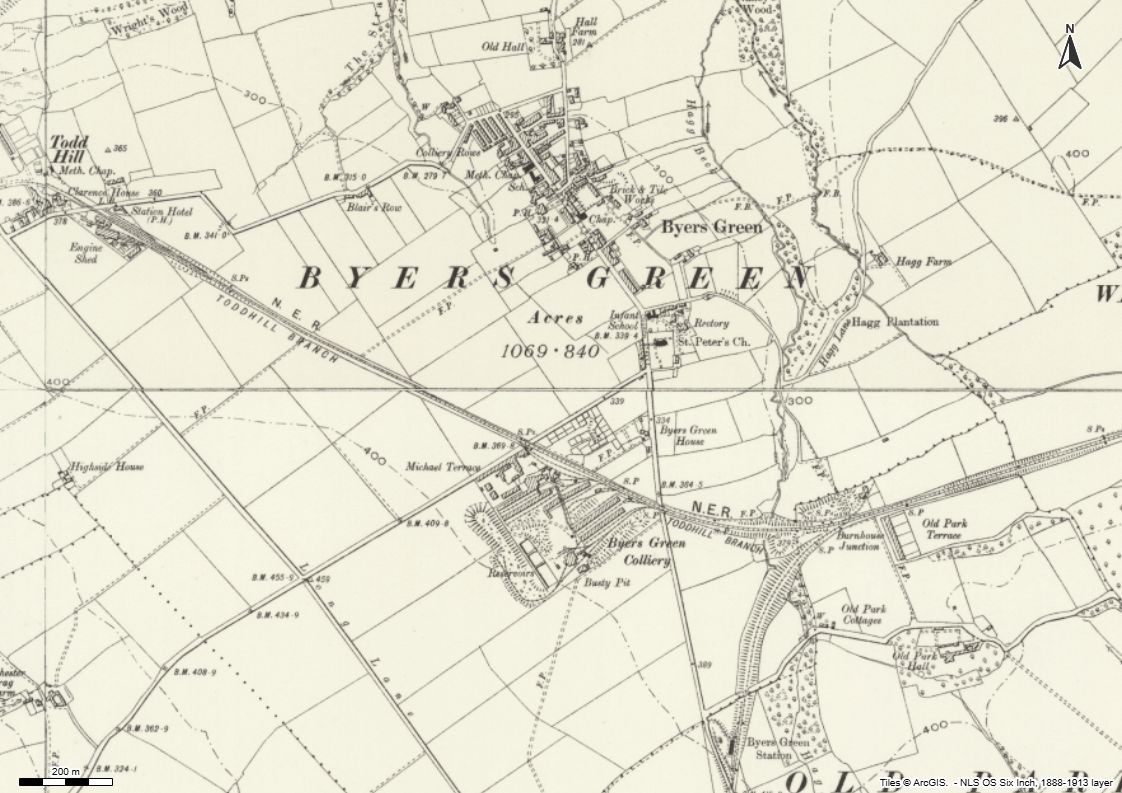 5 AM Coal Raid.
Eight Me Fined for Damaging Byers Green Embankment.
Robert Conlon, Charles Wintersgill (29), Thomas Chaytors (32), Walter Thompson (19), James Thompson (17), John Spark (32), William Brown (50), Richard Henry Bourne (39) and 14-year-old boy, all of Byers Green and Binchester, were charged at Spennymoor Court, to-day with having damaged a railway embankment belonging to Dorman, Long and Co. at Byers Green Colliery.
PC Tubman said on Sept. 29, with PC Mitcheson, he kept observation upon the embankment and about 5am saw a number of men approach and begin digging coal out of the embankment. They waited until daybreak, so that they could recognise the men. While they kept observation they saw over 30 bags of coal filled from the embankment.
All pleaded guilty, and each was fined 5s., and ordered to pay 1s. damage.
(6th October 1931 Newcastle Evening Chronicle)
Kept Bets House
Hard labour for Low Spennymoor Man.
“I never saw anything more barefaced in all my police experience,” declared Police Superintendent F Foster at Spennymoor yesterday, when George Sinclair (41), of 100, Weardale Street, Low Spennymoor, was sentenced to six months’ hard labour for keeping a betting house.
Supt. Foster said that the business had not only been extensive, but day after day children had come to the house with bets and money.
The house, said the Superintendent, had been kept under observation on five different days by the police, and during that time large numbers of adults and children were seen to go to the house.
“He has been on the dole since 1926 drawing £1 12s 6d a week” said the Superintendent. “The raid took place on October 3, and that was the only day on which Sinclair declared at the Labour Exchange that he was at work, showing that he knew he was behaving wrongly.
This man was collecting for a man in Spennymoor and must have been making a minimum of £6 a week.”
(14th October 1931 Newcastle Daily Chronicle)
Movement Not Recorded
Byers Green Butcher Fined for Animal Order Offence.
Arthur Parker (42), a butcher of Pear Tree Square, Byers Green was charged at Spennymoor to-day with not keeping a correct record book of animals moved by him, and contravention of the Movement of Animals Order 1925.
Superintendent Headen said it was most important that correct records should be kept and entries made within 36 hours of the animals being moved. Between September 8 and October 9 several cattle and sheep had been moved and when Inspector Cook called at the defendant’s premises he admitted that some animals had been moved and entries not made.
MR J E Brown-Humes pleaded guilty on behalf of Parker and said it was only a case of carelessness. Defendant had been entering the book up weekly, and he had pointed out to him that, that also was an offence against the order. In future the book would be correctly kept.
Supt. Headen said there were 16 previous convictions against the defendant, many of which were against the Public Health Act, including six cases of unsound meat.
A fine of £5 was imposed.
(20th October 1931 Newcastle Evening Chronicle)
 Church Jubilee
Dean Bank Member Who Was Present at Foundation.
Jubilee services at the Mount Pleasant Independent Methodist Church, Spennymoor, were held during the weekend.
On Saturday there was a service around the grave of the founder, the late Mr Robert Hope, of East Howle. A short service in front of the old premises in Duke Street followed, and then service was held in the church.
Special services were also held yesterday.
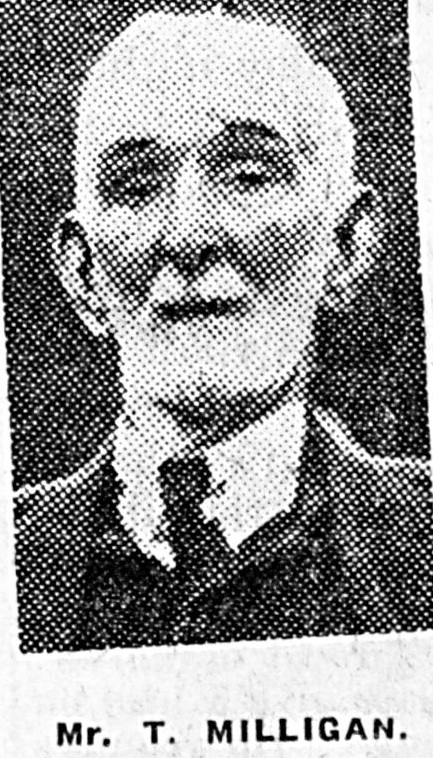
Among those present at the services was Mr Thomas Milligan, of Dean Bank, who is 84 years of age, and is the sole survivor, of those who were present at the foundation of the church.
(12th October 1931 Newcastle Daily Chronicle)
Leaving Tudhoe.
Father Francis Tuohey Going to Houghton-le-Spring.
Parishioners of Tudhoe St. Charles’ Roman Catholic Church are taking their farewell this week of Father Francis Tuohey, who is leaving to take over the duties of parish priest at Houghton-le-Spring.
Father Tuohey has been curate at Tudhoe St. Charles’ Church for the past 11 years and during that time has become one of the most popular priests who has ever been in the Spennymoor district, numbering among his friends many people of other denominations.
Born at North Shields, where his father was headmaster of St. Cuthbert’s Church, in 1899, Father Tuohey was ordained at Ushaw College in 1917, proceeding afterwards to Carlisle for three years and then to Tudhoe in October, 1920.
He has two brothers in the priesthood – Canon Ernest Tuohey, of Windermere, and Father E C Tuohey, parish priest at North Gosforth.
(21st October 1931 Newcastle Daily Chronicle)
Father Francis Tuohey was succeeded at Tudhoe by Father Denis O’Brien of St Mary’s Cathedral.
(26th October 1931 Newcastle Daily Chronicle)
£500 For Byers Green Church.
Mr. Frederick Purdy, of Dunelm, York Place, Wetherby, Yorks left gross estate of £8,456, with net personalty £7,922. He gives £500 to the rector and churchwardens for the time being of the parish church of Byers Green, Durham, to be applied in or towards the maintenance, repair, renewal or rebuilding of the fabric of the church.
(26th October 1931 Newcastle Evening Chronicle)
 County Palatine of Durham.
Division of Counties Act, 1828.
Application for the Formation of a Petty Sessional Division of Spennymoor.
Notice is Hereby Given that I have received the following Statement signed by Five Justices of the Peace for the County of Durham namely:—
To: The Clerk of the Peace for the County of Durham.
We, the undersigned Justices of the Peace for the County of Durham are of opinion that the following Parishes and Townships within the said County and now forming part of the Petty Sessional Divisions of Bishop Auckland and Durham would form together a convenient and a proper division within and for which a separate and special Sessions should henceforth be held, and that the name of such new Division should be the Spennymoor Petty Sessional Division, namely:—
The Townships of Whitworth and Whitworth without.
The Township of Merrington
The Township of Middlestone which includes Middlestone Moor and Middlestone Village
The Township of Byers Green
The Township of Newfield
The Township of Merrington Lane
and a portion of the Township of Ferryhill all in the Bishop Auckland Petty Sessional Division
and
The Township of Tudhoe including Tudhoe Grange and Tudhoe Colliery, and Mount Pleasant
The Township of Sunderland Bridge including Croxdale
The Parish of Hett
The Township of West Cornforth
Part of the Township of Ferryhill comprising Thinford, East Howle, Ferryhill and Dean Bank and the Township of Low Spennymoor, all in the Durham Petty Sessional Division.
The proposed new Petty Sessional Division is more particularly shown on the map which accompanies this statement.
There is a population of over 35,000 persons residing within the proposed new Division.
The names of such Justices of the Peace as at the date hereof are usually resident or acting as such within the boundaries of such proposed new Division are as follows:—
Thomas Adam Beresford Kane, Esq.,
Henry Askew, Esq.,
John Bell, Esq.,
William Henry Clark, Esq.,
William Robson Dakers, Esq.,
John Henry Bacon Forster, Esq.,
William James Glasper, Esq.,
John Reavley, Esq.
Mrs. Elsie Royston
The existing Petty Sessions at Spennymoor was established there some 20 years ago, and is held at present on alternate Tuesdays one for the Bishop Auckland and the other for the Durham areas, such Petty Sessions being conducted by the Clerks to the Bishop Auckland and Durham Petty Sessional Divisions respectively.
This makes for a dual instead of a united Police Court and the consequent procedure results in some cases in confusion and unfairness, as for instance, in the granting of extensions to Licensed Houses and opening of Picture Halls on certain special occasions, when the two Petty Sessions have not been agreed on the rules to be adopted in dealing with such applications.
Under present arrangements there is also continual difficulty and unnecessary trouble and expense caused to persons who have to make use of the Spennymoor Police Court, inasmuch as they must go either to Bishop Auckland or Durham to institute process, and this would be avoided by the proposed new Petty Sessional Division being established at Spennymoor.
Dated this 15th day of September, 1931.
John Reavley.
H. Askew.
W. H. Clark.
W. J. Glasper.
John Bell."
And Notice is Hereby Further Given that the above Statement was in pursuance of the directions of the first-mentioned Act of Parliament laid by me before the Justices assembled at the General Quarter Sessions of the Peace holden in and for the County Palatine of Durham on the 12th day of October, 1931, and that the same will be taken into consideration by the Court at the next General Quarter Sessions of the Peace to be held at Durham in and for the said County on Monday, the 4th day of January, 1932.
Harold Jevons,
Clerk of the Peace.
Shire Hall,
Durham, 17th October, 1931.
(19th October 1931 Newcastle Daily Chronicle)
Found in Skerne
Spennymoor Man’s Suicide After War-Contracted Malaria.
A verdict of “Suicide while temporarily insane” was recorded at an inquest at Darlington last night on John Barker Knight (40), of 66, Craddock Street, Spennymoor, whose body was found in the river Skerne at Darlington on Thursday.
Evidence showed that Knight suffered from malaria as a result of war service in Egypt, and this gave him pains in the head.
(17th October 1931 Newcastle Daily Chronicle)
 Death of Dr. J. O’Kane.
The death took place at his residence, Hillcrest, Ferryhill, of Dr. J O’Kane. He visited patients and attended to his surgery on Friday.
He was a noted footballer in his younger days, playing as an inside-left forward, in which position he gained his international cap for Ireland. He also appeared with Ferryhill Athletic. He leaves a widow and six young children.
(18th October 1931 Sunday Sun Newcastle)
The funeral was at Chilton Cemetery after the coffin remained in Ferryhill All Saints’ Roman Catholic Church during Monday night in charge of members of the Confraternity of the Blessed Sacrament. Requiem mass was sung, the Rev L Power being celebrant, and a large number of mourners attended the funeral.
(21st October 1931 Newcastle Daily Chronicle)
Died at Door of Surgery
Mr E Robson, of Spennymoor.
The death occurred suddenly last night of Mr Edward Robson, of Clyde Terrace, Spennymoor.
Mr Robson, who was 76 years of age, was entering Dr Farquarson’s surgery in Whitworth Terrace to consult the doctor when he collapsed and fell to the ground.
He was picked up and carried inside, but he was found to be dead.
Mr Robson was well-known in mining circles in the Spennymoor district, having for a number of ears been manager at Tudhoe Colliery and later manager of the Merrington Park Colliery.
(20th October 1931 Newcastle Daily Chronicle)
 Driver’s Three Offences.
Lightless and Without Licence at Spennymoor.
John Bradshaw (34), of Parker Street, Merrington Lane, was charged at Spennymoor, to-day, with driving a motor-car without lights, with having no driver’s licence, and with having no certificate of insurance.
PC Brammer said when he asked Bradshaw why he had no lights he replied, “My battery is run down.” Bradshaw pull a wallet from his pocket, and after looking inside said, “I must have left the licences at home.”
On October 2 he came to Spennymoor Police Station, said witness, and produced a driving licence which had expired on August 2, and a certificate of insurance which had expired on September 15.
Bradshaw pleaded not guilty to the charge of no lights, and said the lights were burning dimly when he was stopped. He pleaded guilty to the other two charges.
He was fined 10s for having no lights, 20s for having no driver’s licence, and 20s for not having a certificate of insurance.
(20th October 1931 Newcastle Evening Chronicle)
Spennymoor Thrill
Lorry Driver Fined in Court Sequel.
John Smurthwaite (24), of Wear Street, Spennymoor, was at Spennymoor to-day charged with having driven a motor-lorry without due care and attention.
Supt. Headen said that on October 3, about 3.30pm, defendant was driving a motor-lorry down High Street, Spennymoor. He was following a brass band, and attempted to pass the band on his right side, but seeing a ‘bus standing, he attempted to pass on the wrong side, causing a crowd of people to scatter. One of the bandsmen was struck by the lorry and injured.
John R Burrell said he was one of the bandsmen. He heard a shout and was struck by something. He remembered nothing more until he found himself in a shop nearby.
He was still suffering from the effects of the injury to his leg.
Defendant pleaded guilty and offered no defence. He was fined 20s and 29s 1d costs.
(20th October 1931 Newcastle Evening Chronicle)
Loaned Bus Sequel.
Five Persons Fined for Road Offences.
When Sidney Fisher (23), of Albert Street, Windlestone, lent his bus to Raymond Preston (22), of Wesley Street, Ferryhill Station, he started a train of circumstances which resulted in the appearance at Bishop Auckland Police Court yesterday of several persons charged with offences in connection with the running of buses.
Fisher was charged with having had an uninsured bus, Preston with having used the vehicle while it was uninsured, Thomas Lavery of Bishop’s Close Row, Spennymoor, with driving an uninsured bus, Fred Batson, of Surtees Terrace, Ferryhill Station, with conducting on the bus without a licence, and Mary Preston, wife of Raymond Preston, with allowing Batson to use her conductor’s badge.
Fisher was fined 20s., Preston 10s., and Lavery, who was also charged with overcrowding, 30s in all. Fines of 10s and 5s respectively were inflicted on Mrs Preston and Batson.
On a charge of employing Lavery to drive, Raymond Preston was further fined 10s.
(23rd October 1931 Newcastle Daily Chronicle)
More State Ecomomies.
Big Cuts in Pay of Law Chiefs.
Lew Gardens Toll.
From Our Parliamentary Representative - Westminster, Thursday.
More economies were announced by the Government to-day. Major Elliot, the Financial Secretary, intimated the following cuts in salaries:
The Attorney-General, Sir William Jowitt, from £7,000 a year to £2,000.
The Solicitor-General, Sir Thomas Inskip, from £6,000 a year to £2,000.
In addition to their salaries the Attorney-General and Solicitor-General receive big sums in fees.
It was stated in the House last April that between June 1929 and March 1931 the Attorney-General received in salaries £12,654 and in fees £26,564.
During the period from June 1929 to October 1930, the late Sir William Melville [Melville?] as Solicitor-General received in salary £8,042 and fees £4,720, while Sir Stafford Cripps, his successor, drew, between October 1930 and March 1931 £2,576 in salary and £3,188 in fees.
Acting on the principle that every penny counts, the Government has also decided to impose a penny admission fee to the famous Kew Gardens, so well-known to all visitors to London. This penny toll is estimated to bring in £3,500 a year.
Voluntary Reductions.
It was announced in the House of Commons to-day that Sir Ernest Gowers, the chairman of the Coal Reorganisation Committee, voluntarily surrendered 20 per cent. of his salary as a contribution to the national scheme of economies.
Mr. J. Batey (Socialist, Spennymoor), asked Mr. Isaac Foot, the Secretary for Mines, what was the amount of the chairman's salary cut and Mr. Foot replied that immediately the economy proposals of the Government with regard to the salaries of public servants were announced the chairman asked that during the present emergency an abatement of 20 per cent. (£1,400 a year), might be made from the salary payable to him.
Mr. Foot added that the offer had been gratefully accepted and that reduction took place from to-day.
(2nd October 1931 Newcastle Daily Chronicle)
Unemployment Figures.
Replying to Mr Batey (Soc. Spennymoor) Sir Henry Betterton said that at 21st September, 1931, there were 148,511 persons with claims admitted or under consideration on the registers of employment exchanges in the County of Durham including 33,597 men and 1,725 women with claims authorised for transitional benefit. Of those in receipt of benefit other than transitional benefit at 14th September, 1931, 22,340 men and 1,299 women had received 156 days or more in their current benefit years.
(2nd October 1931 Yorkshire Post and Leeds Intelligence)
Workers' 'Dole' Cut Protests.
Attack on Premier by Spennymoor M.P.
Hint That He Will Not Fight Seaham.
A mass demonstration of unemployed, trades unionists, women members of the Labour Party, and the public generally against the Economy Bill took place at West Cornforth, on Saturday.
Before the meeting, which was addressed by Messrs. J. Herriotts, M.P. for Sedgefield division, J. Batey, M.P. for Spennymoor division, and J. Ritson, M.P. for Durham division, a procession was held from Old Cornforth to the ground behind the Welfare Hall.
A resolution registering emphatic protest against the cuts and economies at the expense of the poorest section of the community, and calling for their withdrawal was adopted.
The resolution also referred to the additional misery and privations which would be caused among the unemployed by the proposed transitional conditions.
Mr. Herriotts said he objected to teachers’ salaries being cut. Education was always attacked by wealth and culture not for the purpose of saving money, but in order that democracy might not be educated.
Effect of Dole Cut.
Mr. Herriotts denounced the cuts made in unemployment pay, and said they were contrary to the principles of equality of sacrifice. He also referred to the degradation that would be inflicted upon many respectable unemployed workmen who would have to appear before Public Assistance Committees to claim their transitional benefit.
Mr. Ritson said he was afraid the slight increase in industry which was reported was only temporary, and was due to gambling in stocks and shares. The only way in which the world would ever get back to sanity was for every nation to clear away the imaginary things called war debts.
The Tory Party were boasting that Labour would not return 100 members to Parliament, and were urging the Prime Minister to get the election over before the people found the pinch, but they were finding it now.
Bitter Attack on Premier.
During his address Mr. Batey dealt with the action of the Prime Minister, whom he bitterly attacked, stating that the Premier was responsible for the political earthquake which had taken place and was now the head of a capitalist Government.
He was glad the Premier had been turned out of the Labour Party, and hoped he would never be allowed to come back, but would be forced to live with the wealthy friends with whom his sympathies were.
Mr. MacDonald, added Mr. Batey, would not have the guts to fight Seaham, where there would be opposition, but would do the same as he did at Seaham, where Mr. Sidney Webb was sent to the House of Lords so that there would be a safe seat. He would do the same with some safe Conservative seat at London.
At a meeting of Cockfield unemployed men it was unanimously decided to protest against the cut in unemployment pay. Addresses were given by Councillor J. B. Heys, of Bishop Auckland, and Mr. W. Worden, of Preston, members of the Independent Labour Party.
(5th October 1931 Newcastle Daily Chronicle)
Never Attend Meetings.
Billiard-Hall Owner’s Advice for Election.
The proprietor of a billiard-saloon in Spennymoor has posted the following humourous list of hints headed:
“What to do if you want to kill an organisation.”
1 Don’t come to the meetings.
2 But if you do come, come late.
3 If you attend a meeting, find fault with everybody.
4 Never accept office, as it is easier to criticise than to do things.
5 Get sore if you are not appointed on the committee, but if you are appointed, don’t attend.
6 If asked to sit on the platform, refuse.
7 If you are not asked, resign at once.
8 Agree with everything said at a meeting, and disagree with it outside.
9 Talk co-operation for the other fellow with you, but never co-operate with him.
10 When all else fails, curse the officers.
(15th October 1931 Newcastle Daily Chronicle)
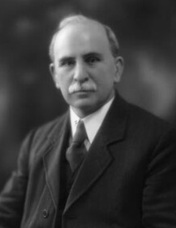 The 1931 General Election
The National Government was a three-party coalition which had been formed two months previous to the election after the collapse of the second Labour government. They received a huge majority of the 615 seats.
National Government: 554: Conservatives 470, National Liberals 67, National Labour 13, Ind 4
Opposition 61: Labour 52, Others 9.
Socialists lost all eleven Durham County divisions except Chester-le-Street and Spennymoor, they also lost Tynemouth, Wallsend, Gateshead, South Shields, Sunderland, Darlington and Stockton.
Candidates Spennymoor.
Joseph Batey, miners’ agent, Sunnybrow House, North End, Durham (Soc).
Michael Dodds McCarthy, retired colliery official, The Grange, Belmont, Carrville, near Durham (Nat. Con.).
(16th October 1931 Hartlepool Northern Daily Mail)
Spennymoor Results.
Joseph Batey 18,072
Michael D McCarthy 14,072
Socialist majority 4,000
A large crowd gathered in the High Street, Spennymoor, to hear the result of the poll and loud cheers greeted the appearance of Mr Batey with Mr H E Ferens, the returning officer.
In moving a vote of thanks to the returning officer Mr Batey said the fight had been a clean one and he thanked his supporters for once more putting him at the head of the poll.
Mr McCarthy seconded the vote of thanks and said the fight had been a keen one and he was delighted with the excellent support he had received. This constituency was looked upon as one of the safest Socialist seats but he had reduced the majority by more than one half. He felt sure when the full benefits of the National Government policy had been felt that he would win the seat next time.
(29th October 1931 Newcastle Daily Chronicle)
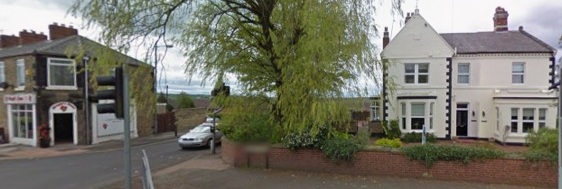 Golden Wedding
Mr & Mrs T H Warwick, of West Hartlepool.
Mr. and Mrs. T. H. Warwick, of 32 Grange Road, West Hartlepool, celebrate their golden wedding to-day.
Born at Gateshead-on-Tyne in September, 1857, Mr. Warwick received the whole of his education at the High West Street Wesleyan Day Schools. He commenced his business career in the passenger superintendent's office, Central Railway Station, Newcastle, under the late Godfrey Smith, and one of his colleagues in the same office was the late T. M. Healey, Governor-General of Ireland.
Subsequently he joined the staff of Monkhouse Goddard and Co., chartered accountants, Newcastle, and within a few weeks was transferred to West Hartlepool, where the firm were opening out a branch office.
In 1880 he received an appointment with the firm of Edward Withy and Co., at the Middleton shipyard, and eventually occupied the position of chief cashier and accountant with that company.
At Spennymoor.
In 1900, when the late Lord Furness was taking over the blast furnaces, rolling-mills, and collieries of the old Weardale Iron and Coal Company, Mr. Warwick was offered, and accepted, the secretaryship of that huge undertaking, and shortly afterwards was appointed commercial manager also.
During his residence in Spennymoor he devoted much time to local affairs, and was ever ready to help in any good cause. He was a prominent member of the Urban District Council for many years, and for a period was chairman.
During a period of extreme local depression a relief fund was formed for the purpose of alleviating the distress, and he was personally instrumental in collecting over £500 towards the fund. In recognition of this he was the recipient of a pleasing public memento.
Perhaps, however, the most satisfactory result of his labours was when he presented a cheque for nearly £1,000 towards the Aged Miners' Homes. His old friend, the late Mr. John Wilson, M.P., President of the Durham Miners' Association, had made a strong personal appeal to him to organize a bazaar in Spennymoor in aid of the homes, and, having secured the active personal assistance of the late Marchioness of Londonderry, Lady Stephen Furness, and the late Lord Furness, Mr. Warwick was enabled to hand over the amount mentioned — an extraordinary achievement at a time of great trade depression and in a small colliery town like Spennymoor.
Services During the War
During the war Mr. Warwick was engaged in various Government departments concerned with costs of production, etc., and for two years after the Armistice his services as an expert accountant were retained by the Government for the purpose of examining and settling hundreds of claims for compensation owing to cancellation of contracts and consequent loss of profit. Latterly he has been practising as a consulting accountant.
Mrs. Warwick was the elder daughter of Mr. and Mrs. Moffet Little, of Penrith. The marriage took place at Stranton Church on October 31st, 1881, the officiating clergyman being the Rev. John Rudd, the vicar.
During her residence in Spennymoor Mrs. Warwick took a very active part in the social life of the people and was president of the Nursing Association, with Sybil Lady Eden as a most active associate. No appeal to her sympathy and practical help was ever made in vain when once the justice of such appeal had been established.
(31st October 1931 Hartlepool Northern Daily Mail)
Thomas Henry Warwick (1857 Gateshead-1932 W. Hartlepool) was the son of Joseph Warwick, who worked in a brass foundry and was also a congregational local preacher, and Mary Ann Waggott. In 1871, aged 13, Thomas is an office boy in Gateshead, by 1881 he is a boarder in West Hartlepool and working as a shipbuilder’s clerk.
He married Annie Mary Little in 1881 at West Hartlepool and they had three children, Vivian Summers (1884, W Hartlepool), Olive (1886, Penrith)and Mabel Annie (1888, Headingley, Leeds). In 1891 they are at Headingley, Leeds where Thomas is an accountant.
By 1901 Thomas and Vivien are boarding at 1 Bessemer Terrace, Mount Pleasant, Tudhoe, Thomas is Secretary of the Weardale Company and Vivian is an assistant cashier. Annie is visiting a relative in Wales and Olive and Mabel are with a servant in Rotherham.
In 1911 the family were living at The Poplars, North Road, Spennymoor, they left Spennymoor in 1913.
Presentation at Spennymoor
In the Council Room, Spennymoor, last night, Mr T H Warwick was the recipient of a handsome present by his friends and the public generally. Councillor W Baines was in the chair. The gift consisted of a purse of gold. Mr Rhymer, in handing over the present to Mr Warwick, spoke of the many public offices he had held, and of the regret expressed at his leaving the district Mr Warwick suitably responded.
(16th January 1913 Newcastle Journal)
In 1921 Thomas was at Bloomsbury Hotel, London while Annie and Olive were at 16 Milton Road, West Hartlepool, Olive was a dispenser of medicines at Havelock House, West Hartlepool for two doctor’s.
Thomas Henry Warwick died on 7th January 1932 at his home in Hartlepool.
Road Collapse Near Spennymoor.
An alarming accident occurred yesterday afternoon to a steam lorry owned by the Sacriston Motor Co. The lorry, which was loaded with about ten tons of road chippings, was being driven past the side of the Commercial Hotel, Nutter’s Buildings, near Spennymoor, when the road collapsed over an area of several feet.
The off-side rear wheel of the lorry sank into the ground and the lorry was partially overturned, the near side wheels being suspended in the air. A steam roller was obtained to pull the lorry clear of the hole. The driver escaped injury.
(12th September 1931 Hartlepool Northern Daily Mail)
Lady Chaytor’s Escape.
Crash Into Lamp-post in Avoiding a Lorry.
Lady Chaytor, of Witton Castle, was involved in a motor accident in Whitworth Terrace, Spennymoor.
In avoiding a lorry which was turning into a side street, Lady Chaytor drove on to the pavement and knocked down a lamp-post.
Sir Edmund Chaytor and a friend were in the car, but all three escaped injury.
“There were some people at the street corner,” Lady Chaytor told an “Evening Chronicle” reporter, “and how I missed them I hardly know.”
“It was a miracle. Luckily I kept my head, for had I gone into these people I hardly know what would have happened.”
(15th September 1931 Newcastle Evening Chronicle)
Bus On Fire.
Vehicle Burned Out Near Cornforth Bridge.
A 14-seater Chevrolet motor-bus, forming part of the Unity Service which conveys passengers between Spennymoor and Coxhoe , took fire this afternoon at Cornforth Bridge between West Cornforth and Coxhoe, while on its way to the latter village. The vehicle was almost destroyed, onlby the conductory the bonnet remaining.
The fire originated under the driver’s seat close to the petrol tank. It was first noticed by the conductor, James Bruce, of Spennymoor, who warned the driver. Fortunately there were no passengers in the bus at the time.
The conductor managed to escape without injury, but the driver, Allen Tolley, of Spennymoor, had a more difficult task, and his hairwas slightly singed. Bus owned by Elijah Pearson of Spennymoor.
(19th September 1931 Hartlepool Northern Daily Mail)
Skids on Road - Cause of Motor Accidents During Week-End.
A serious motor accident befell a party of eight holidaymakers at Croxdale, on the Great North Road, yesterday. The party left Ramsgate on Saturday to spend a week’s holiday at Gateshead.
The car, driven by Fred Leslie Curry (19), of Canterbury, skidded on the greasy road, mounted the kerb, ran up the bank side and overturned. Two passengers – Mrs Martha Forsester and Mrs Ann Bryan- sustained injury which necessitated their removal to Durham Infirmary. The rest of the party escaped with shock. The car was wrecked.
(21st September 1931 Leeds Mercury)
10 M.P.H. Over Crossing.
Boy Knocked Down by Bundle Hurled from Van.
“You men drive at a terrible rate. I have seen vans pass me on the road like a flash,” said the chairman of the Spennymoor bench (Dr T A Beresford Kane), when the driver of a newspaper van was charged with driving without due care and attention yesterday.
The driver, Claude Wilson, of Barnesbury Road, Newcastle, pleaded guilty, and was fined 40s.
Inspector Cook stated that on Saturday evening, September 5, he saw a newspaper van coming from Spennymoor towards Bishop Auckland. It passed the Binchester road ends without slackening down at a speed between 40 and 50 miles an hour and, as it passed, a boy sitting beside the driver hurled out two bundles of papers.
One bundle went into a field, and the other struck a small boy waiting for a bus, knocking him down.
(23rd September 1931 Newcastle Daily Chronicle)
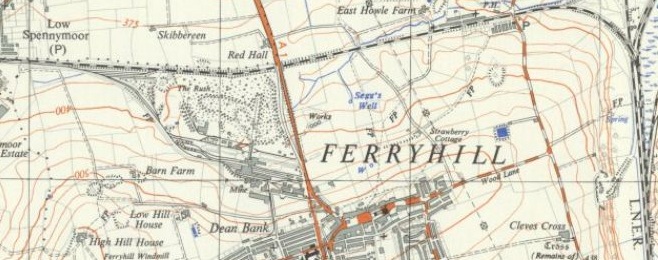 Remarkable Escape
Motor Lorry Suspended Over Bridge.
Cows and Horse Killed in Mishap Near Ferryhill.
Drover Flung to Ground.
A Lorry Driver, his companion, and a farm worker, had narrow escapes to-day, when a motor-lorry, after dashing into a herd of cows on the Great North Road between Durham and Ferryhill, crashed into a railway bridge and came to rest with its front wheels suspended over the railway.
Three valuable cows and a horse were killed and several cows injured; while the railway line was blocked and road traffic had to be diverted.
Series of Road Deaths.
The accident occurred at the railway bridge near Red Hall Farm.
A herd of cows belonging to Mr. William Morgan, of the Village Farm, Ferryhill, was being driven from a field near Red Hall Farm by Robert Hepplewhite when they were run into by a lorry owned by Lockwood and Hayes, of Mexborough, and driven by Paul Allan Jones, of Byron Road, Mexborough, who was accompanied by Joseph Lawrence, also of Mexborough.
In an attempt to avoid the herd the lorry swerved and crashed into the railway bridge on the main L and N.E.R. line between Ferryhill and Spennymoor, and the corner stone of the bridge, weighing several tons, was flung on to the railway line, which was blocked for some time.
The front of the lorry was completely wrecked, the windscreen was shattered, the woodwork smashed, and one door was wrenched from its hinges and thrown some distance away.
Flung From Horse.
Hepplewhite told an "Evening Chronicle" representative that he was driving the cows along the main road when the lorry dashed into the herd and then collided with him, knocking him from a horse which he was riding.
He felt the wheels of the lorry scrape his shoulder as it passed him while he lay on the road.
The lorry was laden with glass bottles, and a number of these were strewn about the road, and for a time traffic was diverted by the old Ferryhill road.
The lorry is in a precarious position, hanging over the railway bridge.
(28th September 1931 Newcastle Evening Chronicle)
Court Case November 1931
Cow's 48 Feet "Flight"
When Paul Jones (30), a motor-lorry driver, of Mexborough, was fined £10 at Spennymoor, to-day, for careless driving, it was stated his vehicle killed three cows and one horse and then crashed into a bridge, the masonry from which blocked the railway beneath.
The accusation was a sequel to a collision on the North Road, near Ferryhill, on September 28 at 6 a.m., when it was stated that Jones driving a heavy lorry carrying six tons of goods ran into a number of cows and horses which were being driven along the road.
Traffic Blocked.
Three cows and one horse were killed and the lorry, after dispersing the animals in all directions charged into the parapet of the bridge and dislodged several tons of masonry on to the railway beneath, completely blocking the traffic until a breakdown gang had cleared the line.
One of the cows, it was alleged, was lifted bodily from the ground, and hurled a distance of 16 yards.
Police evidence was given to the effect that Jones’s vehicle travelled 43 yards with the wheels locked before it struck the bridge with tremendous force.
Jones pleaded guilty, and said that he had driven throughout the night from Mexborough, and had only had half an hour’s break at Catterick.
He contended that the damage done was not due to the speed of the lorry, but to the fact that the weight of the vehicle, and the load was considerably over ten tons.
(10th November 1931 Sunderland Daily Echo)
Passengers Sit on Stools - Bus Driver in Trouble at Sunderland.
Allan Tolley (20), of Upper Church Street, Spennymoor, was accused at Sunderland Police Court, to-day, of driving a public service vehicle without first-aid dressings, of having the exits obstructed, and of carrying an excess number of passengers.
Dolonzo Pearson, of Stratton Street, Spennymoor, the owner, was accused at the same time of aiding and abetting the first offence.
P.C.s Rouse and Race stated that when the bus was stopped in Durham Road it was carrying 25 adults and four children. It was licensed to carry 20 passengers. In the gangway were house stools, and some passengers were sitting on them.
A fine of 10s was imposed in each of the four cases.
(30th September 1931 Sunderland Daily Echo)
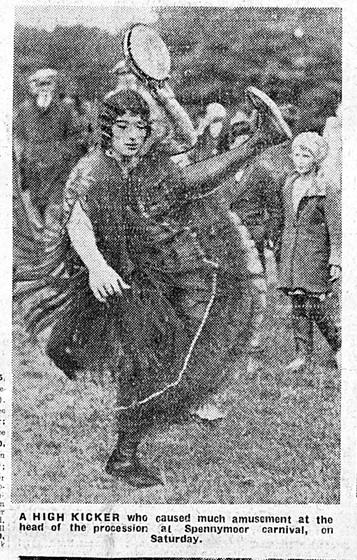
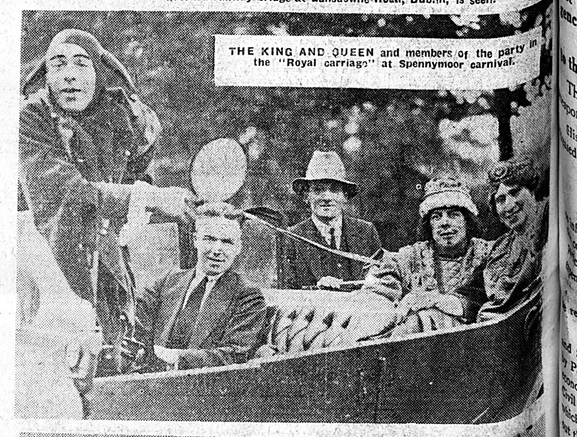
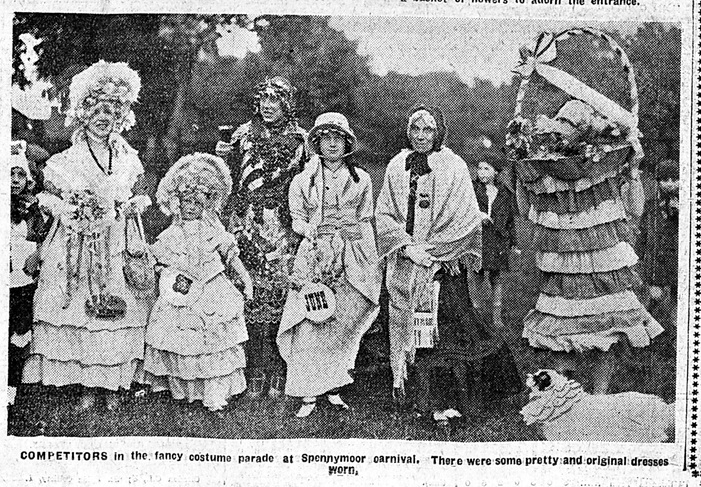
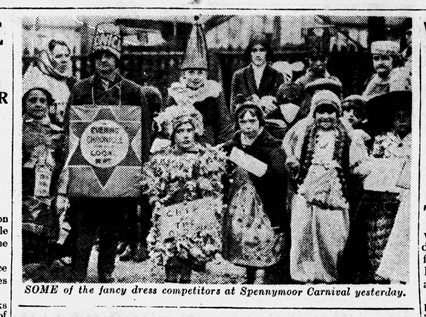
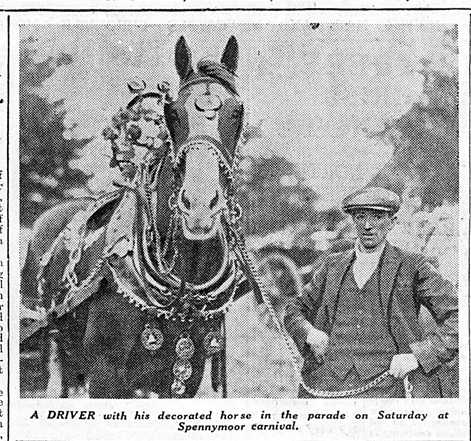 Spennymoor's Carnival Time.
Winners at Parade and Band Contest.
The streets of Spennymoor were lined with people on Saturday when the charity carnival procession passed along.
Councillor W. Hirst and Mr. W. Newton occupied positions of honour as the King and Queen of Carnival.
The following awards were made:—
Jazz Band Parade.—1, Thornley Melody Makers; 2, Trimdon Jolly Tars; 3, Hetton Downs Pierrots.
Jazz Band Muster Prize.—Trimdon Jolly Tars.
Juvenile Jazz Bands.—Shotton Stars.
Trade Display.—1, W Jameson, Spennymoor; 2, Co-operative Wholesale Society’s Soapworks, Dunston.
Decorated Vehicle.—1, W Jameson, Spennymoor.
Groomed Horse.—1, Sedgefield R.D.C.; 2, Spennymoor U.D.C.
Original Costume.—1, W Scott, Witton Park; 2, L Pollard, Coundon.
Adults’ Fancy Costume.—1, Mrs Pearson, Blaydon; 2, Mrs Hunter, Eldon Lane.
Adults’ Comic Costume.—1, J Vester, Chilton; 2, A F Lindsay, Woodside.
Adults’ Costume Advt.—1, D Pollard, Coundon; 2, Mrs Cowie, Winlaton.
Children’s Fancy Costume.—1, A Pollard, Coundon; 2, A Trotter, Bishop Auckland; 3, E Cowie, Winlaton.
Spec.—I Ankers, Sherburn.
Children’s Comic Costume.—1, J Thomas and J Clark, Spennymoor; 2, E Brain, Spennymoor; 3, A Jameson, Spennymoor.
Children’s Costume Advt.—1, M Stephenson, Spennymoor; 2, W Ross, Bishop Auckland; 3, W Towers, West Auckland.
The brass band contest was held in the New Town Hall owing to the cold weather.
The adjudicator, Mr. W. H. R. Straughan, Hetton, made the following awards:—
Selection: Test piece “Golden Age.”—1, Cargo Fleet Ironworks Band; 2, Thornley Colliery Silver Band; 3, Eldon Silver Band; 4, Houghton-le-Spring Silver Band.
March Contest.—1, Cargo Fleet Ironworks; 2, Thornley Colliery.
The carnival concludes to-day, when a programme of children’s sports will be carried out.
6 photos
(7th September 1931 Newcastle Daily Chronicle)
Allotment Rivals - Spennymoor Society’s Show Awards.
The White Moor Spennymoor Allotments Society held their annual show of vegetables and flowers at the Half Moon Inn, Low Spennymoor on Saturday. Mr E Forth, of Spennymoor, was the judge, and the following were prize-winners:-J Mason, W Proctor, P Mason, E Edwards, G Greenwood, C Proud, B Mason, J Spencer, W Harrison, R Clements, F Spence, G Mason, C Bennett, J Goundry, W Ainsley, D Edwards, C Mason, C Greenwood, P McCann, C Ward, J Anderson, J Ainsley, A Edwards, R Hardacre, J W Cooper, G Waistell.
(7th September 1931 Newcastle Daily Chronicle)
Allotment Cup Winner.
The Howson Cup awarded for the neatest and best set out allotment of the Ferryhill Station Allotment Association, has been won by Mr James R Barber of The Broom, Ferryhill, for the second year in succession.
Mr Sedgewick, of Winterton, Sedgefield, the judge, visited more than 250 allotments.
The association has 300 members, the chairman being Mr J R Eales.
(24th September 1931 Newcastle Daily Chronicle)
Rate Cuts For 3 Districts
Spennymoor UDC’s Surprise.
Salaries Reduced.
There was a pleasant surprise for the ratepayers at Spennymoor Urban Council, last night, when the finance committee recommended a reduction in the rates in three of the districts of the urban area for the forthcoming half-year.
The new rates are:-
Low Spennymoor 7s 2d a decrease of 9d.
Tudhoe 7s 6d a decrease of 7d
Whitworth 8s 10d a reduction of 3d
Merrington Lane 9s 7d an increase of 2d.
It was explained that the increase in the Merrington Lane district was due to the council having to levy a special rate of 9d left over from the old board of Guardians.
(15th September 1931 Newcastle Daily Chronicle)
Spennymoor Urban Council.
The SUC have decided to reduce the salaries of their officials and other employees by amounts varying from 25 per cent, to 2.5 per cent as from October 1.
The clerk’s salary will be reduced by the larger amount, those of the surveyor, sanitary inspector and medical officer bt 10 per cent., and the remainder between five and 2.5 per cent.
Estimates have been cut so as to allow the rate reductions.
(26th September 1931 Yorkshire Post and Leeds Intelligence)

 Old People’s Treat.
A hundred old people of Ferryhill, ages range between 65 and 87, were entertained by the Ferryhill Parish Council. on Saturday.
During the afternoon they were taken to the Gaiety Theatre, and later tea was provided in the Town Hall and Club Hall.
(14th September 1931 Newcastle Daily Chronicle)
Ferryhill “NO” to P.O.
Ferryhill Parish Council last night refused permission to the Post Office to erect telegraph pole additions in open spaces.
The Post Office were also requested to remove poles that have already been erected in open spaces, as they were considered dangerous owing to the great increase in motor traffic.
(17th September 1931 Newcastle Daily Chronicle)
Playfield for Ferryhill.
Mr Robert Willey, the Clerk of the Ferryhill Parish Council, has had a visit from Mr Crawley, agent of the Dean and Chapter, to discuss possible sites for a playing field in the village.
They will meet the Dean of Durham on October 3, with recommendations. Mr Crawley said that the Vicar had not yet abandoned the consideration of the Glebe Field.
(17th September 1931 Newcastle Daily Chronicle)
 Nail Cause of Death?
Inquest on Tudhoe Colliery Miner Adjourned.
Because the doctor who had attended him was away on holiday, the inquest on William Brown (41), a colliery overman, of Front Street, Tudhoe Colliery, who died from blood-poisoning caused, it is believed, by a nail, was adjourned last night.
Annie Brown, the widow, stated that her husband came home from work on Friday and complained of feeling ill, and went straight to bed. As he was no better on the following Monday, and had been unable to sleep, she called in Dr Patullo, who gave him some tablets.
Dr Patullo did not see her husband again until two days later, and, as the doctor was then going away on holiday, he left his assistant, Dr Stein, to attend him.
Her husband made improvement from the Wednesday until the Friday, when he had a relapse and died, she added.
The inquest was then adjourned till September 4 so that Dr Patullo could give evidence.
(12th August 1931 Newcastle Daily Chronicle)
Sat On A Nail - Tudhoe Miner’s Inquest Story.
A verdict of “Accidental death” was returned at the resumed inquest at Tudhoe Colliery, last night, on William Brown (41), a colliery overman, of 104, Front Street, employed by the Weardale Steel, Coal and Coke Company, who died after sitting on a nail.
At the opening of the inquest on August 11 evidence was given of a postmortem examination having been made and that Brown had died of blood poisoning
Set up from a punctured wound, said to have been caused by his sitting upon a nail. No evidence was then available as to where he had received the wound.
Last night, Dr Patullo, who attended Brown from July 27, until August 1, said that the wound was rather peculiar looking, and had the appearance of an abscess with a hole.
Brown had volunteered the information that he had sat upon a nail while at work.
Coroner E B Proud: Are you quite clear that he added the words “while at work?”
Dr Patullo: “Quite clear.”
(5th September 1931 Newcastle Daily Chronicle)
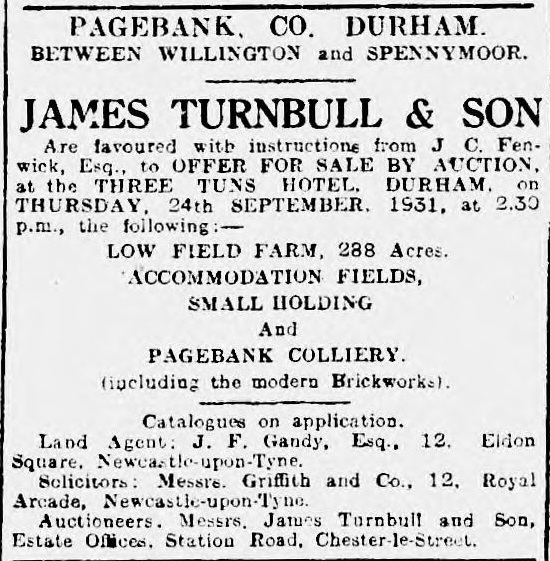 Page Bank Colliery
Offered with Farm, but Only Fitting Shop Sold.
Page Bank Colliery, near Spennymoor, with Low Field Farm, small holdings, etc., was put up for public auction at the Three Tuns Hotel, Durham, yesterday, and of the 10 lots offered, only one was sold, this being the fitting shop, which went to Mr H Dixon, of Page Bank, for £40.
Page Bank Brickworks, which comprises the colliery, brickworks and a brickfield, was withdrawn at £280.
Lieut. Colonel J Turnbull (auctioneer), of Chester-le-Street, said they were endeavouring to clear up the sale of all properties belonging to Mr J C Fenwick in that vicinity. There were several attractive lots, in spite of depressed conditions, and he was optimistic enough to think there would be an improvement in industry.
It may be recalled that many dwelling-houses in the village of Page Bank were disposed of some time ago.
(25th September 1931 Newcastle Daily Chronicle)
Putters Strike - Ferryhill Wages Dispute Sequel.
A strike of putters in the Brockwell Seam occurred at Dorman Long and Co.’s Dean and Chapter Colliery, Ferryhill yesterday afternoon.
It appears that on Monday afternoon a putter had a dispute with the banksman, and was sent home. Yesterday when the putters presented themselves for the night shift they approached the manager and demanded that the putter who had been sent home should be paid his wages for the day.
The manager was said to have refused to accede to their request and the putters thereupon refused to go down the pit and marched off home in a body.
The hewers in the Brockwell Seam after waiting some considerable time below had to be withdrawn from the pit and went home.
(16th September 1931 Newcastle Daily Chronicle)
Pit Laid Idle for a Day
Sequel to Putter’s Disobedience.
How a whole colliery was laid idle by the refusal of a putter to take a place allotted to him in a descending cage was heard at Spennymoor Police Court to-day when Thomas Ellison (22), of Beaumont Street, Dean Bank, was fined 40s and costs, for refusing to obey the orders of a banksman at the Dean and Chapter Colliery.
It was alleged that on September 14 Ellison refused to enter the upper deck of the cage when the third shift of men was descending when requested to do so by the banksman.
As a result he was not allowed to descend at all and the upshot was that there was a general dispute between the men and the management and the colliery was laid idle for the day.
For the defence Mr Patrick Bennett said that no request was made to Ellison by name to enter the upper deck of the cage.
(13th October 1931 Sunderland Daily Echo)
“Dole” Cuts Protest.
Arrangements Being Made for Mass Demonstration.
Arrangements are in progress to hold a mass demonstration of trades unionists, both employed and unemployed, at West Cornforth, on Saturday week, to protest against the cuts in unemployment pay. Messrs, J Herriotts, Jos. Ritson, and J Batey, MP’s for the Sedgefield, Durham, and Spennymoor divisions respectively, are being invited.
At a conference of representatives of the various trades unions in Ferryhill, Coxhoe, Kelloe, and West Cornforth, a resolution protesting against the reduction of unemployment benefits, and the introduction of the “needs” test, and asking all trades union and Labour MP’s to resist the introduction of cuts in unemployment and benefit was passed.
(22 September 1931 Hartlepool Northern Daily Mail)
More Workless. - S.W. Durham Toatal Now 18,000.
An increase in the number of persons unemployed in Bishop Auckland and South-West Durham is revealed in the official returns for the past quarter.
It is indicated that there are now 18,002 persons on the live registers at Bishop Auckland, Cockfield, Crook, Shildon, Spennymoor, Stanhope, and Wolsingham labour exchanges, compared with 13,613 for the corresponding quarter last year. The increase during the past quarter, however, is 1,427.
The heaviest rise in figures during the past 12 months has been at Shildon, where the numbers out of work have increased by 1,830. At Cockfield, however, there has been a welcome reduction.
(24th September 1931 Newcastle Daily Chronicle)
4 AM Coal Raid
Spennymoor men Fined For Early Morn Theft.
Wilfred Newall (26), John Rowlands (45), and Wilfred Gray (31), all of Duncombe Street, Spennymoor, were each charged at Spennymoor Police Court to-day with stealing coal, valued at 5s, the property of Dorman Long and Co., at the Dean and Chapter Colliery.
PC Chatt said that at about 4.45am on August 11 he saw four men crossing the colliery yard carrying sacks of coal. He gave chase, but they escaped. He recognised three of the men as the defendants. The fourth man he did not know. On returning to the colliery yard he found 20 sacks full of coal on the ground.
Inspector Derry said coal stealing was becoming so serious at this colliery that the Ferryhill police were kept fully employed watching the coal stacks to the neglect of their other duty. A fine of £1 10s was imposed in each case.
(1st September 1931 Newcastle Evening Chronicle)
 Damaged School Bushes.
Metal Bridge Youths Fined at Spennymoor.
George Holmes (17), Joseph Garrett, Ernest Gibson (17). of Metal Bridge, were each fined 10s and 3s 4d damages at Spennymoor to-day, for having damaged berry bushes and turnips in the East Howle School gardens.
P.C. Walling said that he inspected the gardens and found that the berry bushes had been stripped, and damage done to turnips to the extent of 10s. He interviewed the youths who admitted the offence.
(15th September 1931 Newcastle Evening Chronicle)
62-Year-Old Learner.
Spennymoor Motorist Fined at Gateshead.
When a 62-year-old man, Robert Musgrove, of North Street, Spennymoor, appeared at Gateshead Police Court, to-day, charged with driving a car without due care and attention, the police alleged that he passed a stationary tramcar in Durham Road and scattered passengers who were alighting.
Mr J H Sinton, who appeared for Musgrove, said he was only a learner and the car was a very old one. He said Musgrove knew nothing about the regulations regarding tramcars.
Musgrove was fined 5s and ordered to pay 5s costs.
(16th September 1931 Newcastle Evening Chronicle)
Brothers Fined.
Loitered to Receive Bets at Merrington Lane.
Edwin and Albert Curie, brothers, of Merrington Lane, were charged at Spennymoor Police Court yesterday, with loitering to receive bets at Merrington Lane, and Robert Fearnley (45), of Upper Church Street, Low Spennymoor, was charged with aiding and abetting the offence.
Albert, who admitted 49 previous convictions, none of which were for betting, was fined 40s.; Edwin, who had been before the court four times, was fined 40s.; and Fearnley, whose first offence it was, was fined 20s.
Edwin was stated by Sergeant Taylor to have received slips and money from several persons, but he strenuously denied the charge.
Albert, who took the affair very light-heartedly, asked the magistrates: “Do I look like a bookie’s ‘nark?’ Did you ever see a bookie like this?” as he pulled out his pockets, empty but for many holes.
(23rd September 1931 Newcastle Daily Chronicle)
Spennymoor’s 32.
At Spennymoor Police Court, to-day, 32 persons were summoned for the non-payment of rates. In some cases adjournments were allowed while a definite weekly sum was paid towards the rates, and in others distress warrants were issued.
(29th September 1931 Newcastle Evening Chronicle)
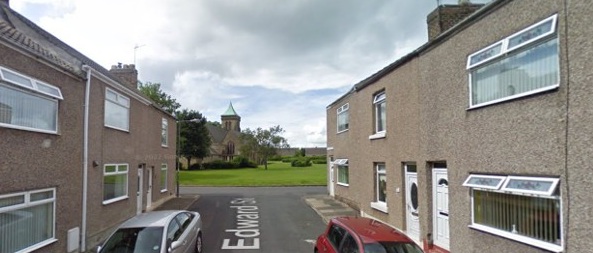 Housework at 94!
Spennymoor’s Oldest Resident.
Although she is 94 years of age, Mrs Elizabeth Urwin, of Edward Street, Spennymoor’s oldest resident, still does her own housework and shopping.
For over 20 years she lived in the Newcastle district, and was from 1869 to 1874, schoolmistress at Sugley.
In 1860 she was married to Mr Thos. Urwin, at Sugley and 50 years ago they removed to Spennymoor.
Her husband, however, died 34 years ago.
Mrs Urwin is very fond of reading and does not require to wear glasses except for the smallest print.
She has three daughters, 16 grand-children, and 38 great grand-children.
She treasures several prints of photographs of the Victorian Royal Family which were taken by her uncle (one of the earliest professional photographers) at the invitation of Queen Victoria.
(14th September 1931 Newcastle Daily Chronicle / 15th September 1931 Yorkshire Post and Leeds Intelligence)
Voting October 1931 She walked unaided from her home to the Rosa Street polling booth to record her vote. She is a hale and hearty old lady, in full possession of her faculties, and did not even require glasses to read the ballot paper.
(28th October 1931 Leeds Mercury)
Death of Mrs Elizabeth Urwin.
Native of Lemington District.
Mrs Elizabeth Urwin, who died at the residence of her daughter, Mrs Thompson, 40 Edward Street, Spennymoor, at the age of 94, was well known and highly respected. Her father, the late Mr Griffiths, was headmaster at Sugley Schools, Lemington, for many years, and his daughter was also a teacher at those schools. She married Mr Thomas Urwin who was well known in the Lemington district. The funeral took place on Thursday and was attended by a large gathering of relatives and friends.
(14th May 1932 Blaydon Courier)
Urwin Family
Elizabeth Urwin (1837 Bristol-1932 Spennymoor, nee Griffiths) was the daughter of Henry Mills Griffiths (1811 Shropshire-1863 Sugley) and Harriett Whiteley (1811 Marsden, Yorks-1900, age 89) who married in 1832 at Ashton-Under-Lyme, Lancashire.
In 1841 the family were at Martock, Somerset where Henry was an exciseman, in 1851 Harriett and Elizabeth are at Colchester while Henry is a lodger in Suffolk working as an Inland Revenue Officer. By 1860 Henry is a schoolmaster at Sugley, Northumberland and Elizabeth is a teacher.
Elizabeth married Thomas Urwin (1838 Bedlington-1897) in 1860 at Sugley. He was the son of Thomas Urwin (1813 Newcastle-1879) and Eleanor Butters (1811 South Shields-1889). Thomas was an enginewright in 1841 Bedlington/1851 Wallsend and the family had already lived in several places in Northumberland and County Durham, Thomas junior was already a colliery labourer, aged thirteen.
In 1861 they are living at Benwell, they had eight children, six sons and two daughters. James (age 16) is a blacksmith, John (age 14) is a rope maker and William (age 12) is a paper maker.
In 1871 Thomas (b1838) and Elizabeth are at 46 Albert Street, Gateshead, Thomas is a millwright at a marble works. Harriett, Elizabeth’s mother is now widowed and living with her daughter.
Elizabeth had nine children but only three daughters survived their early years, Eleanor (1864), Harriett (1867) and Elizabeth (1877).
In 1891 Thomas and Elizabeth are living at Gurney Pit with their now married daughter Harriett Hodgson and her husband, David, and Elizabeth’s mother, Harriett, who was 80 years old.
Thomas died in 1897, in 1901 Elizabeth was living alone at Coundon where she was a shopkeeper for sweets and bakery, she was still living there in 1911.
By 1921 Elizabeth had moved in with her daughter Elizabeth Thompson, now a widow, and her children at 40 Edward Street, Spennymoor.
Edward Street. was a very popular subject for Norman Cornish.
If anyone is interested in the Urwin/Griffiths family there are photos in the "Public Member Trees" on Ancestry.
Hut For First Aid.
Spennymoor Men Asked to Help With Work.
The pleasing response made by residents of Spennymoor and district to the house-to-house collection recently made by members of the Spennymoor branch of the St. John Ambulance Brigade has enable the committee to purchase the large wooden hut at Tudhoe Colliery formerly used by the Salvation Army.
A plot of land has also been purchased at the rear of the Arcadia Cinema in Tudhoe Grange, Spennymoor, which it is proposed to use as an ambulance station.
The committee are hoping that bricklayers and joiners in Spennymoor will come forward and offer their services so that the hut may be erected with as little expense as possible.
(19th September 1931 Newcastle Daily Chronicle)
Accident at Air Pageant.
Pilot and Woman Injured at Spennymoor.
Large crowds who assembled at an air pageant held at Middlestone Moor, Spennymoor, last night witnesses an unexpected thrill when one of the ‘planes engaged in taking the public for joy-rides crashed, and the pilot and a young woman passenger were injured.
The injured persons were Miss Cora Dicks, aged 18, of Staindrop, who was making her first ascent, and the pilot, Mr T McGreevor, who was piloting a two-seater Avro biplane belonging to the Newcastle Aero Club. The ground conditions were bad owing to the rain, and the pilot, after taxying his machine the whole length of the pageant field, failed to clear a hedge, which caught the underside of the machine. He stopped the engine immediately to avoid the danger of fire, and the ‘plane nose-dived into an adjoining field of oats. The engine and the under-carriage were torn completely from the machine, the propellor was smashed, and one of the wings was badly damaged.
Mr McGreevor was able to scramble out, and he speedily released Miss Dicks, who was unconscious. She had received head injuries which were not serious, and recovered consciousness soon afterwards while receiving treatment at the surgery of a Spennymoor doctor. The pilot’s injuries were only slight, and were limited to a few face cuts.
(4th September 1931 Yorkshire Post and Leeds Intelligence)
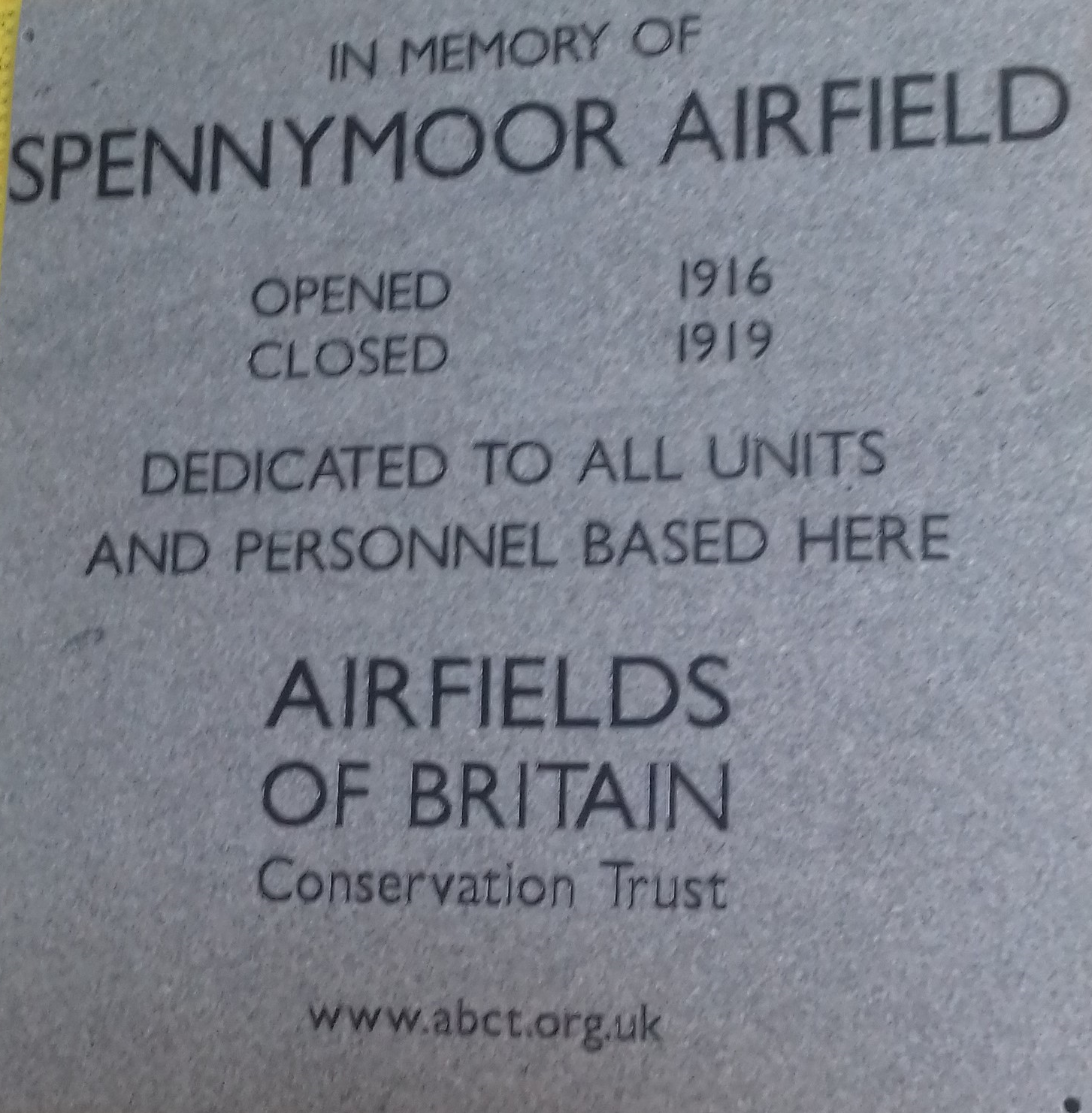 Middlestone Moor Airfield was a World War I Home Defence landing ground and emergency flight station. In 2018 a plaque was installed on the Mason’s Arms (now a restaurant) in Middlestone Moor.
Stunt Flying.
Thrilling Displays Near Spennymoor.
Six aeroplanes of the Berkshire Aviation Tours Ltd., provided thrilling displays at Middlestone Moor, Spennymoor, yesterday.
Stunt flying, aerobatics, wing walking, and upside-down flying were among the features of the programme.
Those taking part in the flying were Messrs. A N Kingwill, W Bonar, W Miller, G F Bullmore, J M Kemp, and E Slade, under the direction of Mr F J V Holmes.
(24th September 1931Newcastle Daily Chronicle)
In Coxhoe District.
Temporary Bridges at Railway Station.
The floods in the Coxhoe district had subsided a great deal this morning. The water rose to a good height between the platforms at Coxhoe Bridge Station, and temporary bridges had to be laid in respect of one platform.
The fields and becks at Cornforth Mill were flooded for a considerable distance. A motor-lorry on its way to deliver goods at Mill House this morning missed the road, and the forepart of the lorry went into the beck. The lorr was dragged out by a steam wagon.
The water is 2ft. in depth for a distance of about 100 yards on the Coxhoe-Spennymoor road. A bus came to a standstill in the water this morning and was unable to proceed farther. It was later pulled out.
The road from Metal Bridge through Tursdale is flooded to a good depth.
(5th September 1931 Hartlepool Northern Daily Mail)
Snooker For Draughts.
Th adjourned annual meeting of the Spennymoor and District Orme Billiards League was attended by representatives from the following institutions:-
Tudhoe Grange Social, Dean bank Miners, Eldon Colliery, Coxhoe Social, Coundon Y.M.C.A., Mount Pleasant Wesley, Thornley Welfare, United (Bishop Auckland), L. and N.E.R. (Bishop Auckland), West Cornforth Welfare, Mainsforth Welfare, Auckland Park, Windlestone Welfare, St Paul’s Spennymoor, and Deaf Hill Welfare.
It was decided to omit draughts from this season and substitute snooker. A committee meeting is to be held to-morrow night to receive the names of four players from each Institute, so that they can be registered and handicapped. It is expected to commence the games on Wednesday, September 30.
(8th September 1931 Newcastle Daily Chronicle)
Orme & Sons were a prominent Manchester-based billiard table manufacturing firm.
 Hare Caught In Hotel.
Chase Through Streets of Spennymoor.
After being chased by dogs along the main street of Spennymoor, a hare ran into a hotel and was caught by a customer.
The hare was put up in a field of oats, which Mr J Gornall, a farmer, of Whitworth Pit Farm, was cutting.
Three dogs gave chase, but the hare eluded them ad raced along the railway line towards Spennymoor Goods Station.
The hare continued along the railway line, and near Cairns Street jumped down from the railway embankment into the street.
Other dogs took up the chase, and, followed by a number of men and boys, the hare dashed down Carr Street into the High Street where it turned into the doorway of the Vane Arms, owned by Mr J G Ratcliffe. It collided with an inner door, stunned itself and was captured by a customer.
(21st September 1931 Newcastle Daily Chronicle)
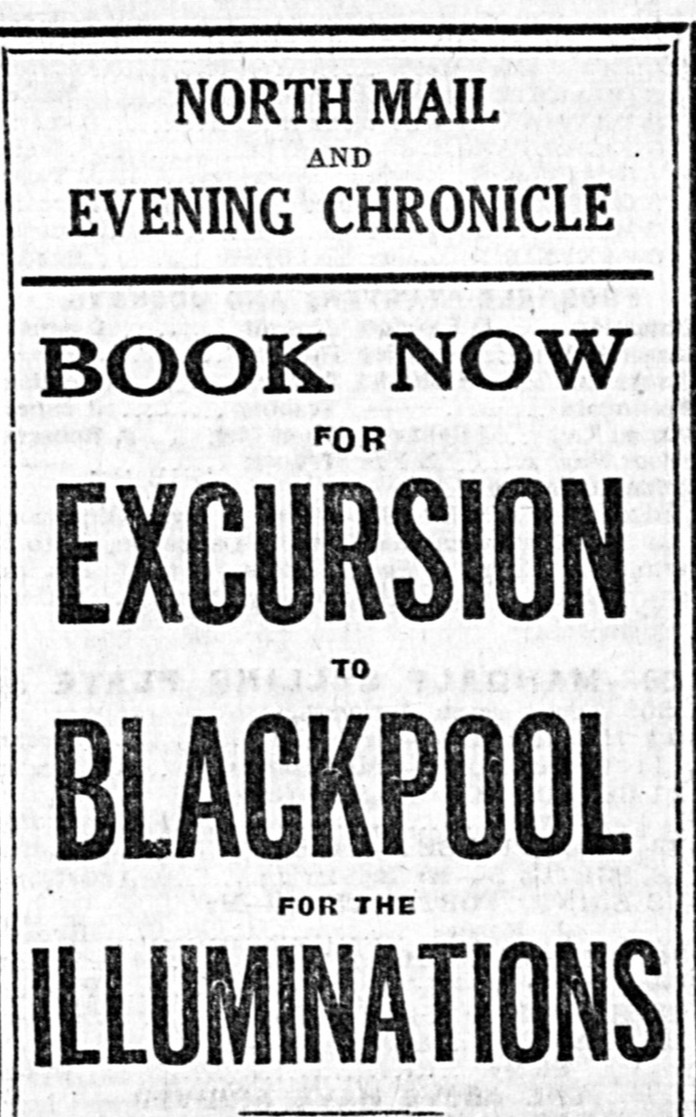
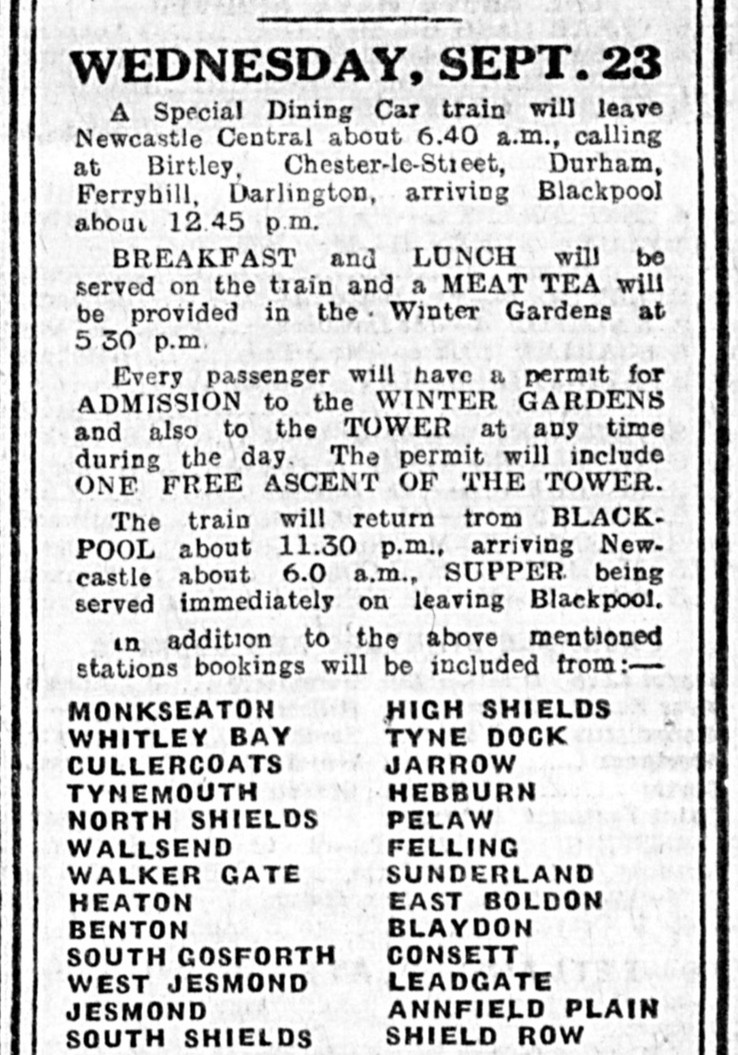
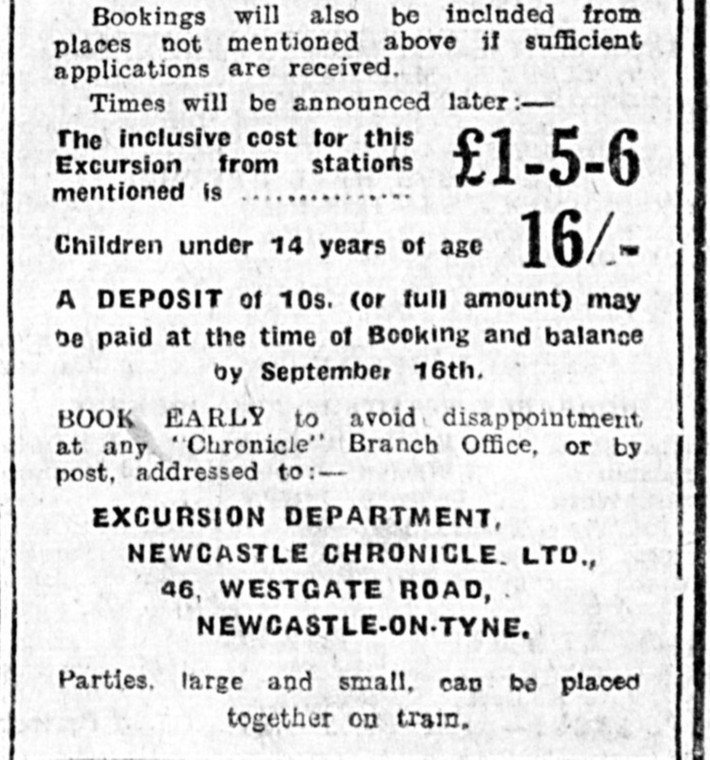
Trips to Blackpool were very popular, either a full day trip on the train or staying at boarding houses.

Two on the Pillion.
Charged with having driven a motor cycle carrying two pillion passengers, Ernest Lerigo (30), of The Bungalow, East Howle, Ferryhill, was fined 10s at Spennymoor to-day.
On a charge of having no driving licence, Lerigo was ordered to pay the costs.
The offence was stated to have occurred at Ferryhill.
(4th August 1931 Newcastle Evening Chronicle)
 1s Damage – 10s Fine.
For having done damage to the amount of 1s in a flower bed at Spennymoor Jubilee Park, James O’Brien (19), of Lincoln Street, Leeholme, was fined 10s at Spennymoor Police Court to-day.
John Egglestone the park keeper, said he saw O’Brien jump on to the bed to recover a ball, damaging the flowers.
(11th August 1931 Newcastle Evening Chronicle)
Motor Lorry Driver Fined at Spennymoor.
Walter Edwards (18), of Whitworth Terrace, Spennymoor, was fined 20s at Spennymoor to-day, for driving a motor lorry in a dangerous manner.
Superintendent Foster said Edwards was driving a motor lorry along Barnfield Road. A motor ‘bus was in front and the driver signalled his intention of turning into a side-street. As he did so he felt a bump and found the lorry had run into him.
Edwards pleaded “not guilty” and said he sounded his horn to pass the ‘bus and the driver gave no signal of his intention to turn till he was alongside.
(18th August 1931 Newcastle Evening Chronicle)
Gambling in Fields - Youths Who Damage Crops at Auckland.
That gangs of youths used meadows for gambling purposes was a statement made by a farmer at Bishop Auckland Police Court yesterday when 16 defendants, whose ages ranged from nine to 40, were charged with damage to crops.
Fines of 2s 6d were imposed in each case, two girls among the defendants, who failed to appear in court, being fined 5s.
Mr J B Walker, of Little Chilton Farm, asked the Bench to assist him in stopping the damage by these youths.
A Ferryhill Station man, Frank Robinson (21), was fined 10s, on a charge of damaging meadow grass, and William N Wright (21), of Witton Park, who was stated to have been seen by a farmer while in the act of pulling up potato plants, was fined 20s.
“It is wicked, seeing the amount of corn trampled down in the district,” said Police-Inspector Keable, when three Chilton men – Frank Rodwell (27), James Bradshaw (40) and John Pearson (27)- were charged with damaging oat crops.
“This cannot be tolerated,” remarked the chairman, imposing a fine of 20s in each case.
(21st August 1931 Newcastle Daily Chronicle.)
Bridesmaids in Green.
The bridesmaids, defying superstition, were dressed in green at a wedding at Ferryhill St. Luke’s Parish Church this afternoon.
The bride was Miss Edna Marshall an assistant mistress of East Howle, Ferryhill Council Schools, a member of one of the oldest agricultural families of Ferryhill, and daughter of Mr and Mrs William Marshall, of East Howle Farm, and the bridegroom was Mr Henry C Tomlinson, under manager at Sherburn Colliery and son of Mr J J Tomlinson of Stanley Grove, Redcar.
The bride was charmingly attired in a dress of oyster satin classically cut on long flowing lines, her bridal veil being of oyster Brussels net and her bouquet a sheaf of lilies.
Miss Doris Marshall, her sister, and Miss Dorothy Elliott were bridesmaids. They were dressed in green georgette.
Mr D Alan Tomlinson was best man and Mr C Naylor groomsman, The Rev C B Snell officiated.
(1st August 1931 Newcastle Evening Chronicle)
 Dundalk Footballer’s Wedding.
The wedding took place at St Paul’s Church, Spennymoor, Durham Co., of Ebor Reed, a well-know member of the Dundalk Association Football team, to Miss Mary E Holmes, of Spennymoor. The bride was given away by her brother. The bridesmaids were Miss Mabel Reed (sister of the bridegroom) and Miss Florence Proud, of Spennymoor. Mr R Craig was best man. Following the ceremony the happy couple left for Scarborough.
(5th August 1931 Derry Journal)
Easington Colliery.
Wedding – The wedding was solemnized by the Rev J R Soulsby at the Primitive Methodist Church, Easington Colliery this morning of Miss Ellen Wood, only daughter of Mr and Mrs J Wood of East View, Easington Colliery, and Mr William Dawson Hopper, the only son of Mr and Mrs W Hopper of Tudhoe Colliery. The bride, wo was given away by her father, wore a fawn dress of georgette, and lace, with hat and shoes to tone. She carried a bouquet of pink carnations and lilies. Miss Lilli Woof of Cornforth, cousin of the bride was bridesmaid, and Mr A Wood, brother of the bride, acted as best man. A reception was held aat the residence of the bride’s parents and later the couple left by car for Blackpool where the honeymoon will be spent.
(22nd August 1931 Hartlepool Northern Daily Mail)
 Minister and Vocalist Bride at Spennymoor..
There was a large attendance at the Wesleyan Church, Spennymoor, to-day, for the marriage of Miss Mary Lumley – daughter of Mr and Mrs H Lumley, of 17, Rutherford Terrace, Broom, Ferryhill – to the Rev. Percival F Bywater, son of Mr and Mrs Bywater, of Burton-on-Trent.
The bride is a well-known contralto singer and a member of Ferryhill Station Wesleyan Church choir, while the bridegroom is second minister in the Spennymoor Wesleyan Circuit, and has been stationed at Ferryhill for the past three years.
It is understood that this is the first time a minister has been married during his term of service in the Spennymoor Circuit.
The bride, who was given away by her father, was charmingly attired in a dress of pale gold ring velvet with hat to tone. She carried a bouquet of dark cream roses. She was attended by one bridesmaid, Miss Ethel Irwin, who wore a dress in flamingo georgette with hat to match and bouquet of roses
The best man was Mr Arthur Lumley, and Mr Stanley Springhall was groomsman.
The Rev James Henderson, Superintendent Minister of the Spennymoor Circuit, officiated, assisted by the Rev. A Taylor Richardson, of Bedale.
After the ceremony the happy couple left for the Isle of Arran. Mr Bywater takes up duties in his new circuit at Penistone (Denbydale) on September 1.
(5th August 1931 Newcastle Evening Chronicle / 6th August 1931 Newcastle Daily Chronicle.)
The May Report.
The May Report, was a publication on 31 July 1931 by the Committee on National Expenditure. The May Committee was set up to suggest ways for the government to curb expenditure after a proposal by a Liberal MP. The committee was chaired by Sir George May. Its main conclusions were extensive public sector spending cuts, including a cut to the unemployment benefit, and increased taxation.
On 24th August 1931 a National Coalition Government headed by MacDonald came into being, which was to split the Labour Party.
Brutal Report - Spennymoor M.P.’s “Burn It” Advice to Premier.
Characterising the Economy Report as one of the worst and most brutal reports that could be imagined, Mr Joseph Batey, Socialist MP for Spennymoor, speaking at Crook on Saturday said: “The best thing the Prime Minister can do, is to gather the report together and burn it.”
Referring to the speech in which Viscount Grey indicated that Liberals favoured the report, Mr Batey said that the Labour Party would not adopt the report to maintain Liberal support.
“I am quite certain,” he added “that after considering the report, the Cabinet Sub-Committee will recommend that it be ignored.”
(10th August 1931 Newcastle Daily Chronicle)
A comment in the Shields Daily Gazette. THE DAY OF RECKONING.
Mr. Joseph Batey, the member for Spennymoor, may possibly be well inspired in predicting that the Cabinet Committee will recommend that the May Economy Committee report be ignored. The present Government has proved itself very ready to refer awkward questions to Commissions and Committees, but seldom or ever does it adopt the advice which those bodies tender. So no one would be very much surprised if it treated the Economy Committee in the same style.
But that would be only postponing the day of reckoning, with every possibility of making the reckoning much more disagreeable. A firm stand ought to be taken in Parliament against letting matters drift, and the people who, of all others, ought to take this stand are Liberals. They owe the nation that much, for in their anxiety to prop up the present Government, and prevent what they fear will be a Protectionist and worse one coming into office, they have condoned far too much Socialist extravagance already. It is time they made it clear that the old watchword "Retrenchment" still has some appeal to Liberals.
(11th August 1931 Shields Daily Gazette.)
 Bus Wages "Scandal." - Protest by Traffic Commissioner at Auckland
"We Cannot Allow This Sweated Labour."
"It is a scandal the wages that are being paid to drivers and conductors in this area," declared Coun. J. Wallace, one of the Traffic Commissioners who sat with Mr. H. Riches (chairman) to hear applications for licences at Bishop Auckland yesterday.
The comment was made after several private operators had spoken of the wages which they paid their drivers and conductors.
"I want you to realise that we cannot allow this sweated labour and it is sweated labour," Mr. Wallace told one owner, who said that the wages of his drivers were £3, £2 10s, and £2 12s.
The owner was one of several who operate services between Bishop Auckland and Spennymoor, and he was advised along with several others, to join the Operators' organisation and bring the wages of employes up to standard.
"This Road Act is the busmen's charter, you know," Mr. Riches said, "and you will have to comply with the provisions of the Act."
Conductor's 15/-
Another applicant admitted that he was paying a conductor 15s a week.
"And this is a distressed area? It is a distressed area for conductors," commented Mr. Wallace. "It is a scandal the wages that are being paid to drivers and conductors in this district."
Replying to Mr. Clifford Cohen, who appeared for the applicants, another operator said they were hoping to do better now that the Commissioners had stopped chasing on the routes.
When the application of Messrs. Preston and Dobson and Preston for the service between Spennymoor and Ferryhill was considered, Mr. W. R. Preston, an owner-driver, told the Commissioners that the unemployed paid on a workmen's fare basis. He added that he ran a special bus for men on the dole.
Preston who said he was 21 and drove his own bus, stated that his wife was conductress "And what do you pay each other?" queried Mr. Wallace, amid laughter.
Road Chaos Alleged.
"It will be a question of what he takes out of her bag," suggested Mr. Norman Harper, who appeared for Preston.
Mr. C. B. Fenwick, for the United Co., who objected to the applications, said the United did not want to push these men off the routes if they would play the game.
"The state of affairs in Bishop Auckland for a long time past beggars description," said Mr. Fenwick.
"The local licensing authority, no doubt out of the goodness of their hearts, have bestowed licenses on anybody.
"The result has been that by everybody getting licenses confusion has arisen and routes have been covered for a short period by people who dashed in and out when and where they liked."
(7th August 1931 Newcastle Daily Chronicle)
Rain Delays Aeroplane.
Owing to a heavy rainfall in Ferryhill district last night about nine o’clock, an aeroplane which was passing over and piloted by Mr Fawcett, going to Newcastle from the South, had to make a forced landing at Thinford, about a mile north of Ferryhill.
Mr Fawcett made his ‘plane secure, and will continue his journey this morning, weather permitting.
(13th August 1931 Newcastle Daily Chronicle)
Mainsforth Nursing Association.
To assist in procuring an ambulance-van for the Mainsforth (Ferryhill) Nursing Association, an open-air whist-drive and dance was held in the Mainsforth cricket field yesterday.
(14th August 1931 Newcastle Daily Chronicle)
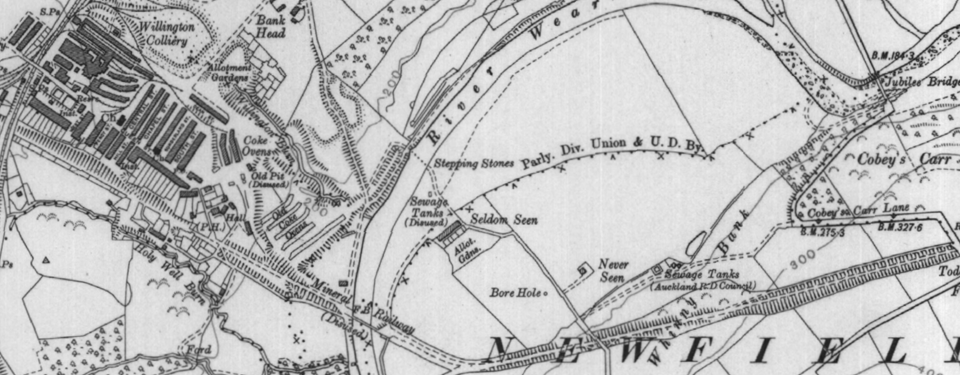 Scouts’ Anniversary.
The 1st Ferryhill St Oswald’s Boy Scouts celebrated their anniversary during the week-end. On Saturday the troop mustered at Seldom Seen, where exhibitions of signalling, bridge-building, and first aid were given and sporting events were held.
Yesteday a drum-head service was held in the Vicarage field, when several troops of Scouts and Boys’ Brigade were present, the Rev. P. Metcalf giving the address.
(17th August 1931 Newcastle Daily Chronicle)
Ferryhill Gala.
To raise funds for hospitals, a gala is to be held in the Dean Bank cricket field, Ferryhill, to-morrow.
In the afternoon there will be a cricket match between teams representing the Divisional Police and the Ferryhill district, while at night a dance will be held.
(18th August 1931 Newcastle Daily Chronicle)
Ferryhill Aged Folk.
A fund that has been idle for 16 years has been revived by Ferryhill Parish Council, to provide a treat to Ferryhill’s Aged People, of whom 500 will be entertained on September 12.
(21st August 1931 Newcastle Daily Chronicle.)
 More Work in Pit. Coalhewers Signed on at Ferryhill.
A large number of unemployed coal hewers attended at the offices of the Dean and Chapter Colliery, Ferryhill, on Saturday to sign on for work in the No. 3 pit of the main coal seam.
This pit has only been working two shifts a day, and it is suggested that three shifts be worked, thus giving employment to about 150 men and boys.
(17th August 1931 Newcastle Daily Chronicle)
Fuel Oil From Coal - Spennymoor M.P. Has Faith in Scheme.
Mr Joseph Batey, Socialist M.P. for Spennymoor, speaking at New Brancepeth, last night, said he had immense faith in the extraction of fuel oil from coal.
“The future of the industry is in that direction,” he said. “I believe the coal industry will become a healthy industry, but that day is not at the present nor does it seem to be as if it will come for some time.”
While making inquiries at the Coal Reorganisation Committee’s office he was informed by the Secretary that most of the collieries in South and West Durham would be out of production in a few years.
In fact, within the last seven years 74 pits in Durham had stopped, and in the present year 19 had been stopped in the county up to the month of June.
The Reorganisation Committee was arranging the amalgamation of the profitable and productive collieries of the country while they were closing down the smaller and unproductive concerns.
(28th August 1931 Newcastle Daily Chronicle.)
 Workmen's Pay to be Cut in Spite of Industrial Board's Decision to Defer Action.
Spennymoor Move.
The action of the Joint Industrial Council in deferring for six months the question of a reduction of one penny an hour in the wages of municipal workmen led to a long debate at last night’s meeting of Spennymoor Urban District Council.
The Finance Committee recommended that a reduction in wages at the rate of one penny an hour be made from the first pay in September, in accordance with the sliding scale of the Joint Industrial Council.
Councillor Blenkin (Soc.), who is the Council’s representative on the Joint Board moved the deletion of the recommendation. He said he voted at the meeting of the Joint Board for the reduction of wages, which was in accordance with the regulations which stated that wages should rise or fall according to the cost of living.
There had been a fall of 13 per cent., which made the men due to a reduction of one penny an hour, but as the J.I.C. had decided to defer the matter for six months he considered the Council were bound to honour that decision.
J.I.C. “A Bogie.”
Councillor Crane (Soc.) opposed the deletion, and said the Council should stand by the agreement. All his life he had been dealing with the question of advances and reductions of wages and he considered they must stand by the regulations.
If the men had been due to a penny advance they would have been in honour bound to give it them.
He considered that by remaining members of the J.I.C. they were “members of a bogie which had never properly functioned.”
Various members expressed the opinion that the J.I.C. had outlived its usefulness and that the Spennymoor Council should withdraw from it, as Darlington and Middlesbrough Corporations had.
It was pointed out that no injustice was being done to the workmen, as their agreement made it clear that they were due for a reduction of wages.
Councillors Reaveley, Kenmir and Milburn (Mods.) said that they considered that as custodians of public money that council were honour bound to abide by the regulations and make the reduction.
The recommendation of the finance committee was carried by 12 votes to 9.
(28th August 1931 Newcastle Daily Chronicle)
Ferryhill All Saints’ Roman Catholic Church.
In the Ferryhill All Saints’ Roman Catholic Hall last night, the Bartonian Male Voice Choir from Spennymoor gave a concert in aid of the Church Building Fund. Councillor I Cockayne presided.
(14th August 1931 Newcastle Daily Chronicle )
Ferryhill Concert.
At a concert in the hall of Ferryhill All Saints’ Roman Catholic Church, the two-act play “Milky Way” was given by the Church repertory Company.
Mr J Mountford took the title role, and was ably supported by Mr J Sharkey, Mr Keenleyside, Mrs Richardson and Miss Durkin.
The variety part of the programme was in the hands of Mr Woodward, Mr M King, and Miss A Carmedy. Mr J Pattison was pianist and Councillor I Cockayne chairman.
(21st August 1931 Newcastle Daily Chronicle)
All Saints’ Roman Catholic Church.
In aid of the building fund of All Saints’ Roman Catholic Church, Ferryhill, the Church Repertory Company presented the drama “Alone in Paris.”
(28th August 1931 Newcastle Daily Chronicle)
Playing Fields Scheme.
Councillor J Steel reported at the monthly meeting of Ferryhill Parish Council the result of an interview the sub-committee had with the Rev. T L Lomax, Vicar of Ferryhill, who had been asked to allow the use of part of his fields as playing-fields.
After an hour’s deliberations the vicar regretted that at the moment he could not give an answer.
(20th August 1931 Newcastle Daily Chronicle)
Church Pageant - Scenes in Lives of Saints at Ferryhill Vicarage.
A pageant was enacted upon the Ferryhill Vicarage Garth on Saturday, before a large crowd of spectators. The three churches in the parish are named St Luke, St. Columba, and St. Cuthbert, and the pageant had the title of these saints.
The background of the vicarage and the grounds were splendidly adapted to the rural scenes, which included incidents in the lives of St Luke and St Columba, and by permission of the Newcastle Historical Pageant, episode 2, showing the removal of the body of St Cuthbert to Durham for burial, was reproduced.
Other scenes included “The Widow’s Mite,” “The Seven Pieces of Silver,” and “The Madonna and St Luke.”
There were 100 performers, who, under the supervision of Mrs Lomax, wife of the vicar, got the pageant up in three weeks. Mrs R Crawford was musical director, and Miss D Carr, was in charge of the Eastern dancers.
(31st August 1931 Newcastle Daily Chronicle.)
 Accused Man’s Collapse - Spennymoor Plea To Avoid Gaol Fails.
While the Bench were considering their verdict in a coal-stealing case at Spennymoor, to-day, one of the men accused, George Allan, of Low Spennymoor, collapsed in a faint.
When he recovered he had to be helped to a seat.
Allan was charged with Thomas Grayson (40), also of Low Spennymoor.
Allan said he did not want to go to prison.
Allan, against whom there were four previous convictions for coal stealing was sent to prison for four weeks, the Chairman (Dr A Beresford Kane) remarking that he should have more sense than go coal stealing as he had an Army pension of £2 5s a week, and a rent allowance of 6s 6d.
Grayson was fined 20s, and in other cases of coal stealing Frederick Hopper (37), Elias Walton (37) and Henry Davis (33), all of Low Spennymoor, were each fined 20s, and James Burton, of Low Spennymoor, was fined 15s.
(4th August 1931 Newcastle Evening Chronicle)
Ran Over Fowls
Took Two Away – Fined at Bishop Auckland.
A sequel to an accident in which hens were killed by a motor vehicle was the appearance at the Bishop Auckland Police Court yesterday of Charles McDermott (38) and Samuel Gargett (43), both of Spennymoor, on a charge of stealing two dead fowls valued at 7s 6d each.
The men travelled from Spennymoor to work at Wearhead, and on July 25 the lorry in which they were travelling ran into some hens.
Two of the birds, it was alleged, were taken away by the men.
McDermott and Gargett were each fined 10s.
(11th August 1931 Newcastle Daily Chronicle)
Stolen Tennis Rackets - Club-House Raid.
Sydney Mitchell (22), Thomas Casson (22), John Douglas (24), all of East Howle, were charged at Spennymoor today with stealing three tennis rackets and six balls, valued £5 7s, the property of Metal Bridge Recreation Welfare Club.
Supt Foster said the charge had been reduced from club-house breaking to ordinary larceny, so that it could be dealt with at that court.
Sydney Jones, secretary of the club, said that on August 1 he locked up the gear box and on Monday, August 3 he found it had been broken open and three tennis rackets and six balls missing.
Douglas pleaded guilty, and Mitchell and Casson pleaded “Not Guilty,” the two latter saying that they were on the road, and not in the clubhouse. They admitted, however, receiving a tenis racket and said they threw it away. All three said that it was a drunken escapade.
Fines of 20s each were imposed.
(18th August 1931 Newcastle Evening Chronicle)
Coal Gang Raids - Organised Thefts From Ferryhill Pit.
“It assumes a serious aspect when men go in gangs of 20 to 30” said Police Superintendent Foster when a number of Ferryhill and Low Spennymoor men were charged at Spennymoor yesterday with coal stealing from Dean and Chapter Colliery, Ferryhill. “Organised raids are being made on Colliery property at Ferryhill,” he added.
Michael Carmedy (48), his son Stephen, and James Riley (40), of Ferryhill pleaded not guilty to stealing coal. Michael Carmedy declared that he took the coal as usual from the heap near the colliery. He was fined 15s, his son 10s, and Riley 15s.
“You will be sent to prison next time” said the chairman (Mr W H Clarke) when nine Low Spennymoor men were charged. They were alleged to have taken coal from trucks at the colliery.
Constable Scott saw some men filling bags with coal from trucks at 5.20am.
Defendants were all fined 15s each.
(19th August 1931 Newcastle Daily Chronicle.)
 Carnival Fun at Kirk Merrington.
Many original costumes and tableaux were included in the procession at the Kirk Merrington and District Nursing Association annual carnival on Saturday.
The procession paraded round the village headed by the "King" and "Queen" of Carnival (Messrs. R. Croft and T. Dent) and the Kirk Merrington Scouts' Band and, on arrival at the carnival field, the "Royal" party were received by the Vicar (the Rev. E. V. Simpkinson).
During the afternoon interesting displays were given by the Chilton and Windlestone Ambulance Brigade and the Merrington Boy Scouts.
Principal prize-winners in the parade were:—
B Wray, M Atkinson, J Bland, A Easby, G Oliver, E Bainbridge, O Walton, J Oliver, W Johnson, J Maughan, and W Kell.
Sybil Lady Eden presented a cup and prize to the "Merrington Sparkler's" Comic Jazz Band.
(31st August 1931 Newcastle Daily Chronicle.)
Honours at Oxford and Cambridge.
A girl clerk, coalminers, and a cotton operative are among those who have achieved high honours at Oxford and Cambridge. Mr A Dowdell, a miner, of Spennymoor, has obtained honours in philosophy, politics, and economics at Oxford.
(23rd July 1931 Hartlepool Northern Daily Mail)
Mr Dowdell, it is understood, is the first miner to secure a B.A. with first class honours, and out of 130 who sat the examinations only 10 secured first-class honours.
(1st August 1931 Newcastle Evening Chronicle.)
Dowdell Family
Albert Dowdell (1901-1980) was the son of Arthur Dowdell (b1864, Ireland), a miner, and Sarah Roberts (b1866 - 1912) who married in 1886.
 Arthur Dowdell (b1865, Ireland - 1914, Tudhoe)
In 1891 the family are living in Tudhoe Colliery with two daughters, Isabella (b1888) and Florence (b1891).
In 1901 they are at 20 Half Moon Lane with two more children, Lillian (b1897) and Margaret Jane (b1899), his mother-in-law Margaret Jane Roberts (b 1843, Seaton Delaval) and brother-in-law James Roberts, a miner, (b1880, Spennymoor).
Arthur became a councillor for the Tudhoe Ward. By May 1903 he had been appointed to the office of sanitary inspector to SUDC which necessitated his severance from the Durham Miner’s Council. He was associated with the Tudhoe branch of the Durham Miner’s Association for many years, as corresponding secretary and also as the men’s delegate he accomplished excellent work. The workmen to show their appreciation of his past services, have presented him with a handsome gold albert. Councillor Bell, in making the presentation, spoke highly of Mr Dowdell and of his work as their representative in the Spennymoor District Council.
(29th May 1903 Durham Chronicle)
In August 1903 the Local Government Board in London had rejected his appointment as sanitary inspector as he did not have a sanitary certificate. This was discussed at a SUDC meeting where the members felt he was performing his duties in a zealous and painstaking way and they felt they should stand by him on the understanding that he would prepare for the examination for the certificate. A vote 15 to 2 agreed to appoint him for 12 months to prepare for the examination.
(7th August 1903 Durham Chronicle)
In 1908 he was re-appointed as Sanitary Inspector when his salary was increased from £110 to £120, Mr Reavley questioned him about his appointment as Secretary of the Workmen's Club as he was supposed to be Sanitary Inspector full-time and it could be a conflict of interest. After some discussion Mr Dowdell agreed to resign from being Secretary of the Workmen's Club.
In 1911 the family are living at 76 Durham Road, Spennymoor, with two more children, Albert (b1901) and Ernest (b1906).
 Albert Dowdell (1901 - 1967 Whitley Bay)
Albert won a scholarship to attend Bishop Auckland Grammar School, while there he secured a scholarship tenable at Barnard Castle Grammar School but was unable to attend because his father died and he was compelled to return home and start work. He began employment at Tudhoe Colliery and later worked as a hewer at Mainsforth Colliery.
(1st August 1931 Newcastle Evening Chronicle.)
In 1921 Albert, a putter at Tudhoe Colliery for Weardale Steel, Coke and Coal Co., is living at 24 Jackson Street, Spennymoor, with his two sisters Isabel and Jenny, his brother Ernest, niece Vera, uncle James Roberts and grandmother Margaret Jane who is aged 78.
In 1924 Albert marries Hilda Armstrong (1901-1974 Whitley Bay) and they have two children Arthur (b1925) and Alan (b1927).
 Albert now returns to education as shown in this extract from "The Science and Art of Mining", 15th June 1929, Page: 384, Column: 2.
Ex-Miner's Scholastic Achievement.
For the past two years Mr. Albert Dowdell, an ex-miner of Spennymoor, who formerly worked at Mainsforth Colliery, Durham, has been studying at Ruskin College, Oxford. The Durham Education Committee have awarded him a special exhibition of £50, while the University authorities have offered him an adult scholarship of £225, which will enable him to continue his University career after his present scholarships at Ruskin College expire in July. Mr. Dowdell does not appear to regard his success in an exceptional light, for in an interview he asked : "Why should the scholastic achievements of a coal hewer be regarded as something out of the ordinary? There are hundreds of men cleverer than myself working in the mines who will never get a chance of proper training. I have been lucky." The modesty of Mr. Dowdell will impress his fellow men. At the same time the Miners' Welfare Scholarships are serving to convince the man in the street, if he needed convincing, that many lads go down the pit shaft who, given the opportunity, would make their mark. Unfortunately some of them neglect local opportunities for study. The success of Mr. Dowdell may revive their interest. (http://dmm.org.uk/news19/9290615h.htm)
In 1930 he was allowed to continue his education before completing it in 1931.
The Committee also decided to continue a special exhibition of £50 to Albert Dowdell, of Spennymoor, to aid him in reading for an Honours Degree at Oxford. Last session Mr Dowdell’s scholarships amounted to £250, in addition to £150 for home maintenance for his wife and two children. His tutor has written from the University stating that Mr Dowdell was working hard and making splendid progress.
(17th July 1930 Yorkshire Post and Leeds Intelligence / 25th July 1930 Chester-le-Street Chronicle)
Durham Miner’s B.A. - Success with First Class Honours.
Mr Albert Dowdell, aged 30, who was until recently a miner at Mainsforth Colliery, near Ferryhill, Co, Durham, was notified yesterday by telegram that he had taken the degree of Batchelor of Arts with first class honours.
Mr Dowdell yesterday visited Hatfield College, of the University of Durham, where a summer school is proceeding in connection with the Workers’ Educational Association, and was warmly congratulated by University tutorial lecturers and his fellow-students.
He was attracted to the Workers’ Educational Association in 1926, and under its auspices, in conjunction with the Club and Institute Union authority, he went to Ruskin College, Oxford. He had meagre resources, and was in the habit of journeying to Oxford on a push cycle. At the end of each term he cycled back to his home at Spennymoor, where he has a wife and young family, and resumed his work at the colliery. He won various scholarships, and took the Diploma in Economics and Political Science with distinction in both subjects. The successes he gained brought him to the notice of the Oxford Delegacy, who awarded him a scholarship which enabled him to take a degree course, and he went into residence at Queen’s College, Oxford. The result of his studies was intimated yesterday to him by telegram.
 Mr Dowdell was welcomed at Hatfield by Ald. W N Smith, who is the chairman of Durham County Education Committee and the secretary of the North-Eastern Area of the Workers’ Educational Association. He addressed the assembly and spoke of the men who had influenced him, and also referred in glowing terms to Ruskin College. His ambition is to remain in the working-class movement. He hopes to take a research scholarship at Oxford in the hope that he will qualify for the degree of Doctor of Philosophy.
(1st August 1931 Yorkshire Post and Leeds Intelligence)
In 1939 the family live at 32 North Street, Spennymoor, Albert was a clerk at the ARP Department for the Urban District Council. He was secretary for the War Appeals Council, and was deputy chief warden qualifying as an anti-gas certificate holder and instructor.
He later became a lecturer in industrial administration at Manchester University and also lectured at Newcastle University.
Fell Into Quarry
Workman’s Lucky “Landing” at Coxhoe.
William Hilker, aged about 50, of Spennymoor, a quarryman at Steetley Lime Co.’s old quarry at Coxhoe, had a surprising escape from serious injury yesterday afternoon when he fell from the top of the quarry to the bottom, a distance of about 40ft.
Hilker was working on a ledge on the top of the quarry face, removing the soil on the top of the stone, when the soil came away suddenly, with the result that be overbalanced, and fell over the edge of the quarry.
Fortunately he landed on a six feet heap of soil which had been removed from the quarry top earlier in the day, and rolled gently down the side of it.
First aid was given by Mr Frank Balance, foreman at the quarry, and a workman named Ernest Atkinson, who found to their surprise that the only injuries he had received were a dislocated left shoulder and some bruises.
Hilker was afterwards removed to Durham Hospital.
(1st July 1931 Hartlepool Northern Daily Mail)
Lorry Smashes Weigh Machine.
Remarkable Mishap at Spennymoor
Crane to Rescue.
An extraordinary accident occurred at Spennymoor to-day, when the 20-ton weighing machine at the L. and N.E.R. Goods Station was wrecked by the weight of a lorry drawn on the machine for the purpose of being weighed.
The lorry was loaded with about ten tons of tarred stones.
The platform collapsed under the load, and the rear wheels of the lorry dropped through, the lorry being partly turned on its side.
The driver escaped injury. A crane was necessary to lift the lorry clear of the machine.
(2nd July 1931 Newcastle Evening Chronicle)
 Edward George Eldredd.
How a Spennymoor miner, Edward George Eldredd (62), of Bishop’s Close Street, was killed on falling downstairs after entering a neighbour’s house in mistake for his own, was told at the inquest at Spennymoor, yesterday, when a verdict of “Accidental death” was returned.
(29th July 1931 Hartlepool Northern Daily Mail)
Chester-le-Street Motor Accidents
Head-on Crash Victims.
Three accidents of a more or less serious nature occurred in the Chester-le-Street district on Wednesday night.
A motor-cycle driven by Maurice Spence, of Hume Street, Spennymoor, was involved in a head-on crash with a motor-car on the Great North Road at Ravensworth Colliery. Spence and his pillion passenger, Anthony Grey, of The Green, Tudhoe Grange, Spennymoor, sustained serious injuries and were conveyed to newcastle Infirmary. Their machine was wrecked and the car, which was driven by Fred Gee, of Low Fell, was also badly damaged. Gee excaped injury.
10th July 1931 Hartlepool Northern Daily Mail reported that Anthony Grey, (23), had fatal injuries.
(10th July 1931 Chester-le-Street Chronicle)
Church Events.
Sunday scholars connected with Ferryhill Parish Church, and the Mission Churches of Dean Bank and East Howle, had their annual excursion to Redcar.
The Croxdale Colliery annual children’s tea and sports were held in the Recreation Ground, more than 300 children assembling at the Council Schools, and headed by the Mainsforth Colliery band, paraded the principal streets. All widows and aged people over 60 years were entertained to tea.
(6th July 1931 Newcastle Daily Chronicle)
80 Candles on Cake.
To celebrate the 80th anniversary of her birthday, Mrs Salkeld was entertained by her fellow members of Ferryhill Mothers’ Union at their July meeting. The cake had 80 candles.
Mrs Salkeld was one of the first to join the movement in Ferryhill 25 years ago.
Mrs Lomax, on behalf of the Union, handed to Mrs Salkeld a jacket, while the Vicar, the Rev T L Lomax, and Mrs Lomax, also gave presents.
(8th July 1931 Newcastle Daily Chronicle)
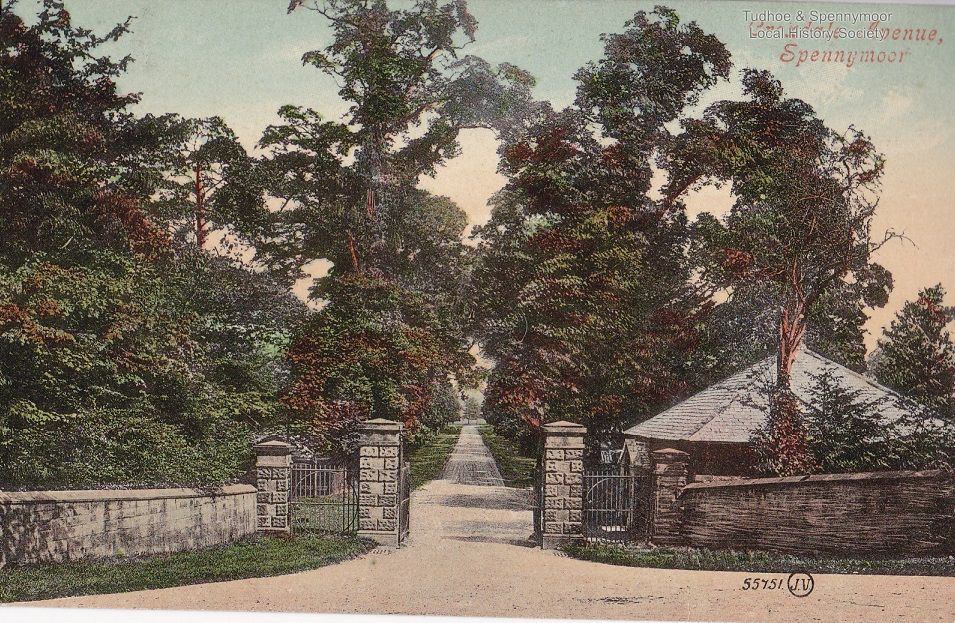 The Gardens of Croxdale Hall, Durham.
Take Note By Kind Permission of Lt.-Col. Salvin
The Gardens of Croxdale Hall, Durham
Will Be Open to the Public on Wednesday, July 15th, 1931,
From 2.30pm to 7.30pm.
Admission 1/-
Proceeds in aid of the Durham City and District Gardens Guild.
Buses from Durham to Ferryhill and Bishop Auckland pass within 100 yards of the Lodge Gates.
(13th July 1931 Newcastle Evening Chronicle)
300 Women Entertained.
Nearly 300 Women’s Institute members from Ferryhill Village, Mainsforth, Dean Bank, and Bishop Middleham, were the guests of East Howle Women’s Institute at a fete in the grounds of East Howle School House yesterday.
(24th July 1931 Newcastle Daily Chronicle)
County of Durham’s Unemployed
Minister’s Figures.
Mr Joseph Batey, MP for Spennymoor, has askd the Minister of Labour the number of miners in the County of Durham who are in receipt of unemployment benefit, and the number in receipt of transitional benefit.
Replying, Mr Lawson said: On May 18th 1931, the total number of male claimants to benefit in the coal-mining industry in County Durham was approximately 44,000, but was unable to separate this figure into ordinary and transitional benefits. Since that date the Delight Colliery, Dipton and Burnhope, are to add to the list of unemployed. Another 1,000 can safely be added to the 44,000, making a total of 45,000 in the Durham coal area.
(4th July 1931 Blaydon Courier)
 Ferryhill Men Receive Notice.
And Asked To Vacate Colliery Houses.
One hundred miners and officials of the Dean and Chapter Colliery, Ferryhill, have received a fortnight’s notice and also notice to vacate their houses and deliver up the keys.
They have been working in the new Harvey Busty seam, which was recently discovered when driving a drift from Leasingthorne.
The Colliery, which for nearly eight months was lying idle, has gradually been restarted with nearly the full complement of men employed, and it was expected that it was now in full working order.
No reason is given for the issuing of these notices, but it is surmised that the working costs are excessive.
Reports are prevalent that another seam will be shortly closed.
(17th July 1931 Newcastle Daily Chronicle)
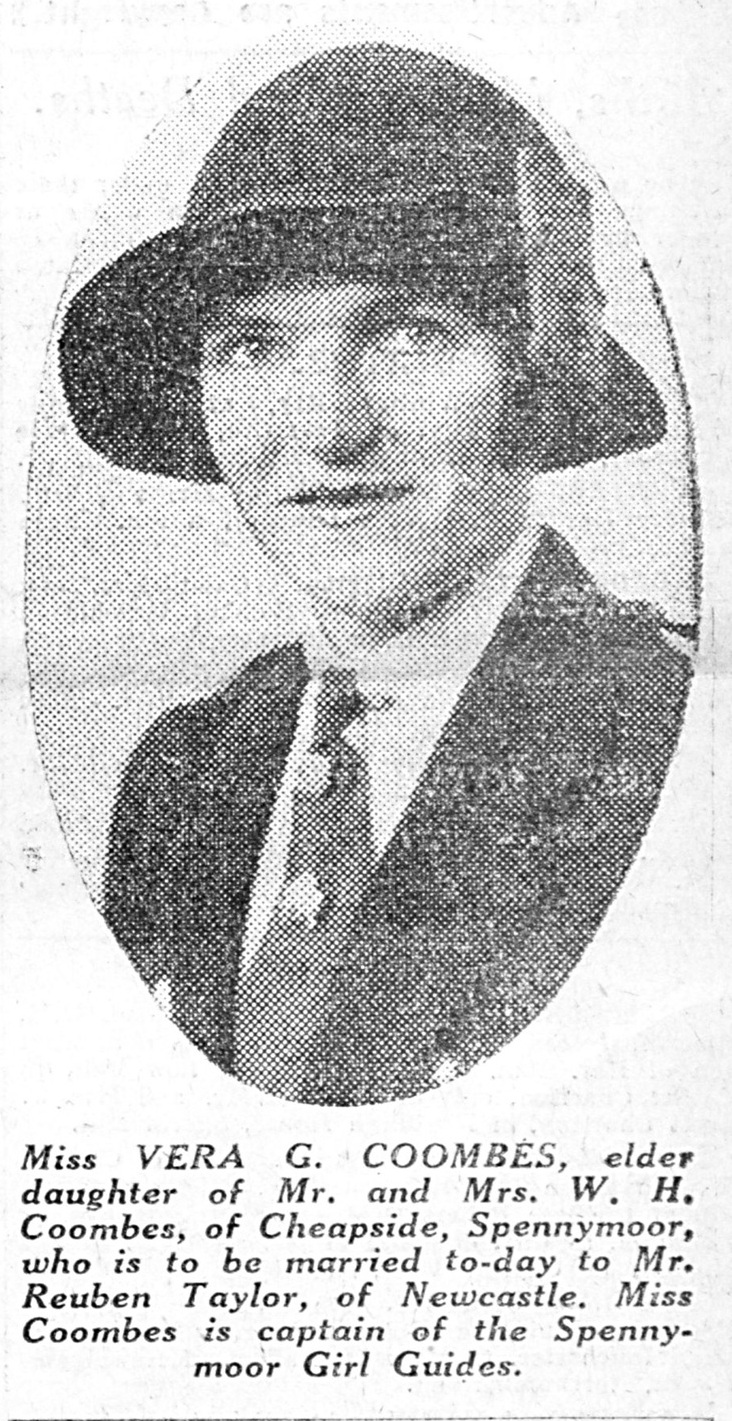
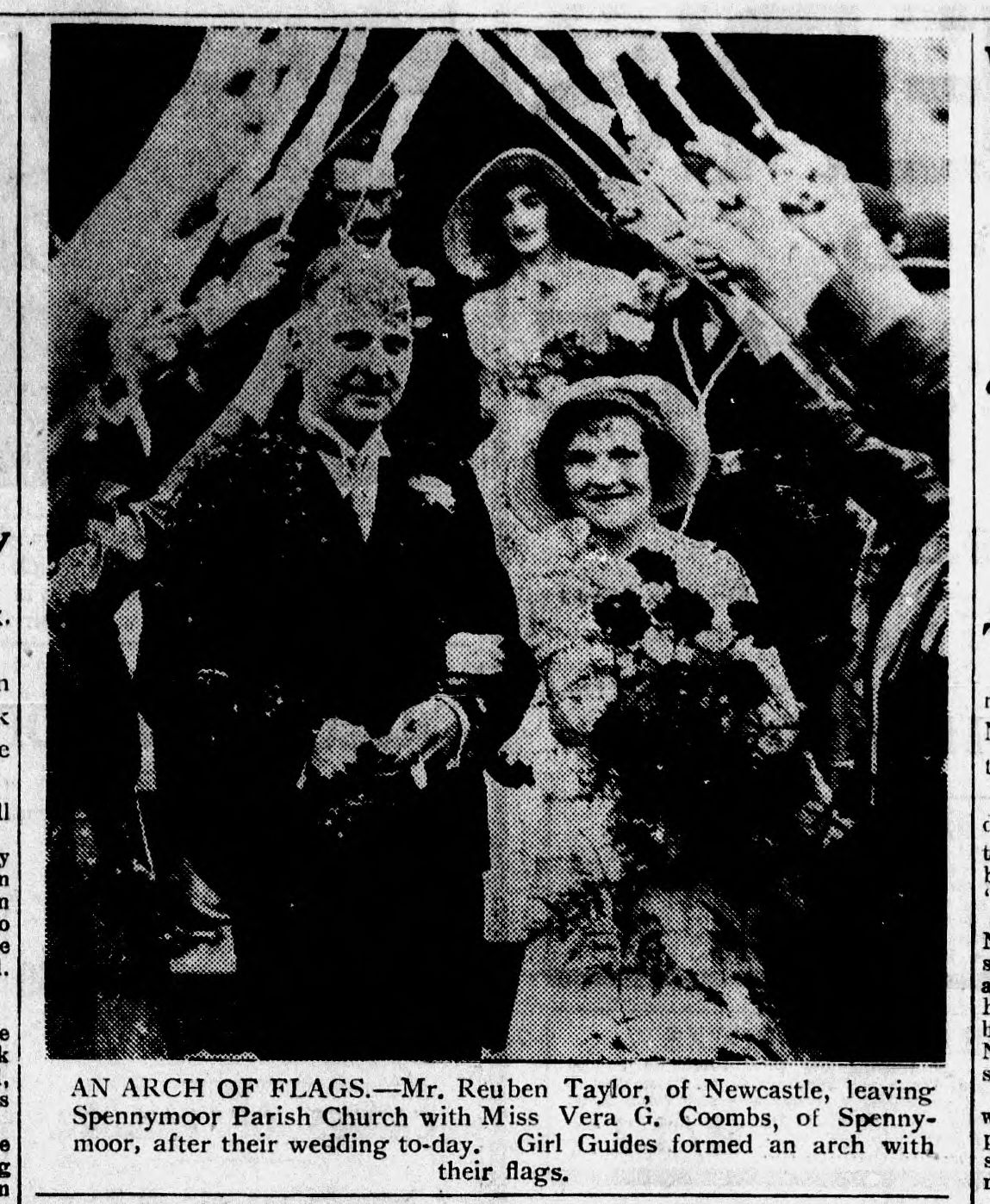 Girl Guide Wedding.
The wedding took place this afternoon at St Andrew’s Church, Spennymoor, of Mr Rueben Taylor, of Newcastle, and Miss Vera Gwendoline Coombes, elder daughter of Mr and Mrs W H Coombes, of 37, Cheapside, Spennymoor.
The bride, who was goven away by her father, was attended by her sister, Mrs Olga Luke, as Matron of Honour, and two small attendants were Miss Pamela Leatherland, of Ponteland, and Master Kenneth Taylor, of Newcastle. Mr George Taylor, of Newcastle, brother of the bridegroom, was best man.
A feature of the wedding was a guard of honour consisting of Brownies and Girl Guides of the 3rd Spennymoor Company, of which Miss Coombes was commanding officer.
Afterwards a reception was held in the Masonic Hall, and later the newly-married couple left for the South by motor. Where the honeymoon will be spent.
(8th July 1931 Newcastle Evening Chronicle / 9th July 1931 Newcastle Daily Chronicle)
Wedding of B.A.s.
Spennymoor Bride for West Hartlepool Clergyman.
The wedding of the Rev. Oswald Hogg, B.A., L.TH., of West Hartlepool, son of Mrs and the late Mr W Hogg, North Shields, and Miss Norah M Hall, B.A., daughter of Mr and Mrs J G Hall, Martin's Bank House, Spennymoor, took place at St Paul’s Church, Spennymoor, on Saturday.
The bride wore a shell pink satin dress with a pale pink veil embroidered in silver and carried a bouquet of pale pink carnations.
The bridesmaid, Miss Elizabeth Punshon, B.A., of Whitley Bay, was attired in a pale green georgette dress with a large picture hat to match, and carried a shower bouquet of cream roses and mauve sweet peas.
The Rev. W James, of Norton, was best man, and the ceremony was performed by the Rev. G R Cook, M.A., Vicar of Seaton Carew, formerly of Spennymoor, assisted by the Rev. A S Thompson, M.A., Vicar of St Paul’s, West Hartlepool. The reception was held in the Masonic Hall.
The honeymoon will be in Switzerland and Italy.
(13th July 1931 Newcastle Daily Chronicle)
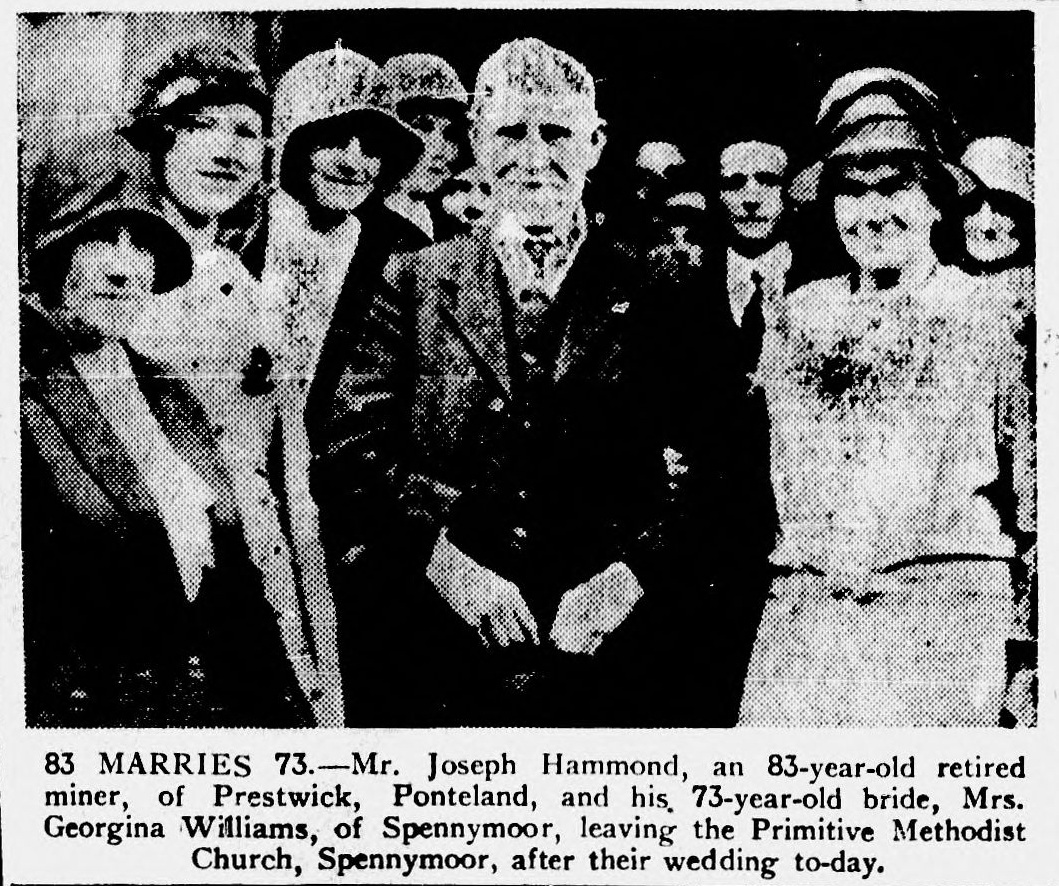 Widow Alters Mind - Former Neighbours Marry
50 Years’ Friendship - Primitive Methodists’ Romance.
A Friendship of more than fifty years between an 83-year-old retired miner and a widow aged 73, had a happy sequel at Spennymoor Primitive Methodist Church, today, when Mr Joseph Hammond, of Crestwick, New Houses, Ponteland, was married to Mrs Georgina Williams, of Oak Dene Terrace, Middlestone Moor, near Spennymoor.
In addition to the Minister who performed the ceremony (the Rev. J Clennel) there were only five people present.
Mrs Williams was given away by her son, Mr J Sangster, of Wheatley Hill, and she was attended by a neighbour, Mrs Raisbeck, of Middlestone Moor, and her daughter.
The wedding is the result of a friendship which began over 50 years ago, when Mr and Mrs Hammond and Mr and Mrs Williams were next door neighbours living at Middlestone Moor.
The Hammonds moved away, but the friendship between the families was maintained at public gatherings.
Mr Hammond has been a local Primitive Methodist preacher for 60 years and Mrs Williams is also prominently connected with the Spennymoor circuit.
Renewed Acquaintance
Two months ago both attended the Primitive Methodist synod which was held at West Hartlepool and renewed the friendship which had been interrupted for several years.
Meanwhile Mr Hammond’s wife and Mrs William’s husband had died, and Mr Hammond proposed to Mrs Williams shortly afterwards.
“At first I did not intend to get married again. I wished to carry out the promise made to my late husband, that I would not marry again,” Mrs Williams said to a “Sunderland Echo” representative, today.
“I expect however, that we both felt very lonely and when Mr Hammond visited Middlestone Moor on June 6, he renewed his proposal and I accepted him.”
Immediately after the ceremony, Mr and Mrs Hammond, accompanied by Mr Sangster and Mrs Raisbeck, left to spend the day in Durham, after which they will return to Middlestone Moor to live.
(21st July 1931 Sunderland Daily Echo)
Morland – Bertram.
The wedding took place at St Paul’s Church, Spennymoor, yesterday, of Miss Margaret Bertram and Mr John F Morland. The bridegroom is the only son of a former mayor of Stockton, Alderman J Morland and Mrs Morland, of Greta House Thornaby, and the bride is the second daughter of Mr and Mrs Alexander Bertram, of North Road, Spennymoor.
The bridesmaid was Miss Doreen Spencer, and the best man was Mr Leslie Marshall. The ceremony was performed by the Rev M Bell, vicar of Tudhoe. Following a reception the bride and bridegroom left on a motor tour of Devon and Cornwall.
(2nd July 1931 Yorkshire Post and Leeds Intelligence)
Cut In Grants
Blow to Durham County Council.
The Ministry of Transport has notified the Durham County Council that the 85 per cent. Grant for trunk road schemes, and the 75 per cent. Grant for unemployment schemes in the five years programme, will not in future be available, but that grants for all schemes will be limited to the normal 60 per cent. for first-class roads and 50 per cent. for second-class roads.
In conveying this information the Divisional Road Engineer of the Ministry states that so far as the trunk road scheme is concerned a total of £589.093 has been accepted in principal, and it will be possible to indicate grants within that amount.
With regard to the five years’ programme the grants approved to date total £270,822. Any schemes outside that total will be subject to the normal grant basis.
Hold Up Of Plans.
This decision involves an entire revision of the County Works Committee’s estimates, and will necessitate the holding up of works until it can be seen whether they can be completed out of moneys available.
The whole of the works at present included in the trunk road scheme can be carried out within the limited rate fixed by the Ministry, but it will not be possible to indicate grants of 85 per cent. On any further sections of the scheme.
These latter include half a dozen works which were estimated to cost £279,610, the main one being on the road from Ferryhill to Croxdale, which, under the Ministry’s ruling, will now only rank for 60 p.c. grant.
Schemes affected in the five years’ programme by this decision total £251,105.
Effect of Reduced Grants.
The Durham County Surveyor (Mr W J Merrett) reports that the effect of the changes in the Ministry grant policy on the current estimates will mean a cut of about £30,000 if the rate figure is to be left at the same level. From the point of view of employment, it represented a sum sufficient to employ an average of 300 men for 50 weeks.
At their meeting tomorrow the County Council will be asked to approve the sending of a deputation to the Ministry to discuss the whole question.
(28th July 1931 Shields Daily News)
Miners’ Bus Fares
Northern MP Questions Minister on Increase.
Mr J Batey (Soc., Spennymoor) asked the Minister of Transport if he is aware that the Commissioners of the Northern Area have compelled the bus owners to increase their fares from 6d to 9d per day for carrying miners to and from their work, and if, owing to the low rates of wages being paid in the Durham coalfields, he will take steps to see that the old fares are restored.
Mr Morrison said that his attention had not been called to the matter except by correspondence. “ I have no jurisdiction in the matter of the conditions attached to a road service licence by the Traffic Commissioners except on appeal,” he said.
Mr Batey pressed his question, and Mr. Morrison said: “I must be careful not to submit to political pressure in a judicial function.”
(9th July 1931 Newcastle Daily Chronicle)
Ministry of Transport.
Bishop Auckland Council called a conference of Crook, Shildon, Willington and Spennymoor Urban, and Auckland Rural Councils with a view of joint representation to the Ministry of Transport in opposition to the increase of bus fares and diminution of services.
The return fare from Auckland to Newcastle from 3s to 3s 10d, Auckland to Durham 1s 2d to 1s 7d.
The Auckland to Stockton service formerly within 60 mins now 80 mins.
(29th July 1931 Newcastle Daily Chronicle)
Spennymoor “Pirate”.
A Spennymoor “listener-in” Wilfred Jameson (30), of 7, West Terrace, was fined 5s, by the Spennymoor magistrates yesterday, when charged with using a two-valve wireless set without a licence.
Jameson said he bought the set in January and forgot to obtain a licence. He had previously held licences in respect of other sets.
(1st July 1931 Newcastle Daily Chronicle)
John Robert Mole
Chase Capture - Merrington Lane Man Remanded.
An unemployed man, John Robert Mole (25), of 16, Front Street, Merrington Lane, was remanded at Durham yesterday, accused of having stolen a two-seater car from Councillor T W Holiday, an ex-Mayor of the City. And having broken into the Blue Coar Schools and the old police station in Claypath.
Further charges will be preferred against Mole at Spennymoor to-day and Superintendent F Foster expressed the view that it was a case for medical examination.
Superintendent Foster said Mole took slates and several articles from the school and loaded them on to one of Messrs Holiday’s waggons in full view of several people, “who had not the sense to interfere.”
Mole could not, said the inspector, start the engine of the waggon, and drove off in Mr Holiday’s car but was stopped by a policeman.
When the car stopped, Mole ran off but was chased and caught.
Mole declared that the car had been loaned to him and said he had been asked to clean the school.
(7th July 1931 Newcastle Daily Chronicle)
Too Violent To Appear In Court. - Merrington Lane Man’s Condition.
Charges against John Robert Mole (25), of Front Street, Merrington Lane, of having stolen a motor-car and of breaking and entering the Blue Coat School and the old police station in Claypath, were adjourned sine die [indefinitely] at the Durham City Police Court to-day.
Inspector F Derry said Mole, who was remanded in custody last Monday for observation as to his mental condition, had since been certified as of unsound mind.
“We could not bring him here this morning because he was so violent,” added the Inspector.
(13th July 1931 Newcastle Evening Chronicle)
Coal Theft Charge - Spennymoor Man Fined for Stealing from Sidings.
“He has more money coming in than many miners. There is no need for him to steal,” commented Police Superintendent Foster at Spennymoor Police Court yesterday, when John Whitehead (32), of Low Spennymoor, was charged with stealing coal belonging to Messrs. Dorman, Long and Company at Ferryhill.
William Wheatley (41), and his son, Cecil Wheatley (16), both of Low Spennymoor, were also charged with the same offence.
It was stated that the three were seen filling bags with coal at the colliery sidings.
“I went for cinders. I had no intention of stealing coal,” declared Whitehead.
He was, however, fined 20s. The same penalty was imposed on William Wheatley, while the boy was bound over for 12 months and placed under the supervision of the probation officer.
(8th July 1931 Newcastle Daily Chronicle)
 Amazing Scenes at Spennymoor Police Court
Crowd Rush Building Already Packed.
Door Force Off Hinges: Stiff Task for Police
Nine Months’ Sentence on Hawker.
Amazing scenes were witnessed at Spennymoor Police Court, today, when a crowd numbering hundreds clamoured for admission to the hearing of charges of assault on police officers preferred against a young hawker.
The building was soon packed to the doors, which were accordingly locked, but the crowds continued to press forward and a door was forced from its hinges. The police were presented with a stiff task, but the case was duly completed.
Sisters Join in Attack.
The hawker, Michael Bradley (22), of Catherine Street, Spennymoor, was sent to prison for three months for having assaulted P C Jackson, and was committed for a term of six months for having assaulted P C Yeandle, the sentences to run consecutively.
On a charge of breaking a shop window, Bradley was ordered to pay the amount of the damage and the costs of the Court, a tota of £11 5s 8d.
He was further charged with having assaulted William Jackson, of Flora Street, and there were cross-summonses against Jackson and his brother, Robert Jackson, for assault. A tree cases were dismissed.
Sisters Fined
Bradley’s two married sister, Mary M Nelson (25), of George Street, and Margaret Cook (19), of Stratton Street, were each fined 30s, with the option of 14 days’ imprisonment, for having assaulted PC Jackson.
When Bradley was sentenced a woman at the back of the court swooned, and was carried outside in a fainting condition.
Bradley continually interrupted the proceedings, and accused witness for the prosecution of being paid to go there to tell lies.
Large numbers of people waited until Bradley left the court handcuffed.
Bottle Weapon Alleged.
Story of Fight and Skull Injury.
Dr T A Beresford-Kane presided.
Dealing with the summonses brought by William Jackson against Michael Bradley for assault, and by Michael Bradley against Wm. And Robt. Jackson for assault, Mr H L Swinburne, for the Jackson, said the affair occurred on May 29.
“Several days after the Jacksons took out their summonses,” he said, “Bradley took ou the cross-summonses.”
“The brothers Jackson were talking to someone when Bradley came along full of drink and badness. He was insulting, and eventually Wm. Jackson and Bradley decided to go around the corner and fight it out.
“Then Bradley set upon Jackson with an instrument, believed to be a bottle, and split Jackson’s skull. Jackson’s brother then went round, and gave Bradley the hiding of his life.
“As a result of his injury Wm. Jackson may not get back to Army service again,” said Mr Swinburn.
Had Drink Himself.
William Jackson bore out his solicitor’s statement, and answering Mr N K Veale, for Bradley, in this case, said he had had some drink himself, but had not been previously warned by the police.
A woman named Hood who saw the fight said she saw no bottle used.
Bradley and Robert Jackson pulled his brother and himself (Bradley) down and that was how William Jackson got the injury to his skull.
He used no instrument, but fought with his fists.
Mr E H R Freenman, prosecuting in the case of assault on PC Yeandle, said that on July 4 the officer, having finished his duties, went into the Red Lion Hotel for a glass of beer.
Later Bradley came in and challenged the officer to go with him into the woods and have it out. Yeandle pushed Bradley towards the door and the latter took up a fighting attitude. In the yard Bradley struck and kicked the officer, and laid him out for the time being.
Broken Shop Window
Sisters’ Attack P.C. in Struggle With Brother.
“About 10.40 the same evening,” continued Mr Freeman, “P.C. Jackson was called to a disturbance near the Templare Dance Hall. Later, when the people were coming out, fighting started.”
“P.C. Jackson stopped this, and then Bradley shouted, “No --- is going to take my mate away,” and started the trouble. Bradley appeared to go madheaded, He ran across the pavement and put his foot through a large plateglass window.
Sisters Arrive
“P.C. Jackson rushed forward, caught hold of him, and managed to get him down. As they were struggling Bradley’s two sisters took a hand in the show. One of them got hold of the officer’s ears and pulled him back, and the other pushed her fingers and thumbs into his eyes and face, and pushed him back.”
“The constable tried to handcuff Bradley, and got the cuff on to one of his wrists, but while he was tempprarily laid out Bradley got up and ran away.”
P.C. Yeandle said that at the Red Lion Hotel Bradley took running kicks at him, and eventually knocked him down.
P.C. Jackson said Bradley struck him, put his knee in his stomach and kicked him.
“ I put my handcuffs on one of his hands,” he said, “when someone kicked my other hand away. I saw Mrs Nelson had kicked me, and then she pulled my head back by the ears, Mrs Cook put her hands over my face, got hold of my hair and pushed her fingers into my eyes.”
Bradley kept interrupting, and here he said, “You want to tell the truth. I don’t care what I get so ong as I get a fair crack.”
Bradley’s Denials
Bradley said the crowd knocked him through the window, and then P.C. Jackson hit him and five people jumped on him.
(21st July 1931 Newcastle Evening Chronicle)
“Little Mother” Steals £20.
Spennymoor Girl of 15 Sent to Reformatory.
Previous Theft.
Stated to be the “little mother” of a large household, a 15-year-old Spennymoor girl was sent to a reformatory school for three years by the Spennymoor magistrates yesterday on a charge of stealing over £20 in money and a handbag from a shop near her home.
Mrs Betty Malcolm, the owner of the handbag and money, told the magistrates that on Friday, July 17, the girl, whom she knew well, called three times at the shop during the afternoon and on the last occasion, purchased a packet of cigarettes, asking at the same time for two threepenny pieces in change. Mrs Malcolm took these from her handbag which she placed on the floor behind the counter.
Shortly afterwards witness heard a sound in the shop and saw the accused dash out. A chair was upset and the handbag and its contents were gone.
Police Sergeant Taylor said that when he interviewed the girl later that day, she said that Mrs Malcolm was telling lies. He searched to house and found nothing. Later he recovered the handbag from some boys who said they had found it while playing near a reservoir.
Girl Denies Charge
For the defence, Mr R H H Whitehead submitted that Mrs Malcolm was mistaken in thinking that the accused had been at the shop and the girl in evidence denied that she was ever in the shop on July 17.
The father said the girl was in the house during the day, and he added that she was a good girl to him, and “mothered” the family. Witness admitted, in reply to Supt. Headen, that defendant had taken about £5 from the house some years ago.
After the girl had been found guilty, Supt Headen told the magistrates that she had been before the court twice previously, once for attempted larceny, and in 1928 for larceny of cigarettes. She was then bound over for two years.
(29th July 1931 Newcastle Daily Chronicle)
Died at Work
Farm Workers See Spennymoor Tragedy.
While hoeing turnips in a field yesterday, Frank Gatenby (54), of The Cottages, Bishops Close, near Spennymoor, collapsed and died.
Haymakers in an adjoining field, saw Gatenby collapse, and ran to his aid, but nothing could be done. Gatenby leaves a widow and a grown-up family.
(2nd July 1931 Newcastle Daily Chronicle)
Post Office Death
Page Bank Policeman’s Collapse.
Police Constable Arthur James Cole, stationed at Page Bank, near Willington, collapsed and died while in the Page Bank Post Office yesterday afternoon.
Aged 47 years, Constable Cole belonged to the London district, and had been in the Durham County Constabulary for over 18 years. Before being posted to Page bank he served at Ferryhill and Willington.
He was an enthusiastic dog fancier, and had taken several prizes with Alsations at shows in Durham county.
He is survived by a widow and two young sons.
The Coroner (Mr J T Proud) was notified of the death but an inquest will not be held.
(24th July 1931 Newcastle Daily Chronicle)
 Bardsea - Visitor’s Gallant Rescue.
A thrill was provided the crowd on Bardsea beach on Conishead Priory, with great gallantry, dived in to the lad’s rescue. This visitor, Mr A Waldock, a native of Croxdale, Durham, dived in fully clothed and brought the youth safely ashore, little the worse for his experience. The rescuer promptly returned to the Priory, and after a hot bath and a change happily suffered no ill effects from his immersion.
(25th July 1931 Barrow News)
Durham Summer School.
The following [local] members, of Durham County branch of the Working Men’s Club and Institute Union have been awarded weekly scholarships at the Summer School to be held at Durham University.
A Thompson, Tudhoe; A H Smart, Croxdale.
(13th July 1931 Newcastle Daily Chronicle)
 Spennymoor School Reunion.
The annual summer reunion of the Alderman Wraith Secondary School, Spennymoor, took place on Saturday.
A cricket match between Past and Presbet students resulted in the former scoring 34 against their opponents 29. For the old scholars J Boustead took six wickets for 18 runs and W Curry took four wickets for one run for the school.
Miss P Parker and S Rutter beat Miss L Hunter and J Hardy in the final of a tennis tournament played on the school courts.
(13th July 1931 Newcastle Daily Chronicle)
Champion Houses - Trophies Won by Spennymoor School Students.
The Alderman Wraith Secondary School held their 12th annual sports on the school playing field at Spennymoor yesterday.
“Champion House” trophies were awarded to Speedwell House (girls) and Celts House (boys).
Other principal awards were:
Boys’ senior championship (Hornsby Challenge Cup), R Askew;
Boys’ junior championship (Walker Challenge Cup), B Jackson;
Girls senior championship (Wraith Bowl), L Edwards;
Girls’ junior championship, M Kennedy.
Senior Boys
Long Jump D Smith 18ft 2in., 1; R Askew, 2; F Mitchell, 3.
High Jump R Askew and J Stanworth ties at 5ft 1in.
80 Yards W Foster, 1; J Stanworth, 2; H Shearer,3.
80 Yards Hurdles R Askew,1; W Forster, 2; W Hetherington. 3.
Half-mile W Smase and A Stephenson, dead heat, 1; J Stanworth, 3.
Relay Norman House, 1; Saxon House, 2; Celt House, 3.
Senior Girls
High Jump M Adamson, 4ft 5in, 1; D Raffle, 2; L Edwards, 3.
Long Jump L Edwards, 1; V Machin, 2; E Brown, 3.
80 yards M Adamson, 1; L Edwards, 2; E Brown, 3.
Relay Campion House, 1; Speedwell House, 2.
Junior Boys
Long Jump B Jackson, 1; J Hardy, 2; W Stoker, 3.
High Jump B Jackson, 1; W Clarke, 2; J Hardy, 3.
80 Yards B Foster, 1; D Knowles, 2; F Kennedy, 3.
Hurdles: N Clarke, 1; M Latheron, 2; B Jackson, 3.
440 Yards J Greenwell, 1; F Kennedy, 2; A Marshall, 3.
Relay: Celts House, 1; Dance, 2; Norman, 3;
Junior Girls
High Jump J Cockburn, 1; M Kennedy, 2.
Long Jump D Webb, 1; M Kennedy, 2.
Obstacle M Ward, 1; D Webb, 2.
80 yards N Hood, 1; B Newman, 2.
Relay Speedwell House, 1; Primrose, 2. The prizes were presented by Miss Robertson, head mistress.
(28th July 1931 Newcastle Daily Chronicle)
 Playing Field - Ferryhill Station Scheme Decided Upon.
A recreation ground is to be provided in the Ferryhill Station area under the Playing Fields’ Association scheme.
The decision follows addresses given at Chilton by Brigadier-General H Conyers Surtees (chairman of the Durham Council of the Association), Mr W Spedding (secretary of the Durham FA and chairman of the Durham executive committee), Mr R Thompson (Bishop Auckland), and Mr W H Wood (general secretary).
General Surtees expressed the strong conviction that every town and village in the country should be equipped with recreation grounds, if only for the safety of the younger people.
(18th July 1931 Newcastle Daily Chronicle)
Ferryhill Play Field - No Progress Reported to Parish Council.
The need of a playing field for Ferryhill and the Broom, which has been discussed for years, was again brought up at the July meeting of Ferryhill Parish Church, and again no progress was reported.
Mr Willey, stated that no answer had been received from the Vicar, the Rev. T L Lomax, to whom application had been made for a field, or from the Playing Fields Association.
The Clerk reported that the Rural Council had taken up the matter of a public bus shelter with the transport people. A special sub-committee have decided to put into operation the Private Street Acts of 1892 regarding the making of back streets.
(23rd July 1931 Newcastle Daily Chronicle)
Car and Motor-Cyclist Collision
A car, driven by Mr Richard Walker, of Osborn Road, Spennymoor, who was accompanied by his wife and the Rev. W Hawthorn, of St. John’s College, Durham, was about to turn into Osborn Road last night when a collision took place with a motor-cyclist, Alfred Moor, of Midland Bank Chambers, Sunderland, who had as pillion rider Miss Vera Meek, of 88, North Street, Highburn, Sunderland.
Both were thrown from the cycle, Moor receiving a dislocated shoulder, and Miss Meek a fractured arm and injuries to the head. They were taken to Sunderland Infirmary.
The occupants of the car escaped injury.
(1st June 1931 Newcastle Daily Chronicle)
 Broken Tow Rope
Car’s Collision With Cyclist at Ferryhill.
A somewhat alarming mishap occurred at Ferryhill last night, when the streets were crowded as a result of a concert in connexion with the local carnival.
A car belonging to Mr E Barker, of Newcastle, which had broken down near Darlington, was being towed by a van along the road known as the Cut when, it is stated, the tow rope broke, causing the car to mount the footpath and swerve across the roadway.
A passing motor-cyclist, Geoffrey Donnison Gibson, was unable to avoid the car, and as a result of the collision was thrown heavily. His machine was wrecked, and he was lucky to escape with abrasions.
(1st June 1931 Hartlepool Northern Daily Mail)
Mishaps To Children
“Chronicle” Free Insurance Payments.
The following claims under the “Evening Chronicle” Free Insurance Scheme have been passed for payment:
£3 Mr Everitt Stubbs (registered reader), of Binchester Hotel, Middlestone Moor, Spennymoor, whose son aged nine, fell while jumping in a field, sustaining a fractured arm.
Newsagent:-Mr Reavley, High Street, Spennymoor.
(30th June 1931 Newcastle Evening Chronicle)
Ferryhill Carnival
Keen Competitions and Good Sport.
Ferryhill Carnival was continued in splendid weather on Saturday, a procession of jazz bands, tableaux and fancy costumes being headed by King and Queen Carnival parading the streets on its way to the football field, where competitions and sports were held.
The results of the events were:-
Jazz Band Contest – 1 Deptford Ramblers, Conductor Mr J Williamson; 2 Spennymoor Biltonions, Conductor Mr J Dodds; 3 West Stanley Mexicans, Mr R Death.
Parade – 1 West Stanley Mexicans; 2 Grange Villa, Mr Collins.
Tableaux – 1C.W.S. Green Olive Soap; 2 C.W.S. Five Soaps.
Individual – 1 Ferryhill Hospital Committee Hospital Ward; 2 Ferryhill Station W.I. Convalescent.
Fancy Dress – 1 Miss D Pollard, Coundon. 2 Mr A Wallace, Annfield Plain
Comic Dress – 1 Mr Dent, West Auckland; 2 Mr Jas Hamilton, Spennymoor.
Children’s fancy Dress 1 Rosemary Trotter, Bishop Auckland; 2 Olive Walls, New Kyo; 3 Maggie Walls, New Kyo.
Children’s Comic Dress – 1 Vera Stephenson, Spennymoor; 2 Albert Pollard, Coundon.
Goal Kicking Contest – 1 P Hodgson; 2 J Forest.
Eleven pounds was collected by the Ferryhill Hospitals Committee.
(1st June 1931 Newcastle Daily)
 Byers Green Carnival
Villagers’ Enthusiasm in Nursing Association Effort.
A commencement was made last evening with the Byers Green and District Nursing Association’s first carnival. A push-ball contest was held in a field lent for competitions. Five teams took part and the winners were: R Goundry, Jacob Goundry, H Bourne, W Cowans, J Edgar, A Shields, T Dargue and T Moult.
Later in the evening a dance was held in the Central Schools, and the music was provided by the Byers Green “Alpha” Band.
The villagers have gone whole heartedly into the carnival. All the streets are gaily decorated with streamers and flags, and many of the dwelling-houses are beautifully done-up for the occasion.
The chairman of the Parish Council was at the station to welcome the “King” and “Queen” of Carnival (Mrs P Dobson and Miss K Todd), the “Jester” (Mr J Sherwood), and their attendants. They drove in state to the colliery, where they joined the procession and paraded the principal streets.
On arrival at the “Constable” garth the “King” and “Queen” were received by County Councillors Mrs J W Royston and Mr H Leedale, Councillor J W Royston and the president of the Nursing Association Mr H Thompson, C.S.I.
The special items this afternoon were the jazz bands parade and the jazz band contest. There was a large entry. Silver cups are given for the winners by Mrs A E Parker and Mr Newsome.
So far as the procession is concerned. Some splendid prizes are being presented to the winners for the best fancy-dress, comic-dress, best decorated cycle, and pedlar’s parade. Other competitions to be held this evening include tug-of-war (teams of six), ankle competition, treasure hunt, best bouquet of wild flowers for children.
The judges are: Mr J W Royston, C.C. and Mrs J W Royston J.P., C.C., of Middlestone Moor; Mr H Leedale J.P., C.C. of Coundon; the Rev. and Mrs Merryweather, of Binchester; Mr and Mrs J C Brown, of Newfield; and Nurse Simpson, of the Nursing Association.
(27th June 1931 Sports Gazette Middlesbrough)
New Dialling System
When the new dialling system now being introduced in West Cornforth comes into operation, telephone subscribers will be in direct constant connection with Ferryhill.
(13th June 1931 Newcastle Daily Chronicle)
Ferryhill Carnival
Parish Council Turn Down Football Club’s Scheme.
Ferryhill Parish Council received a deputation from Ferryhill Athletic F.C., who desired the whole of the market place for the use of amusements at a proposed carnival to be held shortly. The council did not favour the proposal to oust the market traders, and decided not to entertain the request, and further to charge the full scale charges for the market sites.
The Juvenile Tempernce Council, which meets at Ferryhill in September are to be officially welcomed by the parish council.
The need of a public shelter at the bus stand was considered and it was agreed that the matter should be forwarded to the proper quarter.
(19th June 1931 Newcastle Daily Chronicle)
Croxdale Parish Council
At Croxdale Parish Council meeting an agreement was signed between the council and Lieut.-Colonel H C J Salvin, making the wood known as Gerards Gill a public walk, the rent being £5 per annum.
The Clerk was instructed to write to the Playing Fields Association with a view to getting a grant for the provision of amusements for children in the recreation ground.
(25th June 1931 Newcastle Daily Chronicle)
 Ferryhill Initiative.
Nursing Association Makes Voluntary Effort.
Ferryhill and District Nursing Association held a meeting in the Ferryhill Town Hall last night, Mr Stephen Watson presiding.
The financial report showed an income of £73 7s 5d for the month, with expenditure £48 19s 6d, leaving a balance of £24 7s 11d. The balance from th Ferryhill Nursing Association Cup competition had brought in £35.
Owing to the part closing of the Dean and Chapter Colliery at Ferryhill, the funds of the Nursing Association have been greatly depleted.
During the week-end the committee have made a voluntary effort by canvassing. Many new members were enrolled, and arrangements were made for the collection of subscriptions which had been deducted at the Colliery office.
(9th June 1931 Newcastle Daily Chronicle)
Ferryhill FC Sports
The directors of Ferryhill Athletic Football Club, at a special meeting held last night, decided to hold the postponed children’s sports on Saturday, July 18, when a local band will be in attendance and and a net ball and a goal-kicking competition will be added to the programme.
It was reported that a start had been made with the club’s new dressing rooms, which will be ready at the opening of the season.
(16th June 1931 Newcastle Daily Chronicle)
Spennymoor Motorists
Consett Rider Wins the T.T. Tradesmen’s Cup
The Spennymoor and District Motor Club’s Gymkhana provided good sport. The Spennymoor Tradesmen’s Cup for the winner of the T.T. race was awarded to A Bates of Consett, who was fully extended to beat H Atkinson (Consett) and Roy Swinburn (Spennymoor) who were second and third respectively.
Other results were:-
Obstacle race - 1 F Alderson, Sedgefield; 2 H Tatham, Bishop Auckland.
Bun race – 1 T Coulson, Tudhoe Colliery. 2 A Kenmir, Spennymoor.
Chariot race – 1 R Swinburn, Spennymoor; 2 A Bates, Consett.
Musical ride – 1 W Lawson, Spennymoor, and Miss Mitchell.
Tip-the-bucket – 1 R C Hosie, Spennymoor, H Williams (pillion); 2 T Coulson, Tudhoe Colliery, J Thorpe (pillion).
(20th June 1931 Sports Gazette Middlesbrough)
Broom School Sports
Mr E Roberts presided over a meeting of the teachers of the Broom Council School, Ferryhill, when it was decided to hold the annual sports’ day in the Ferryhill LNER recreation ground on June 27th. The heats for the various races will be run off on Tuesday night and the final ties on the day of the event.
(20th June 1931 Sports Gazette Middlesbrough)
 His Tudhoe Holiday
Joseph Musgrave, who has re-signed for West Ham United, is spending the close season at his home in Tudhoe Colliery.
He is a local product, having started his soccer career with Spennymoor Juniors.
He left Spennymoor United last season to join the “Hammers,” and is a half-back of distinct promise. He is only 22 years of age.
(22nd June 1931 Newcastle Evening Chronicle)
£100 Damage in Year.
P.C.’s Sunday Vigil at Ferryhill Quarry.
During the hearing of a case at the Durham County Police Court to-day, in which six Ferryhill youths were summoned for doing damage, it was stated that the Ferryhill quarry had suffered more than £100 damages during the last 12 months.
Huts had been broken into, it was alleged, machinery tampered with, and spare parts stolen. The damage was stated to be so persistent that the quarry required the constant watch of a policeman on Sundays.
In the case before the Court Leonard Smith (25), and Thomas Goldie (18), were fined 15s each, and Sidney Gowling (16), Reuben Gowling (15), James Elsdon (15), and George Goldie 10s each.
(3rd June 1931 Newcastle Evening Chronicle)
Boy Window Smashers
Spennymoor Court Story of Stones in Machinery.
How, during one week-end, 29 windows of the Merrington Lane ironworks of M Coulson and Co. Ltd., were broken and stones were found among the machinery was described by an official at Spennymoor Police Court to-day.
Five Merrington Lane boys were charged with having broken windows, valued at £1 11s 6d, and were fined 7s 6d each, including costs and damages.
The official said the company had suffered so much recently from this practice that they had been compelled to bring this case, in the hope that it would act as a warning to other boys.
It was stated that all the boys admitted breaking the windows, with the exception of the youngest, who told Police-constable Raw that he sat on the wall to watch for the policeman.
(9th June 1931 Newcastle Evening Chronicle/10th June 1931 Newcastle Daily Chronicle)
 Raid On Stores
Men Sent to Goal for Theft at Tudhoe.
During the past five years Tudhoe Colliery Co-operative Stores have been broken into three times and goods to the value of more than £47 have been stolen.
At Durham County Police Court to-day William Chisman (32), of Tudhoe Colliery was sent to prison for six months’ hard labour on each of two charges of larceny, sentences to run consecutively, and Joseph Allen (31), of Spennymoor, was sent to prison for six months’ hard labour for larceny.
The charge had been reduced from one of shop-breaking.
Both men pleaded guilty to have broken into the stores between June 6 and 7 this year, when more than £35 worth of goods were stolen.
Chisman also admitted having been responsible for the two previous burglaries in May 1926, and August 1927, when goods to the value o £5 4s and £8 16s, respectively, were missing.
Allan said: We are guilty, but we did not take all that stuff. We did not take a quarter of that. We couldn’t have carried it away.
Chisman pleaded for a chance to start life afresh and explained that he had just obtained work a fortnight ago at Doncaster.
(24th June 1931 Newcastle Evening Chronicle)
It was stated that entry to the premises had been effected by scaling a wall at the rear of the building and climbing the roof of an out-house. Two departments were ransacked. A discovery which led to arrest was made on a garden near Allen’s house, where a sack was found buried containing some of the missing goods.
(24th June 1931 Hartlepool Northern Daily Mail)
Reynard Busy.
41 Chickens Killed at Spennymoor.
Messrs. Simpson and Corbett, poultry breeders, of Spennymoor, suffered a severe loss to-day, when a fox raided their farm, situated on the Merrington Road, and killed 41 four-month-old chickens.
When Mr Simpson went to the farm about 9 o’clock, Reynard was still at work. He dropped a chicken and made off at the proprietor’s approach.
For more information about Simpson and Corbett go to Old News – April 1924.
(13th June 1931 Newcastle Evening Chronicle)
Ferryhill’s Loss
One of the oldest residents in Ferryhill, Mrs Barker (84), of Parker Terrace, Ferryhill, died yesterday.
Mrs Barker’s family were well known in Ferryhill, where they have lived for many years.
She was buried at Ferryhill Station cemetery.
(11th June 1931 Newcastle Daily Chronicle)
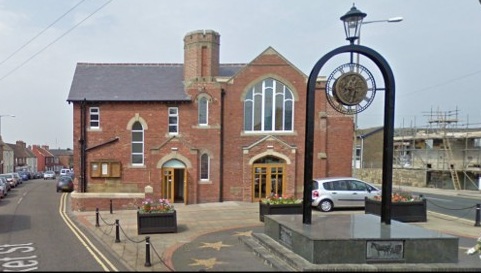 Sun Shines For Northern Weddings.
Special Decorations at Ferryhill.
Bright Dresses.
Several interesting North-East weddings on Saturday were celebrated in happy circumstances splendid weather giving them a good send-off.
The Ferryhill Village P.M. Church was specially decorated for the wedding of Miss Irene Milburn, the youngest daughter of Mr William James Milburn, one of the leading officials at Dean and Chapter Colliery, Ferryhill and Mrs Milburn, and Mr John L Walker, late of Dean bank, who has recently been appointed electrical inspector at Oxford, son of the late Mr L Walker and Mrs Walker, of Dean Bank.
The bride was given away by her father. She was beautifully attired in an ankle length dress of ivory satin bute[?], a bolero coat fastened with a belt and diamante buckle, and her court shoes were of white satin. Her veil was of floral embroidered bet surmounted with a coronet of orange blossom, and her bouquet was of pink and cream roses.
Miss Jennie Taylor, of Durham. A cousin of the bride, and Miss Lili Kennedy, of Dean bank, both dressed in floral georgette and carrying bouquets of sweet peas, were bridesmaids.
A nephew, Master Alare Mutton, and Miss Irene Greathead, were train bearers. Mr Robert T Milburn, a brother of the bride, was best man, and another brother, Mr George Milburn, was groomsman.
The service was fully choral, the organist being Mr Gordon Walker, and the officiating ministers were the Rev. T W Bevan, of Durham, and the Rev. J Henderson, Ferryhill.
Over 100 guests were at the reception at the Town Hall. The bridal pair left for Oxford.
(29th June 1931 Newcastle Daily Chronicle)
 Under-Age Conductors
Youths and ‘Bus Owners Fined at Spennymoor.
Stated to be the first case of their kind in the district under the new Road Act of 1930, three boys pleaded guilty at Spennymoor Police Court to-day to offences in acting as conductors in ‘buses after their licenses had been refused by the Road Commissioners. Three employers pleaded guilty to employing the boys.
Inspector Cook said that the section of the Act provided that no boy under the age of 18, should be employed as a conductor upon a public road vehicle except in cases where he could prove that he had been employed in this capacity for six months prior to January 1, 1930.
The boys were each fined 5s, and the owners of the buses Eliza Pearson (26), of Briar Street Spennymoor; Josiah Jewett (52), of Park Parade, Spennymoor, and E. O. Dunn (57), of Bishop Close Rows, Spennymoor, were each fined 10s.
The chairman of the Bench informed the owners that the offence carried a penalty of £50 and any further cases would be more severely dealt with.
(2nd June 1931 Newcastle Evening Chronicle)
North M.P.’s Bus Inquiry.
Licence Difficulty of Small Firms.
Raised in House.
Mr J Batey, the Socialist Member for Spennymoor, asked the Minister of Transport in the house of Commons yesterday, if he was aware of the difficulty which the owners of small bus companies in the northern area were experiencing to obtain licences, although they had been in existence for five and nine years respectively, and asked him to inquire into the matter.
Mr Herbert Morrison replied that he did not appreciate the precise nature of the difficulty referred to.
Under the Public Service Vehicles (Transitory Provisions) Order, provision was made for the continuance of existing services, pending the grant or refusal of a road service licence.
In the event of the refusal of a road service licence, there was an appeal to the Minister of Transport under Section 81 of the Road Traffic Act.
Drivers Unemployed.
Mr Batey further asked the Minister if he was aware that about 200 young men aged 18 years of age have been thrown out of work in the Northern area owing to the Road Traffic Act, which prevents them from continuing as drivers of buses until they are 21 years of age, and whether he would consider some way whereby they could continue their employment.
Mr Morrison replied: “Section 77 of the Road Traffic Act, 1930, provides that a person shall be disqualified from obtaining a licence to drive a public service vehicle unless he shows to the satisfaction of the Traffic Commissioner that he was during the six months immediately preceding January 1, 1930, regularly employed as a driver of a public service vehicle.”
“I have no power,” he added, “to waive or modify these provisions.”
(23rd June 1931 Newcastle Daily Chronicle)
 Seam Re-Opened
Mechanical Picks in Pit at Ferryhill.
A gang of 28 coal-hewers started in the main coal seam at Dean and Chapter Colliery, Ferryhill, yesterday morning.
This seam was closed some months ago. The men are placed in one district and are working two shifts a day, instead of three as previously.
Mechanical picks are being used.
(3rd June 1931 Newcastle Daily Chronicle)
Mine Closing To-Day.
Over 850 Men Affected In Coxhoe District.
Tursdale Colliery, near Coxhoe, owned by Dorman, Long and Co., is to close to-day. Over 850 workers are affected.
Hopes that the pit would continue to work were dispelled by an official notice instructing underground workmen to send the gear belonging to the colliery owners to the bank to-day. Actually the notices do not expire until Saturday.
Many of the workmen resided in the Spennymoor area, although the majority live at Coxhoe and West Cornforth.
The closing of the colliery will have a serious effect on the district.
(4th June 1931 Newcastle Daily Chronicle)
Dean and Chapter P.R.F.
At a meeting of the Dean and Chapter Colliery, Ferryhill branch of the Permanent Relief Fund there was a proposal from the District Council that after payment of benefit for three years from the superannuation fund, such benefit should cease. The proposal was opposed and the decision forwarded to the proper quarter.
(5th June 1931 Newcastle Daily Chronicle)
Workless Durham Miners.
Mr Lawson (Parliamentary Secretary to the Ministry of Labour) stated yesterday in reply to Mr Batey (Soc. Spennymoor) that on May 18 last the total number of male claimants to unemployment benefit in the coal mining industry, classification in County Durham, was approximately 44,000.
(23rd June 1931 Newcastle Daily Chronicle)
 Actors Left Stranded
Rotherham Man and Wife Fined.
Girls’ Plight.
A midnight visit to the Cambridge Theatre, Spennymoor, Durham, on 9 May by Inspector Cook, who found that a company of performers had been left stranded had a sequel at Spennymoor yesterday, when Joseph Cartwright, aged 48, and Florence Cartwright, aged 52, of 2, West street, Rotherham, were each fined 20s and ordered to pay £4 4s costs on a charge under the Theatrical Employers’ Registration Act of having abandoned a company without leaving sufficient money to pay their expenses.
Superintendent Headon said that the company, which consisted of four adults and a number of juveniles whose ages ranged between 14 and 16, was engaged at the Cambridge Theatre during the week ending 9 May.
Little Money Left
On the Saturday night Cartwright appeared to have left with the intention of going to Stockton, where the company was to appear the following week. Heleft only a small amount of money which was insufficient to pay the expenses incurred by the company during its stay in Spennymoor.
The Saturday nights takings were left to help defray the expenses, but owing to poor support there was only sufficient money to pay six landladies 4s 4d each, leaving 14s for ‘bus fares to Stockton.
Landladies Kindness
Describing his visit to the theatre on 9 May, Inspector Cook said that the takings for that night amounted to approximately £4. There were 14 girls and three boys amoung the performers, and it was only through the kindness of the landladies that they were given lodgings until the following morning.
Both defendants pleaded “Not guilty,” Mrs Cartwright remarking that they had had no intention of leaving the company stranded. She was not at Spennymoor that week owing to illness, and her husband had acted as manager in her absence.
The takings, she added, had been “scandalous.”
(17th June 1931 Sheffield Independent)
Affairs of To-day
The case at Spennymoor, yesterday, when two persons were fined for abandoning a theatrical company, is a reminder of the extremely lean period through which stage performers are passing. The defendants pleaded that they only took £7 in two nights. Slumps in the small towns are nothing new, but to-day, with the cinema having such a firm grip, the stage touches rock-bottom, and it needs not only courage, but sound financial reserve to take a company of no outstanding attraction on tour. The need for the protection of artists is all the greater. They are so placed, that they feel they must occasionally take a chance of a disastrous venture, rather than stand idle.
(17th June 1931 Newcastle Daily Chronicle)
Stepmother’s Cruelty
Said to have Broken Bottle on Spennymoor Girl’s Head.
An allegation that an 11-year-old child was struck on the head with a bottle by her stepmother was made at Spennymoor Police Court yesterday, when Hilda Howe (28), and her husband Thomas Howe (36), of back George Street, Spennymoor, were each fined 20s on charges of cruelty to the child Peggy Howe.
Mr H L Swinburne, who prosecuted on behalf of NSPCC, said that the stepmother had been remonstrated with by neighbours for her treatment of the child. On Sunday, May 3, it was alleged, the child was called into the house and told to go to bed by the stepmother, and the father told her to sit down. She sat down in a chair, and Mrs Howe kicked her on the shoulder, and broke a medicine bottle over her head.
The couple pleaded not guilty, and while the father had nothing to say, the woman denied that she broke the bottle.
An order was made for the removal of the child.
(17th June 1931 Newcastle Daily Chronicle)
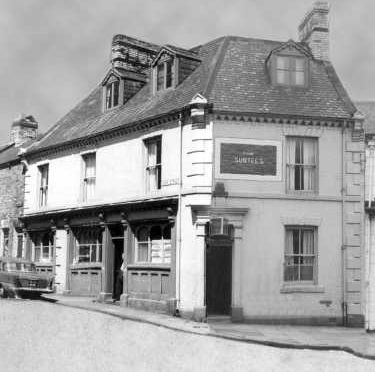 Bets Written Out on Bar Counter
Spennymoor Hotel Transactions.
Licensee Fined.
Penalties for Son and Two Bookmakers.
Stories of alleged undisguised betting transactions in the Surtees Hotel, Spennymoor, were told at Spennymoor Police Court to-day, when charges arising out of a police raid on the premises were heard.
Mrs Jane Gibbons (65), licensee of the hotel, was fined 20s for permitting the house to be used for the purpose of betting; Frank Gibbons (37), her son, was fined £5 for aiding and abetting; and George Richards (39), of North Street, Spennymoor, and James Richardson (34), of Wear Street, Spennymoor, were each fined seven guineas for using the premises for the purposes of betting.
Woman’s Illness
Mr T Jennings, prosecuting, said that Mrs Gibbons had been ill for some time, and the business had been conducted by her son Frank, but in accordance with the Act she was still liable for the conduct of the house.
Betting, he alleged, had been conducted on an extensive scale. The premises were visited by Richards and Richardson, and bets were made openly in the bar, some being written out on the counter in the presence of Frank Gibbons and handed to the bookmaker.
After the bookmakers left, Mr Jennings contended, bets were made out and given to the landlord, who handed them to the bookmakers when they returned.
Policeman’s “Flutter”
P.C.Sanderson, who visited the premises on several occasions, said that one day he was invited by a customer to join in a treble event, and he stood sixpence, but it lost.
On June 3 when witness entered the bar he saw P.C. Dixon who, however, had evidently been suspected, for Gibbons said ”Do not make any bets out today. There is a policeman down at the other end of the bar.”
Relating the story of the raid, Inspector Cook, said that he found upon Richardson 17 betting slips and £3 11s 6d. On Gibbons he found two betting slips.
On a shelf behind the bar the inspector said that he found a tablet relating to a jockey’s sweep, bearing the names of football teams and jockeys, the book having apparently been used for the purpose of both football and jockey sweeps.
Defence Pleas
Mr J F Latimer, on behalf of Richardson, said that Richardson had been forced into bookmaking through lack of employment and no dole.
In the case of Mrs Gibbons he submitted that the summons was bad in law, and if his submission was accepted, they could not convict her son for aiding and abetting.
(16th June 1931 Newcastle Evening Chronicle)
Man’s 40ft. Fall
Spennymoor Erector Injured at Work.
George Taylor (41), of South Terrace, Durham Road, Spennymoor, an erector employed by Messrs. Coulson and Company, Spennymoor, fell a distance of nearly 40 feet from a steel column while at work this morning.
He was later admitted to the Newcastle Infirmary suffering from general injuries.
(2nd May 1931 Newcastle Evening Chronicle)
 Runaway Lorry - Crashes Into Spennymoor House.
An alarming motor accident occurred at Spennymoor yesterday afternoon, when a lorry owned by Grays and Grays, botanical brewers, of Low Grange Road, got out of control and crashed into the front of the house of Mr Alfred Haire, at 7, South Street.
The lorry which was driven by Mathew Lazenby, had been delivering goods in South Street and had just resumed its journey when something went wrong. Careering down South Street out of control for about 100 yards, it mounted the pavement and crashed into the front of the house. The windscreen was shattered and the front wheels and axle totally wrecked.
The wall of the house was badly damaged, bricks being forced inside, and in the sitting room plaster and wallpaper had been displaced over a space of several square feet. The front door was dislodged to such an extent that it would not close.
Lazenby and a boy named Milburn, who accompanied him, escaped with shock and cuts, while the only occupants of the house at the time, Mrs Haire and her son Norman, only suffered from shock.
(9th May 1931 Newcastle Daily Chronicle)
Gallant Rescue - West Auckland Man Dragged from “Live” Wire.
While Frank Catterson, of West Auckland, employed by the Newcastle Electric Supply Co., was working on some overhead electric wires at Spennymoor, yesterday, be received a shock, and his hand and arm and leg were severely burned.
He as attended by a doctor, and taken to Durham Infirmary.
He owes his life to Mr J Ritson, employed at Merrington Lane Slagworks, who at considerable risk to himself dragged him clear.
(12th May 1931 Newcastle Daily Chronicle)
Ferryhill Girl Hurt
Dorothy Joan Laidler (10), after leaving school at Ferryhill, yesterday, was crossing over from Church Road to her grandparents’ home at 2, St Luke’s Terrace, when she ran in to motor-lorry driven and owned by Mr John Bland, of Spennymoor.
Her left arm was broken, and also suffering from head injuries and abrasions she was conveyed to Newcastle Infirmary.
(16th May 1931 Newcastle Daily Chronicle)
The Coxhoe and District Cricket League have decided to form a second division, open to clubs within an eight miles radius of Coxhoe. Coxhoe, Deaf Hill (Trimdon), Davy Lamp (Kelloe), Mount Pleasant (Spennymoor), and Tursdale clubs each entered their second teams, while Byers Green are also likely to join. The division is open to 12 clubs, and a fixture meeting will be held at Coxhoe on Thursday, May 14.
(8th May 1931 Newcastle Daily Chronicle)
C Mason, the Spennymoor Cricket Club’s young bowler, who did so well last year, has started the season in impressive style. Against Dean Bank, on Saturday, he bowled four men in one over and completed the “hat trick,” being the first trundler in the Mid-Durham Senior League to accomplish the feat this season. He finished up with the fine figures of seven wickets for 21 runs.
(9th May 1931 Gazette Middlesbrough)
Markham Schools Cup
The second semi-final of the Markham Schools’ Cup was played on the ground of Ferryhill Athleitic last night, when Dean Bank Boys beat North Road (Spennymoor) by two clear goals. Dean Bank generally held the upper hand, their scorers being Flockett and Hibbert. The feature of the match was the splendid goalkeeping for Spennymoor of Coles, who saved shots from all angles.
The final will be played to-morrow between Dean Bank and Chilton on the Ferryhill ground.
In the final Dean Bank won 2-1.
(8th/21st May 1931 Newcastle Daily Chronicle)
 Dean and Chapter Aged Miners’ Homes Cup
Semi final:
Spennymoor Church of England Boys 2 v Spennymoor North Road Boys 0
Second semi-final:
Dean Bank Boys 3 v Chilton Boys 0 at Ferryhill.
Dean Bank’s team : Wilson; Carr, Stoddard; Robinson, Pratt, Harbour; Summersgell, Flockett, Atkinson, Hibbett, Wayman.
Dean Bank and Spennymoor C.E. play the final at Ferryhill tomorrow.
Final at Ferryhill:
Dean Bank (Atkinson, Hibbett, Pratt 2, Atkinson) 5
Spennymoor C of E (Newcombe) 1
(20th/21st/22nd/25th May 1931 Newcastle Daily Chronicle)
Does anyone have any photos of the teams from 1931?
Pillion Seat Problem
Man Who Used Cushion Fines at Spennymoor
The question as to what constitutes a proper pillion seat came up again at Spennymoor Police Court to-day when Arthur Tonks (23), of Urwin Street, Hetton-le-Hole, was fined 10s for not having a pillion seat securely fixed as required by the Road Act.
P.C. Tupman stated that Tonks’ pillion seat consisted of a leather cushion with a strap across the centre, fastening it to the carrier.
Mr Appleby, of Newcastle, defending, said that the cushion was one Tonks had purchased as a proper pillion seat cushion.
The bench ruled that a cushion, fastened by a strap, could not be called “securely fixed,” as required by the Act.
(5th May 1931 Newcastle Evening Chronicle)
Football in Streets
When three East Howle boys were charged at Spennymoor yesterday with playing football on the highway in Merrington Road, Ferryhill, it was stated that there was a recreation ground only 200 yards away but they would not use it.
Fines of 5s each were imposed. Supt F Foster, who pointed out the danger in playing on a road on which there was considerable traffic, declared that there had been more fatal accidents in Ferryhill during the past twelve months than in any other place in the county.
(13th May 1931Newcastle Daily Chronicle)
Swine Fever Neglect
Well-known Middlestone Farmer Fined £5
A well-known cattle breeder and farmer, Thomas Cheesemond, of West End Farm, Middlestone Village, was fined £5 and costs when charged at Spennymoor Police Court yesterday with failing to notify the fact that swine in his possession had swine fever. He pleaded that he had no idea they were affected.
“This is a very important case and a serious one in many respects,” said Police Supt. Headen, who prosecuted. He stated that Cheesemond made application for a licence to move certain pigs from his premises to Shildon.
The police made enquiries regarding the pigs concerned and a constable went to the farm to inspect them. He found two dead, and bearing signs of swine fever.
Cheesemond was also fined 40s for failing to keep a complete register in respect of the transit of swine, the book being said to be “hopelessly at sea.”
(20th May 1931 Newcastle Daily Chronicle)
Asleep on Pavement
Shotton Man Who Dislikes Workhouses.
Having expressed distaste for the workhouse, John H Price (78), of no fixed abode, was sent to prison for seven days by the Bishop Auckland magistrates yesterday when charged under the Vagrancy Act.
A policeman stated that Price was found begging at Spennymoor. He lay down on the pavement, falling asleep, after visiting a butcher’s shop in quest of a pie.
Price, who said he was a native of Shotton, stated that he had been in and out of workhouses and was not inclined to return.
(29th May 1931 Newcastle Daily Chronicle)
Court Comedies at Spennymoor
People Who Turn Up The Wrong Week
Spennymoor Urban District Council last night decided to petition for the district served by the petty sessions at Spennymoor to be made into a separate petty sessional division.
Councillor Reavley said the district served by the Petty Session now held at Spennymoor had a population of about 35,000 people.
A weekly court was held, dealing with cases from Bishop Auckland Division one week and from the Durham Division the other week.
Confusion was often caused by people appearing the wrong week to apply for summonses.
If they had the whole area made into a separate division, this confusion would be avoided.
(29th May 1931 Newcastle Daily Chronicle)
 Fire Tragedy
Invalid in Fire – Spennymoor Man’s Climb Up Spout To Rescue.
Thrilling rescues were witnessed at a fire at Spennymoor in the early hours yesterday.
About 2am a newsagent Thomas O’Neill, of Villier Street, Spennymoor, was passing the grocery shop of James Trotter at the corner of Villier Street and George Street, when he saw smoke coming fro the cellar and heard the crackling of burning material.
He raised the alarm, and while a man named O’Hara ran to call the brigade he attempted to arouse Mr Trotter and his family, who live above the shop.
Apparently they had become partially overcome by the smoke, for there was no response to his calls.
Mr O’Neill burst open a side door in Villier Street, and attempted to enter, but was forced back by clouds of dense smoke.
Carried to Ground.
He continued to shout and bang upon the door, and at length he awakened Miss Maggie Trotter, who appeared at the bedroom window. He told her of the fire, and she aroused her mother and father.
Flames were now shooting out of the cellar, while the dense smoke cut off the stairs.
Mr Trotter, who is at present an invalid, was assisted through the window by his wife and daughter, and Mr O’Neill climbed up a spout and helped him to the ground.
Mr O’Neill then climbed up the spout again to the window and carried Miss Trotter to safety.
By this time neighbours had been aroused. A ladder was procured, and Mrs Trotter was rescued.
In Night Clothes
As all the rescued people were in their night clothes, Mr O’Neill climbed back into the bedroom to fetch some of their clothes, in spite of the crowd’s warning cries.
Mr O’Neill told the “North Mail” afterwards that on entering the room he felt himself becoming overcome by the smoke, so he grabbed a damp towel, and placed it over his mouth. After hurriedly seizing some clothes he escaped by the window.
Further exciting scenes followed when Mr Trotter, not realising his daughter had been saved, attempted to rush into the house to rescue her. He was followed and pulled out safely.
Inspector Cook and a body of police, assisted by neighbours, poured water into the cellar, and kept down the fire until the brigade came.
On the firemen’s arrival the flames were soon brought under control.
(4th May 1931 Newcastle Daily Chronicle)
 Durham Colliery To Be Dismantled
Village Loses Only Source of Employment
It has been decided to close down Page Bank Colliery, near Spennymoor (County Durham) during the next few days, and the reduced staff of workmen employed there are already working out their notices.
The colliery has been worked during the last twelve months on a short lease extension, granted last year when the long term lease on the colliery and the village of Page Bank expired. At that time the whole of the village, comprising about 170 houses, was sold to a number of different purchasers, and the position now is that the village community of several hundred people will be almost entirely destitute of any source of employment. In effect it will be a village existing almost entirely upon unemployment benefit.
It is understood that the original intention arrived at a year ago to dismantle the colliery will now be proceeded with.
(2nd May 1931 Yorkshire Post and Leeds Inteliigence)
Miners’ Distress in Durham
All That is Possible Being Done – The Premier
The Prime Minister was asked by Mr Batey (Soc., Spennymoor) in the House of Commons if he would in view of the increasing poverty among the mining classes in the county of Durham owing to short-time working, and the continued dismissal of miners, state what steps he proposed to take to deal with the situation.
Mr MacDonald: Short working time and unemployment of men in the coal industry in the county of Durham, which I deplore, is due to the general trade depression which has adversely affected the inland consumption of coal, and also caused a diminution in the coal export trade. The Government are fully alive to the situation in the mining industry, and are doing everything possible to mitigate the effect of the industrial depression in the coal trade.
Mr Batey: When will the Prime Minister be in a position to say what steps the Government propose to take to deal with the situation.
Mr MacDonald: That had better be done on the vote.
Mr Batey: Is the Prime Minister not aware that the situation needs urgent action, and that in his own constituency there is a report of a child dying from lack of food?
The Speaker intervened, and called upon Mr Batey to ask his next question, which was, if the Prime Minister would “bring forward legislation to relieve the industry of the payment of royalty rents by making such rents illegal without compensation.”
Mr MacDonald: The abolition of royalty rents without compensation has never been contemplated. (Hear, hear.)
(2nd May 1931 Yorkshire Post and Leeds Intelligence)
Police Trap Raiders
Organized Gangs of Coal Thieves
Look-Out Plans Miscarry
Organised night raids carried out regularly by gangs of unemployed Durham men upon large coal dumps belonging to the Weardale, Steel, Coal and Coke Co. were described by Insp. Cook at Spennymoor Police Court to-day.
Insp. Cook said large numbers of men belonging to the distress worked in gangs often 30 strong.
Before the raid took place the ground was reconnoitred by several men who after giving the “all clear signal” to their companion, took up vantage points, and were able to give the alarm long before police officers could get near the scene to arrest or identify any members of the gang.
When the police got there, no one was to be seen.
On April 25, however, while a raid was being carried out at Merrington Lane, Spennymoor, by a large gang of men, the look-out plans miscarried.
50 Tons Stolen
Two police officers surprised the raiders and arrested John Kennedy (30), James Kennedy (22), and John Bell (41), all of Burnett Street, Low Spennymoor.
They were to-day each fined 20s and costs and a plea by John Kennedy that he took no part in the raid but had been out all night playing cards in the fields was not heeded.
Inspector Cook said that within a very short time more tan 50 tons of coal had bee stolen from this particular dump, and the owners appealed to the magistrates to protect their interests.
(5th May 1931 Sunderland Daily Echo)
Stealing Timber
For stealing timber from Byers Green Colliery, two Newfield men, Charles Shields, of Garden Street, and Thomas Robinson, of Challis Street, were bound over for twelve months and each ordered to pay 7s 6d costs, at Spennymoor yesterday.
(6th May 1931 Newcastle Daily Chronicle)
Boy of 11 Bound Over
Coal Stealing Allegations at Spennymoor
“The next case we get. I am going to ask the bench to commit without the option of a fine; it is getting so serious,” said Supt. F Foster at Spennymoor yesterday, when a case of coal stealing was before the magistrates.
The defendant was an 11 year old boy of Merrington Lane, who was alleged to have been seen in the company of a 12 year old girl filling a sack from a full wagon of coal at Dean and Chapter Colliery sidings.
When the boy and girl were spoken to it was alleged that they said that their parents had sent them.
Commenting on the seriousness of the position, Supt. Foster said that when full wagons despatched from Dean and Chapter Colliery reached their destination, there had been shortages in weights ranging from five cwts. to two tons.
The boy was bound over and the girl, who did not appear, was ordered to attend the next court.
(13th May 1931 Newcastle Daily Chronicle)
Spennymoor Coal Theft
Robert O’Hara, of Dawson’s Yard, Low Spennymoor, was fined 15s for stealing coal at Tudhoe Iron Works.
(26th May 1931 Newcastle Evening Chronicle)
 Caught Red-Handed
Spennymoor Thief Who Was Cautioned Two Days Before.
A 17 year old youth, who was fined 20s at Spennymoor Police Court yesterday for stealing coal from the Dean and Chapter Colliery sidings at Ferryhill, was stated to have been cautioned by the police two days before the offence was committed.
He was John Parker, of 65, Salvin Street, Low Spennymoor, and he was alleged to have given a false name and address when caught by Police Constable Williams.
“He was actually cautioned two days before,” Supt. F Foster told the magistrates, “and his father came down to the policeman and abused him. Two days later the boy was caught red-handed.”
(27th May 1931 Newcastle Daily Chronicle)
Spennymoor Girl Missing
Vanishes from Situation in Midlands
Great anxiety is being felt for the safety of an 18 year old Spennymoor girl, Edith Marsh, daughter of Mrs Mary E Marsh, of George Street, Spennymoor, who has bee missing from The Mount, Compton, near Wolverhampton, where she was employed as a domestic servant, since May 5th.
The Mount is the home of Lady Mander.
No trace of the girl has been discovered since she asked permission to go to the Post Office on May 5th. At that time she was wearing a black coat, blue dress, navy blue hat, light stockings and brown shoes. The Wolverhampton police are making inquiries. The girl is described as being 5ft. 3in. in height, dark hair, blue grey eyes and a fresh complexion.
This is the second distressing experience Mrs Marsh has had with members of her family engaged away from home on domestic service. About seven years ago her daughter Annie, who was then 17 years of age and was in service at a farm near Scorton, Darlington, was accidentally drowned on her way to church.
For more information see Old News – June 1924.
(15th May 1931 Shields Daily Gazette)
Found Near Home
Spennymoor Girl’s Loss of Memory
…Mary E Marsh was found near Thinford Road Ends on the outskirts of Spennymoor, to-day.
A man who knew her saw the girl standing in the road and recognising her took her home. She was in a distressed condition, apparently suffering from loss of memory. She was placed under medical attention. The girl is unable to give any account as to how she made her way from Wolverhampton to Spennymoor.
(15th May 1931 Newcastle Evening Chronicle)
 Man Dies at Work
Thomas Stephenson (57), married, of 29, Baff Street, Spennymoor, and employed at Coulson and Co., Merrington Lane Ironworks, collapsed at work yesterday afternoon and died.
Stephenson had been unemployed for a considerable time, and had only started work on this job on Tuesday. He was a prominent member of the Spennymoor Rosa Street P.M. Church, being a trustee and also chapel Steward.
(28th May 1931 Newcastle Daily Chronicle)
Policeman’s Death
Constable Willerton, of Byers Green.
The death occurred at Byers Green, yesterday, of Police Constable W J Willerton, who had spent more than 23 years in the Durham County Constabulary.
Mr Willerton was 49. After joining the police force, he spent a number of years at West Hartlepool. He was transferred to Cockton Hill, Bishop Auckland, and was moved to Byers Green about two yeas ago.
(30th May 1931 Newcastle Daily Chronicle)
 Spennymoor – Café and Dwelling House, High Street, to Let lately in the occupation of Mrs Moon, deceased.
Apply Alfred E Morgan, Auctioneer, 1, Cleveland Street, Bishop Auckland.
Shop to Let in Market Buildings, High Street, Spennymoor; rent £55 per annum.
For particulars apply to the Clerk to the Council, Town Hall, Spennymoor.
(9th May 1931 Newcastle Daily Chronicle)
£265 Rent Arrears
Orders Against Spennymoor Company’s Tenants.
In making application at Spennymoor Police Court, to-day, on behalf of the Weardale Steel, Coal and Coke, Ltd., of Spennymoor, for possession of six houses occupied by workmen no longer in the employ of the company, Mr E B Proud, of Bishop Auckland, said the urgency of the matter would be realised by the fact that the arrears of rent amounted to £265.
The company was not desirous of dealing harshly with the tenants, and would be satisfied if possession orders were made, such to be suspended while the tenants paid the current weekly rent and 1s a week off the arrears.
An order for possession in 28 days was made in each case, the order to be suspended for three months if the tenants paid their weekly rent, and 1s a week off the arrears.
(26th May 1931 Newcastle Evening Chronicle)
Miner’s Rent Arrears
26 Years to Pay Them Off !
….The highest arrears were £68 5s owing in respect of one house alone.
Reckoning on that basis, it would take the person owing more than £68 twenty-six years to pay off his arrears.
The Bench made the order.
(26th May 1931 Sunderland Daily Echo)
Kinemas on Good Friday
An Anomalous Position Remedied.
The kinemas will be opened on Good Friday in the Durham County petty seasonal division. This was the decision of the Durham County magistrates today, when the third application was made. They will be open from 6.30 to 10.30pm.
Mr J E Brown-Humes, who appeared on behalf of three kinema owners in Spennymoor, said since the Bench had refused the application the Bishop Auckland magistrates had granted the application, and this brought about an anomalous position in the town of Spennymoor, part of which was in both divisions.
In the Bishop Auckland area the kinemas would be open, while the three in the Durham area would be placed at a great disadvantage. He asked the bench to review the situation in consideration of the action of other benches.
Mr Brown-Humes went on to say that two vicars and one Roman Catholic priest were approached at Spennymoor, and they were in entire agreement with the application, providing the conditions were strictly adhered to.
Mr H E Ferens made an application on behalf of the whole of the kinemas in the area.
Brig.-General Surtees, in announcing the decision of the Bench, suggested that this matter of licensing theatres and kinemas in the county should be subject to one authority instead of to the different magistrates.
(1st April 1931 Hartlepool Northern Daily Mail)
Rambler Cyclists.
Another of a series of easy rides has been arranged for South Shields Ramblers Cycling Club this week-end. Departing from Deans Bridge at 10am on Sunday, the party wil travel over the main road to Chester-le-Street from whence the by-roads through the villages of Waldridge, Edmondsley, and Burnhope will be traversed to Lanchester, the lunch destination. In the afternoon the Ramblers will pass through a network of by-ways through Esh, Esh Winning, Brancepeth and Tudhoe and will partake of tea at Croxdale.
The evening journey home will be by way of Durham, Houghton-le-Spring, Shiney Row, Fatfield, and Washington.
(9th April 1931 Shields Daily Gazette)
 Cricketer’s Death
Passing of “Bobby” Laidler, of Tudhoe Fame
Cricket followers of the Mid-Durham Senior League will regret to learn of the death of Robert Laidler, the Tudhoe bowler. He played with the Tudhoe club for over 30 years, except for one season, with the Mainsforth club.
Mr Laidler started his playing career with the Tudhoe Church club when they won the Durham County Junior Cup in 1895, and it was following the final of this competition, against Medomsley, that he was taken in hand by Tudhoe United, then members of the Durham Senior League. At the age of 15 he commanded a regular place in the club’s first team.
For many years he headed the bowling averages of the club and of the old Wear Valley League, but perhaps his most notable performance was against local rivals, Spennymoor, in a mid-week “Derby” fame, when he bowled the whole of the Spennymoor team for 11 runs. He received many offers of professional appointments but he declined all of them.
The funeral will take place on Monday and it is expected that many local cricketers will be present to pay their last respects.
(11th April 1931 Sports Gazette Middlesbrough)
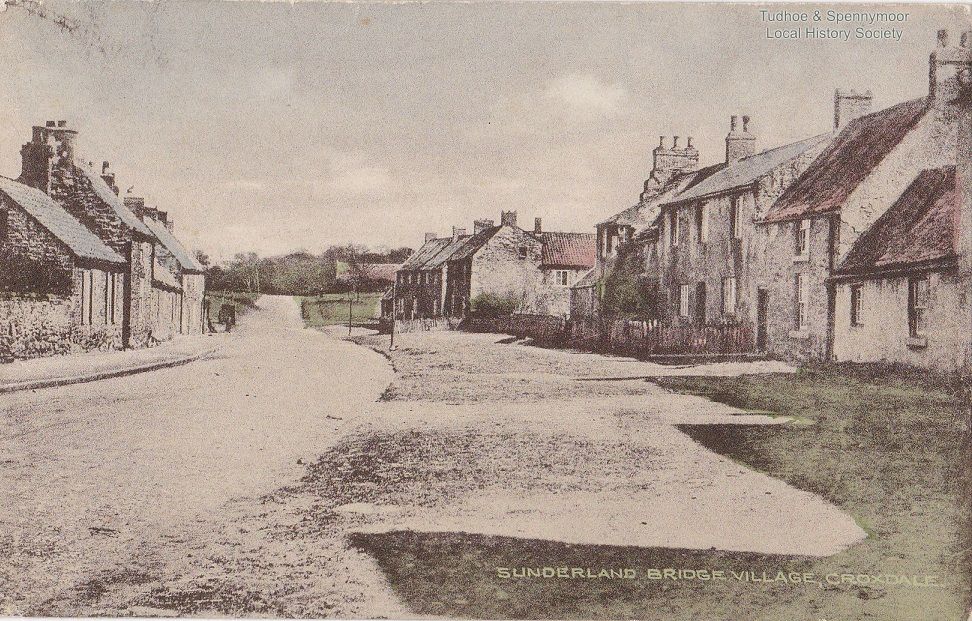 Girl Killed in Brother’s Car
Two Tragedies in Same Village
Two fatal motor accidents occurred within an hour at Croxdale, near Spennymoor.
Ronald Bennington, aged 26, an insurance agent, of Sunderland Bridge village, collided with a saloon car belonging to Colonel Headlam, ex MP for Barnard Castle, of Holywell Hall.
Bennington, who was driving a motor car, was thrown against a windscreen. He died on the way to hospital. He had been married for only six months.
The second fatality occurred in the Great North road, south of Croxdale, when Dennis Burn, aged four, residing with his grandmother at Barmoor Cottages, near Croxdale, ran across the road and was knocked down and instantly killed by an army motor lorry.
(13th April 1931 Dundee Evening Telegraph)
His Last Song
Boy’s Tragic Death While Picking Flowers
“Play ‘Springtime in the Rockies,’ daddy, and I will sing.” Four year old Denis Burns, of Barmoor Cottages, Spennymoor, made this request to his father, John Burns, a dance pianist, who was practising to play at a dance.
The father played his favourite song, and Denis sang it. Then he ran out to pick flowers by the roadside.
A few minutes later he was killed by an Army motor-ambulance travelling from Catterick Camp to Newcastle.
This tragic story was told at the inquest today, when a verdict of “Accidentally Killed” was returned. The driver of the ambulance was exonerated.
(13th April 1931 Liverpool Evening Express)
Car Overturns
A saloon car driven by Mr R Allan of Fleetwood, who was accompanied by his wife, skidded on the greasy road between Middlestone Moor and Spennymoor last night and overturned.
Mrs Allan was stunned but soon recovered, while Mr Allan escaped with shock and cuts. The car was badly damaged and Mr and Mrs Allan completed their journey in another machine.
(29th April 1931 Shields Daily Gazette)
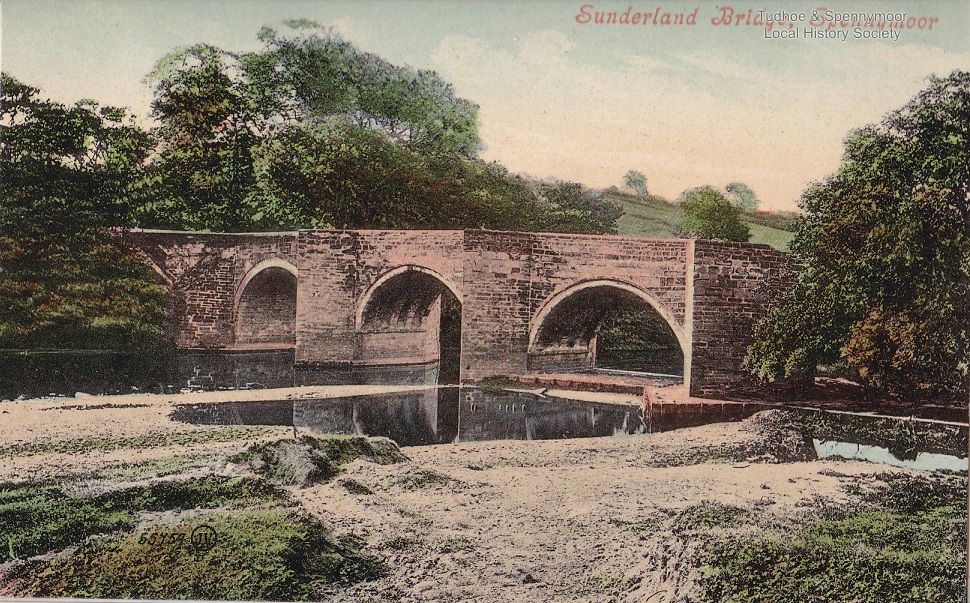 Workless Victims of Hoaxer.
Men Engaged To Carry Boulders From River.
Day’s Toil In Vain.
Further developments are expected as a result of an amazing hoax played upon nearly 30 unemployed colliery workers from the Spennymoor district.
The hoaxer promised work to all the men on a huge road scheme. Eight began work under his instructions on Thursday, shifting huge boulders from the banks of the River Wear.
Eight more were detailed on the same job yesterday, and with the others waited for their “ganger”.”
They waited in vain. The man did not meet them, and they discovered to their anger that they had been subjected to an inexplicable hoax.
The “employer”, a “North Mail” representative was told at Spennymoor last night, visited Page Bank on Wednesday and took the names of nearly every unemployed man there.
Promised a Job
“He secured about 30 names of men anxious for work,” said John Simpson, of Page Bank, “and promised them a job on the road scheme. Eight he said were to start on Thursday and the rest on Monday next.”
Thomas Collins, of Carnes Street, Spennymoor, said the man stopped him in the street and asked him if he wanted a job.
“I agreed” said Collins, “and eight of us went to the Sunderland Bridge with him. Once there he told us to shift a big pile of boulders on the banks of the river, to another spot about 10 yards away.”
“We worked hard all day, rolling the bricks, some of which weighed over five cwt. That day we shifted about 10 tons of stone.”
Vain Wait for “Employer”.
“We arranged to meet him again this morning, and 16 of us met there. We waited in the rain until 11 o’clock, but he did not turn up.”
“The police were informed, and have the matter in hand.”
Thomas Barr, of Rogerson Terrace, Croxdale, another of those hoaxed, said he was alarmed about the employment cards.
When he questioned the hoaxer about it he replied that they had been sent to him by post. Barr had not received them when seen by a “North Mail” representative last night.
Both Barr and Collins stated that the hoaxer used the name of a well-known local surveyor [Mr R Spencer from Spennymoor Council] to convince them that the work was genuine.
When they saw the surveyor he denied all knowledge of it.
(18th April 1931 Newcastle Daily Chronicle)
-----------------
Subsequent newspaper articles stated the police had found the hoaxer who was a well-known Spennymoor man.
I’ve been unable to find any further information so please tell us if you can identify the hoaxer.
 Policeman’s Chase
East Howle Man Takes Cycle “Just for Daftness”
A policeman’s chase was described at Spennymoor yesterday, when John H R Chapman (25), George R Minnikin (26), and Fred Atherton (18), all of East Howle, were charged with stealing a bicycle from a shed in North Street, Ferryhill.
The bicycle belonged to a youth named William McGowan, and after it was missed Police Constable Scott made investigations and later saw the three men walking along Durham Road, Ferryhill.
He shouted to them to stop, but he had to give chase.
All denied any knowledge of the theft, but later Minnikin took the officer to a field where the bicycle had been placed.
Minnikin, it was alleged, said he took the bicycle “just for daftness.”
The three men were bound over.
(15th April 1931 Newcastle Daily Chronicle)
Thief’s ‘Drunk’ Plea Fails
“I was that drunk that I did not know what I was doing,” declared Sidney R Mitchell (21), of Pitt Street, East Howle, who pleaded guilty at Spennymoor Police Court yesterday to charges of stealing two pigeons and 12 chickens and was fined 40s. Police-constable Walling stated that he was unable to find out whether Mitchell was drunk or sober at the time, but he had had the sense to place a brooder with the chickens when he got them.
(15th April 1931 Newcastle Daily Chronicle)
Burglars Foiled
Unable to Break Through Door at Spennymoor.
A determined but unsuccessful attempt was made to enter the Spennymoor and Tudhoe Workmen’s Club in Durham Road. A door two inches thick withstood their efforts but it was so badly damaged that it will have to be replaced.
Marks of blood upon the door suggests that the burglars injured themselves in their task. Moreover, they were apparently disturbed, as a quantity of burglars’ implements were left behind.
The Spennymoor Spiritualist Church was also entered and a small sum of money is missing.
(21st April 1931 Newcastle Daily Chronicle)
“Sweep” Tickets
Spennymoor Letter That Was Intercepted.
A shilling fine, with costs, was imposed by the Durham magistrates to-day on Joseph Cadman (50), of Mount Pleasant, Spennymoor, who was charged with selling lottery tickets.
Supt. Foster said that a letter containing £30, directed to the Irish Sweepstake authorities, was opened, and the Home Office had instructed the Chief Constable of Durham to prosecute.
Mr T Jennings, of Bishop Auckland, who appeared for Cadman, stated that there had been many prosecutions under the Lotteries Act recently, and the magistrates had dealt leniently with them.
An application was made for the return of the £30, but the magistrates told Cadman that he would have to apply to the Home Office.
(22nd April 1931 Hartlepool Northern Daily Mail)
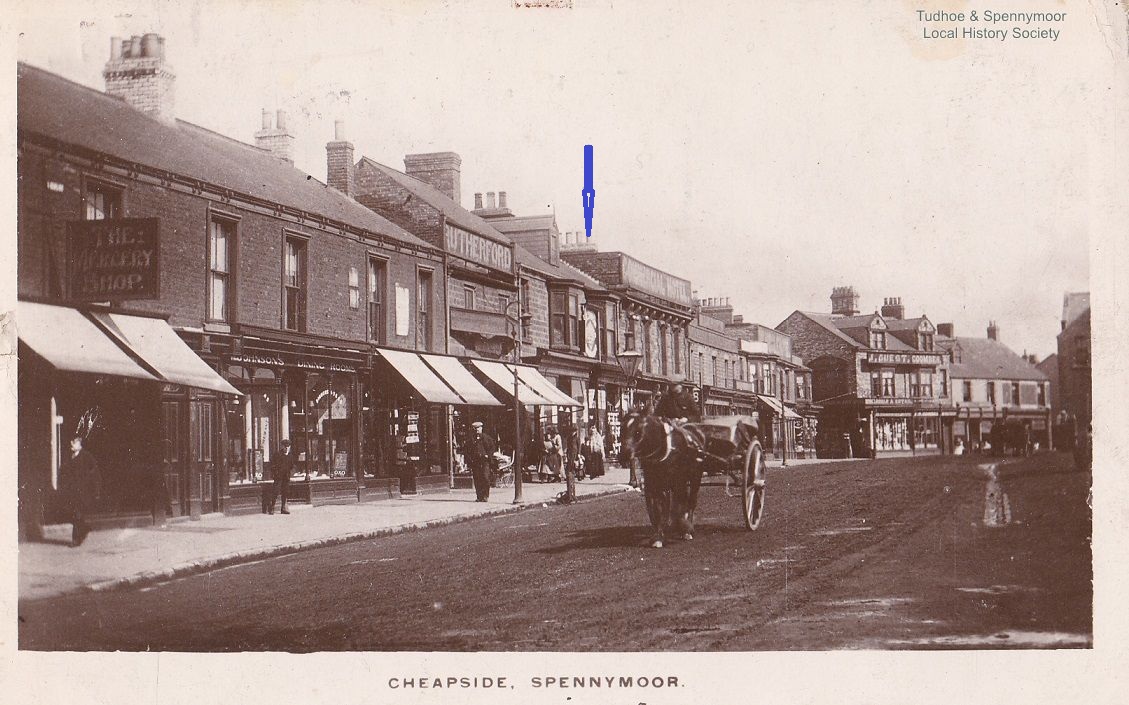
 Pawnbroking Wanted
good, reliable Man for Sales and assist at pledge counter;
permanency if suitable;
references must bear strictest investigation.
Thos Phillips, Cheapside, Spennymoor.
(16th April 1931 Newcastle Evening Chronicle)
‘Gamble With Death’
Stowaways on Their Experiences.
Twenty-two had stowed away on the ship, but 11 were found before it left Fremantle and were put on shore.
One of the men, who had buried himself in the cargo for five days. Stated that he came out of his hiding-place owing to being exhausted. “I was hungry” he said, “and I wanted fresh air and food. When I stowed away among the cargo I realized that it was a gamble with death, but I decided to take the risk rather than face starvation in Australia. I had been in the bush for 12 months. I had no idea that anyone else had stowed away, although I knew there were scores of men in Australia anxious to get back to England.”
A young man from Spennymoor said that Australia is overrun with foreigners and there is no chance of employment for Britishers, especially single men.
“We knew we were running the risk of punishment by stowing away,” he said, “but the risk was worth taking, having regard to the privations we have suffered in Australia.”
(28th April 1931 Hartlepool Northern Daily Mail)
NE Council Elections - Moderate Gains at Spennymoor
At Spennymoor the Moderates gained a majority over Labour. Prior to the election the constitution of the Council was 15 Labour, five Moderates and one Independent, but now the Council will consist of 11 Moderates, nine Labour and one Independent.
Spennymoor Ward (nine seats)
E C Kenmir (Mod), J Reavley (Mod), H Askew (Mod), J Crane (Lab), C Miller (Mod), T Edwards (Mod), D Pearce (Lab), W Hirst (Lab), H Watchham (Lab).
Tudhoe Ward (nine seats)
R S Ross (Ind), W Milburn (Mod), A Blenkin (Lab), T Sutton (Mod), W White (Lab), T Marley (Lab), M White (Mod), R Claughan (Mod), F E Hamilton (Mod)
Ferryhill Ward (three seats)
T Mulloy (Lab), J E Orton (Mod), W Lindsay (Lab).
(1st April 1931 Newcastle Daily Chronicle)
New UDC Chairman
Councillor H Askew Elected at Spennymoor
The first meeting of the newly-elected Spennymoor Urban District Council was held last night. Previously the Socialist Party held the majority on the council, but at the recent election the Moderates succeeded in obtaining a majority of the seats.
Councillor J Reavley, in moving Councillor H Askew as chairman, said Councillor Askew had been on the council for eight years during which time he had for a period been chairman of the finance committee and had also sat upon the Durham County Water Board and on the county assessment committee.
Councillor T Marley, moving Councillor A Blenkin for the chairmanship, said Councillor Blenkin had sat on the council for 33 years.
A vote resulted in Councillor Askew defeating Councillor Blenkin by 11 votes to 8.
For the vice-chairmanship councillor J E Orton defeated Councillor Pearce by 12 to 8.
The following chairmen of committees were elected:-
Finance and general purposes, Councillor T G Sutton
Works Councillor E C Kenmir, Highways Councillor J Crane, Health Councillor W Milburn, Market and parks Councillor J Reaveley, Stable Councillor R S Ross, allotments Councillor A Blenkin.
Rating and Valuation Committee for the urban area:
Councillors Kenmir, Crane and Reaveley for Spennymoor ward;
Councillors Sutton, Blenkin and Hamilton for Tudhoe ward;
Councillor Orton for Ferryhill ward.
(17th April 1931 Newcastle Daily Chronicle)
Crushed to Death by Rope - Inquest Verdict at Spennymoor
Vivid Story of Pit Tragedy - Engineman Praised by the Jury
A VIVID ACCOUNT of a pit tragedy was given by an engineman at a Spennymoor inquest to-day on a youth who met death in a shocking mishap.
The inquest was on William Andrew Fox (17), of Bessemer Terrace, Low Spennymoor, who was killed at Dorman Long and Company’s Mainsforth Colliery.
David Bennett, hauling engineman, said he has seen Fox a few minutes before the accident. He was then walking between the rope beyond the “No Road” board.
Witness then proceeded to haul a full set from out-bye (three tons), when he heard a shout. The next he saw was the boy’s head coming round on the drum. He had been carried on to the drum by the ropes.
Witness immediately stopped the engine and pulled up within eight yards of hearing the shout. He made the set secure and ran out of the engine-house and called for help.
He obtained an endless rope grip and attached it to the main haulage rope, to take the weight of the set off the rope. He then reversed the motor and got Fox off the drum.
It took him eight minutes from the time of hearing the shout to have the body released and laid on the ground. Fox was unconscious when released. First aid was rendered but he died about 45 minutes after.
The body had been internally crushed by the rope, but there was only one coil round it.
The boys were forbidden to come into the engine-house, unless called for by the engineman, but they frequently did so. To get to the engine-house they would have to step across the rope, and witness admitted that he had called for boys to come to the engine-house when the set was in motion.
The boys would have run a similar risk to that of Fox.
On this occasion, however, he had not called for Fox and had no knowledge as to why he was coming towards the engine house.
Mr George Telford, local inspector, said he examined the place shortly after the accident.
The management had now decided to make a road straight through to the hauler, so that there would be no reason to cross the rope to get to the engine-house, and future danger would be avoided.
A verdict of “Accidentally killed” was returned, the jury expressing appreciation of the efficient way in which Bennett had acted after the accident.
(11th April 1931 Newcastle Evening Chronicle)
Stealing Coal
George Kirkbride (41), of Weardale Street and George Walker (33), of Post Office Street, Low Spennymoor, were each fined 10s by the Spennymoor magistrates yesterday, for stealing coal from the Dean and Chapter Colliery sidings at Ferryhill.
(1st April 1931 Newcastle Daily Chronicle)
Raiding for Coal
Four Canny Hill Men Fined at Spennymoor
When four Canny Hill men were charged at Spennymoor yesterday with stealing coal from Messrs Dorman, Long and Company’s Westerton Colliery, Mr E B Proud (prosecuting) said the Company took a serious view of these cases, as they were becoming so frequent.
The Company had lost an enormous amount of coal, he said, as the result of early morning raids.
It was stated that 200 new sleepers had been stolen from the colliery during the past three months.
Two of the men, Joseph Welsh (27), of Garden Terrace, and John Lambert (29), of Bowman’s Terrace, who were charged with stealing sleepers as well as coal, were each fined 25s. The other two, Alex Wales (27), of Garden Terrace, and Stephen Robinson (23), of Sportsman Yard, were each fined 20s.
(22nd April 1931 Newcastle Daily Chronicle)
Fraud by Miner
Drew “Dole” and Benefit From Relief Society
“It is a most contemptible thing that a workman should rob his fellow-workmen. You were getting a weekly income from various sources that amounted to much more than that of the miners who are contributing to the fund.”
This comment was addressed by the Chairman (Mr J Reavley) at Spennymoor Police Court yesterday to Edward Ross (36), miner of 18 Rosa Street, Spennymoor, who was fined £5 for obtaining money from Northumberland and Durham Permanent Relief Fund Friendly Society by means of false pretences.
Mr Barry Jones, of Newcastle, prosecuting, said it was alleged that Ross had obtained £27 from the society in respect of accident benefit and during that time he was in receipt of unemployment benefit. He was asked on several occasions by the society’s local agent if he was receiving the “dole” and he said he was not.
Ross, who pleaded not guilty, said he thought that he was entitled to accident benefit as well as the “dole”.
(22nd April 1931 Newcastle Daily Chronicle)
 Women Fight a Fire
Women assumed the role of fire-fighters at Spennymoor, to-day, when they ran with their buckets filled with water and quelled a shop fire before the town’s fire brigade arrived on the scene.
The fire occurred at a fried fish shop in Half Moon Lane, which was being opened for the dinner hour trade by the proprietor, Mrs Harle.
Flames gushed out from the furnaces and under one of the pans, and a large quantity of dripping got alight, causing the flames to spread in all directions.
Neighbours had their attention drawn to the outbreak by volumes of smoke pouring from the door and windows and soon nearly 40 women were running towards the scene with their buckets which they had filled hurriedly at their homes.
The fire was quelled in record time.
One of the women, Mrs Howess, paused in her work to make a plucky rescue of a nine year old girl, Olive Perkins, who was knocked down by a motor-lorry whilst rushing across the road to see the fire.
Mrs Howess promptly pulled the child from under the wheels of the vehicle and she escaped with slight bruises and severe shock.
(2nd April 1931 Sunderland Daily Echo)
 Big Load on Road
Machinery for Tyne-Built Vessel
Great interest was aroused in Spennymoor High Street, today, when a load of machinery for the Monarch of Bermuda, recently launched in the Tyne, passed through the town.
The convoy consisted of two traction engines, two living vans, and a truck containing machinery weighing about 50 tons. The load had had to be diverted through Spennymoor, as it had been unable to pass under the railway bridge at Darlington North Road.
When it reached the Spennymoor railway bridge it had to proceed very slowly but cleared the bridge with less than a foot to spare.
(11th April 1931 Newcastle Evening Chronicle)
Always Ready
Dear Daddy,
May I become a member of your homely large Circle. My mother has taken the “NWG” for a long time now, and I’m always ready to read it when she has finished reading it. I always look for “Norman, Nora, and Nan.”
I am nine years of age and in Standard III at the C.E. School in Spennymoor. My mother made me a fancy dress to represent England, Ireland, Scotland and Wales in the Carnival. I hope to see my first letter to you in print. I would write you poetry, but I think my letter is too long. Anyway, here it is:
I had a little donkey,
And he wouldn’t go,
Think I’d whip him,
Oh, no, no,
I’d put him in a stable
And give him some corn,
He is the best little donkey
That ever was born.
Your loving member
Alice Coatesworth, Spennymoor.
(18th April 1931 Northern Weekly Gazette)
Mr T B Smith Dead
Well-Known Ferryhill Musician
Mr Thomas B Smith, a well-known local musician, died at his home at Gordon Terrace, Ferryhill, yesterday.
Mr Smith, who was manager of Walker Limestone Quarry Company at Ferryhill Station until the firm ceased operations, was for many years musical director at the Cambridge Theatre, Spennymoor.
He leaves a widow, a son and three daughters. His service was at Ferryhill Station Cemetery. He was on the committee of Spennymoor Social Club, and was a member of the Knight of the Golden Horn.
(15th/17th April 1931 Newcastle Daily Chronicle)
 Spennymoor Preacher Dead
Mr John Pae, one of the best-known Wesleyan preachers in the North, has died at his home, 34 Whitworth Terrace, Spennymoor, aged 86. Mr Pae had been a preacher for 65 years, and only a month ago took the service at Spennymoor Wesleyan Church.
About a fortnight ago he contracted influenza, which developed into bronchitis.
He was born at Byers Green, and was for 50 years a blacksmith at Tudhoe Colliery. He retired in 1921. His wife died some years ago, and there is no family.
(9th March 1931 Newcastle Evening Chronicle/10th March 1931 Newcastle Daily Chronicle)
John Pae was born at Hetton Lyons in 1846 (not Byers Green), his father was Thomas Pae (Pay) born in 1812 at Bewick-on-Tweed, an enginewright, his mother Ann was born in 1806, Pensher. In 1851 they were living at Hetton Lyons, in 1861 they had moved to Blair's Houses, Byers Green, Thomas was a joiner journeyman and John a blacksmith's apprentice.
In 1870 John married Margaret Rivers b1843, Summerhouse, daughter of William, a mason, and Elizabeth Rivers. In 1861 Margaret was a pupil teacher at Byers Green. In 1871 John and Margaret are living with Margaret's father at Byers Green. From 1891 John and Margaret are at 34 Whitworth Terrace with John's step-sister, an ornamental leather worker, and several nieces. Margaret died in 1919 aged 75 and John in 1931 aged 85.
 Induction of Pastor
There was a record congregation at the Presbyterian Church, Mount Pleasant, Spennymoor, yesterday afternoon, for the induction of the Rev. J Murray Rodger to the pastorate of the church, vacant by the call of the Rev. Bernard Paton to Warrington.
Induction of Pastor
There was a record congregation at the Presbyterian Church, Mount Pleasant, Spennymoor, yesterday afternoon, for the induction of the Rev. J Murray Rodger to the pastorate of the church, vacant by the call of the Rev. Bernard Paton to Warrington.
Mr Rodger comes from Sunderland where he has been in charge of the Roker Church for 4.5 years, and before that he was for 6.5 years at Embleton, in Northumberland.
(26th March 1931 Newcastle Daily Chronicle)
LNER ambulance classes
All the students of the Ferryhill LNER ambulance classes who sat at an examination under Dr J B Aitkin have been successful.
(6th March 1931 Newcastle Daily Chronicle)
Van Dwellers’ Fear - Homes Removed in Fire Outbreak at Spennymoor.
Damage amounting to about £25 was done in a fire at a living van in Railton’s Yard, Back George Street, Spennymoor, late last night. The van was occupied by Llewelyn Rowland, an unemployed miner.
Rowland lit the stove and went out to buy his supper.
On his return, about 15 minutes later, he found the van in flames. P.C. Hodgson was quickly on the scene, and, with the assistance of van dwellers, removed the other vans to safety.
(7th March 1931 Newcastle Evening Chronicle)
Spennymoor Society to Disband
Spennymoor Lecture Society, at their annual meeting last night, decided, owing to lack of support, to wind up the Society.
The financial statement showed a deficit of £5 12s 5d, and when the lantern and other assets have been realised the Society will be finally closed.
The secretary, Mr R M Pearson, said it was useless to carry on the Society when there was not a sufficient number of people who would become season ticket-holders. There must be at least 200 season ticket-holders, and in spite of all the efforts of the committee they had only had 160 during the past year.
(28th March 1931 Newcastle Evening Chronicle)
Prison for Bogus Theatrical Manager
A bogus theatrical producer named Henry J George has just pleaded guilty at Spennymoor, Co. Durham, to charges of not being registered and of abandoning his touring company. It is highly satisfactory to see that the recent Act is really being enforced against posts of this sort, who do irreparable damage to the unfortunate young women who join their companies and are left stranded in distant parts of England.
Although he had three previous convictions, George was given the option of a fine. This option proved valueless, since he had no money, and he is likely to serve six months in prison. Although it is no advantage to the community having to support him there, it is gratifying to observe that he seems to have made nothing out of his very undesirable kind of enterprise.
(4th March 1931 Truth)
Chocolate Clue - How Policeman Caught Low Spennymoor Boys.
Smears of chocolate round his mouth led to the appearance in the juvenile court yesterday of a 14-year-old Low Spennymoor boy, who, with two other lads aged 13 and 12, was accused of stealing two boxes of chocolate biscuits from a Low Spennymoor shop.
Police Constable Yeandle said that all the lads had previous appearances in court, and when he saw them together after the theft, he noticed chocolate marks on the face of the eldest.
It was stated that all three were concerned in a charge of damage to an empty house some time ago, and the younger two were bound over for two years in November on a charge of larceny.
The two boys who had broken their recognisances were ordered to pay £2 each, and all three were bound over for two years.
(18th March 1931 Newcastle Daily Chronicle)
Men With a Whippet - Fined for Game Trespass at Spennymoor.
When David Heseltine (23), of Spennymoor, and Richard Robinson (23), of Tudhoe Grange, were charged yesterday with game trespass in a field at Spennymoor, Police Constable Gaddass said he saw the men with a whippet.
A hare was chased by the dog, but escaped. Heseltine then picked up the dog.
Robinson explained that the dog went into the field and chased a hare, and they tried to get it out.
Both men were fined 10s 6d.
(18th March 1931 Newcastle Daily Chronicle)
 Pit Re-Opening - Work for 600 Men at Ferryhill.
No time was lost by the management of Dean and Chapter Colliery at Ferryhill after the miners agreed to work under the new conditions laid down by the Company, in arranging for re-opening the Brockwell Seam.
A special band of messengers were dispatched with notices to all the men required, asking these to sign-on by Saturday morning when cavils for working places would be drawn for. A full complement of horseshoers were busy on Saturday attending to the ponies and a large number of surface men began work.
It was expected that only 100 men would be needed for the Brockwell Seam, which is the only one that is to be worked, but there was an agreeable surprise when it was found that about 240 hewers would be required. These, with the putters, datal men, and boys, will bring the number of workers at the colliery to over 600.
It is expected that the other pits will re-start in about six weeks’ time.
(2nd March 1931 Newcastle Daily Chronicle)
More Miners Engaged - Brighter Prospects at Dean and Chapter Colliery.
A large number of men were signed on at the Ferryhill Dean and Chapter Colliery to begin work opening out the Harvey Seam this morning.
After having been closed for four months the Colliery started away with a week of six days, working on Saturday- the first time on that day for many years- and the prospects in the district are much better than they have been for some time.
The Harvey Seam has been much improved during the time that the pit has been closed with the object of quicker winning of coal with the minimum of labour.
(9th March 1931 Newcastle Daily Chronicle)
Dean and Chapter Colliery - Coke Ovens, By-product Works and Acid Plant
It was also stated at Ferryhill yesterday, that Messrs Dorman, Long and Company intend to transfer their coke ovens, by-product works, and acid plant from Dean and Chapter Colliery to Teesside, and that the plant is to be dismantled for that purpose. The works are among the largest of their kind in Durham County.
(9th March 1931 Blyth News)
Bank Manager Retires
Mr Joseph White, manager of the National Provincial Bank, Spennymoor, retires to-day after 44 years’ service. He started his career at Hartlepool before going to Spennymoor 18 years ago to manage Ferryhill Village, Ferryhill Station, and Spennymoor branches. Mr White is a keen worker in the public life of the town. He is a noted badminton player and was the means of introducing the game in Spennymoor.
(31st March 1931 Newcastle Evening Chronicle)
Mr Samuel Liversidge
Mr C N Liversidge (41), fourth son of the late Mr Samuel Liversidge, of Rotherham, has been appointed manager of the branch of the National Provincial Bank, Ltd., at Spennymoor, Durham.
(4th March 1931 Sheffield Daily Telegraph)
Croxdale Veteran Dead
Mr Tom Stark (75), one of the oldest residents in Croxdale, was found dead in bed by his son, on coming home from work. He was a keen sportsman in his younger days, and took an interest in greyhounds. For years he acted as caller and lamplighter for the village.
(12th March 1931 Newcastle Daily Chronicle)
Co. Durham C.W.L. President.
Mrs Salvin, of Croxdale Hall, has been elected president of the county executive committee, which has been formed for all branches of the Catholic Women’s League in the county of Durham.
(28th March 1931 Leicester Catholic News)
Edith Lady Auckland
The death occurred suddenly at her home in London on Saturday of Edith Lady Auckland, the daughter of Sir William Eden, the 6th baronet, and aunt of the present baronet, Sir Timothy Eden, of Windlestone, Ferryhill, Co. Durham. She was 80.
Lady Auckland was the third wife of the fourth Baron Auckland, who died in 1890. In 1897 she married Mr Phillip Symons, who died in 1926.
(30th March 1931 Yorkshire Post and Leeds_ Intelligence)
 Main Line Blocked - Snow Causes Mishap Near Ferryhill.
A London and North-Eastern Railway goods train, on its way from Newcastle to the south, left the rails yesterday just outside Ferryhill station on the main line.
The engine ran off the lines at a junction, and the three wagons which followed it immediately ran off also. The cause of the mishap is believed to be snow, which interfered with the proper working of the points.
A breakdown gang from Darlington was soon on the spot, and traffic was directed by another route until the late afternoon, when, after about three hours’ work, the line was in order again. The permanent way was damaged, and the rails and switches were put out of order.
(12th March 1931 Hartlepool Northern Daily Mail)
4 Miles for a Penny
A fare-cutting contest between the owners of the two bus services between West Cornforth and the Surtees Arms, Ferryhill Station, a distance of more than two miles has resulted in the return fare being reduced to a penny on one of the services, while the other charges twopence.
(6th March 1931 Newcastle Daily Chronicle)
 Cinema Comedy - Spennymoor’s One Open and Two Shut.
Durham County Bench have refused permission for the opening of cinemas on Good Friday, whilst Bishop Auckland justices have given sanction.
As a result of this a Gilbertian [farcical] situation arises in Spennymoor.
In the main street there are three cinemas – two under the jurisdiction of Durham County authorities and one under Bishop Auckland. Therefore one will be open while the other two will be closed.
Ferryhill district is in the Durham County territory, and the three cinemas there will be closed.
(27th March 1931 Newcastle Daily Chronicle)
Spennymoor Urban Council Rates
Spennymoor Urban Council fixed the rates for the coming half-year as follow:-
Low Spennymoor 7s 11d and increase of 3s on last half-year;
Tudhoe 8s 1d an increase of 4d;
Merrington Lane 9s 5d a decrease of 2d;
Whitworth 9s 1d a decrease of 5d.
Councillor Marley, chairman of the Finance Committee, said that the increase of 3s in the Low Spennymoor area was due to the action of the old Board of Guardians, With regard to Merrington Lane, the rates should have been 10s 2.5d, a levy of 1s 0.5d having been made by the County Council for this area, but this had been divided into four levies of 3d.
(27th March 1931 Newcastle Daily Chronicle)
The Trade Position - Mr F Thompson’s Address at Ferryhill.
Mr Frank Thompson, of West Hartlepool, addressing a meeting at Ferryhill on Thursday, dealt with the question of the critical trade position.
He said the depression of industry and the resultant unemployment had reached a stage when they threatened permanent injury to the industrial life of the country. For some years there was a belief that the country’s industrial vitality would be restored when foreign countries regained financial stability.
To-day, in an ever-deepening depression, there was a tendency to seek consolation in the fact of world depression, and to ignore the real gravity of the situation.
For ten years before the world’s depression began this country had been continuously unable to find employment for ten per cent of its people.
Referring to imported iron and steel, he said that if it was made here instead of being brought from countries which were maintaining a standard of life lower than our own, it would result, as well as finding employment, in an enormous increase in the railway traffic and railway revenue. It would produce something like 21 million tons extra for the railways.
(6th March 1931 Hartlepool Northern Daily Mail)
Workless Up By 7,000 in Year - Coal Revival Need at Bishop Auckland
Unemployment in the Bishop Auckland area, where there is an increase of 7,845 workless compared with a year ago, is unlikely to diminish unless there is a considerable improvement in the coal industry.
The increase has been a gradual one, and since November only 406 persons have been added to the “live” register.
General unemployment situation in the area remains bad, and prospects of any improvement are dependent on the mining situation as a large percentage of the unemployed are colliery workers.
There have, however, been appreciable decreases in the number of workless at Cockfield, Shildon, Spennymoor, Crook and Wolsingham.
At Shildon there are over 100 fewer unemployed than in November last year, and at Spennymoor there has been a fall of nearly 300.
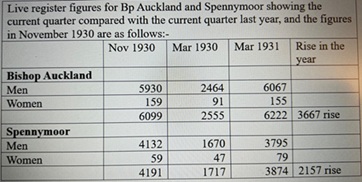
During the quarter 1,045 vacancies were filled locally by the Bishop Auckland exchange and branch offices.
In the women’s department 96 applicants have bee placed locally, the majority of these being domestic workers, while applicants placed in other districts during their quarter totalled 23.
Twenty trainees had completed their course at the Home Training centre at Bishop Auckland and had been placed in London, Cheltenham, York, Macclesfield, Manchester, and elsewhere.
(13th March 1931 Newcastle Daily Chronicle)
Plight of Stranded Circus Artistes - Only 18/- Between Them for Week at Spennymoor.
£10 to Rescue Monkeys and Elephant.
How a troupe of circus artistes, who had only received 18s between them for the week, were abandoned at Spennymoor, with their performing animals, by a Seaham Harbour man who had employed them, was described at the Spennymoor Police Court to-day when the latter was fined £25, or three months’ imprisonment, on each of two charges.
One of the members of the circus was only able to get a performing horse, an elephant and a troupe of monkeys away from the town after a friend had sent him £10.
Stiff Fines on Organiser.
Henry J George (25), of 8 Princess Road, Seaham Harbour, was charged with two offences under the Theatrical Employment Registration Act, of 1925, with carrying on business as a theatrical employer without being registered under the Act, and with abandoning Thomas Fossett and eight others, at Spennymoor on January 10.
Inspector Cook said that on January 10 there had been at the Cambridge Theatre, Spennymoor, what was known as the Regal Stage Circus. George had engaged Thomas Fossett and other circus performers, of Bourne, Lincolnshire.
The circus had opened out at Seaham Harbour the previous week, but business had been bad, and the company received only half their wages. They came on to Spennymoor, and the attendances were worse.
Landladies Losses - Employer Missing at End of Performance
George, said Inspector Cook, was seen on the stage about 9pm on the Saturday night, but after the show he was found to have absconded.
The artists had only received the sum of 18s among them for the week.
Fossett and eight others came to the police station and registered a complaint, and they were got away from the town on the Monday after considerable trouble.
A friend wired Fossett £10, which enabled him to send a performing horse, an elephant, and a troupe of monkeys by rail. Three other horses and their grooms, however, were compelled to go by road to Bourne.
The offence said the Inspector, was a most serious one, for not only had the artists suffered, but also landladies in the town, who had kept them for a week.
Thomas Fossett said that on December 29th he entered into a contract with Savage to provide with the “Regal Stage Circus”, trick horses, lady riders, performing elephants and a troup of monkeys. They opened out at Seaham and very moderate business was done.
At the end of the week they received only half their wages, £15. The following week they came to the Cambridge Theatre, Spennymoor. The business done was very bad.
George pleaded guilty to both charges, and said he regretted the loss to the artists, and the trouble he had caused. He had hoped all the week that he would have been able to raise money to pay them on the Saturday.
Inspector Cook said that when the defendant opened out at Seaham Harbour he had obtained mats to the value of £30 from the Blind Institution at Sunderland, but fortunately these were found at Spennymoor, and had been recovered by the Institution.
Defendant had recently resided at Seaham harbour, but was a native of Sittingbourne, Kent, and last year was employed as advance agent to “Broncho Bill’s Circus”. He had also resided at Cockermouth.
He had previous convictions against him at Marlborough for stealing films, at Hailsham for stealing a cheque book, and West Kent for office and workshop breaking.
He was fined £25 or three months’ imprisonment in each case, sentence to run consecutively.
As defendant had no permanent address, and had not the money to pay the fine, Inspector Cook applied for his immediate committal.
Call From Sunderland.
Inspector Cook added that he should say in the defendant’s favour that when he heard that inquiries were being made for him, he rang up from Sunderland to ask if this was the case, and on being told that summonses were laid at Spennymoor for him he promise to come, and did so.
(24th February 1931 Newcastle Evening Chronicle, 25th February 1931 Shields Daily Gazette)
Fossett's Circus Poster.
The Fossett circus family, whose origins dated back to the mid-nineteenth century in Ireland, were so numerous that it was once said that every circus in the British Isles harboured at least one Fossett!
3 Road Crashes at Spennymoor - Woman and Girl Under Vehicles - Remarkable Escapes.
Three motor accidents occurred in the Spennymoor district during the week-end when three persons were injured and a number had narrow escapes.
1. In a blizzard near Spennymoor on Saturday a ‘bus skidded and knocked down Miss Nellie Binks, of 1, Belle Vue, Byers Green, who was seriously hurt and taken to Durham Infirmary.
It appears that Miss Binks had dismounted from a ‘bus near the Aged Miner’s Homes and was passing in front of the bus to cross the road when she failed to notice the approach of a United bus from the direction of Spennymoor.
The driver of the bus swerved to avoid her with the result that his bus skidded on the snow covered ground, mounted the pavement an crashed through some railings into a field. The girl was knocked down and was found underneath the bus.
Cut By Flying Glass
The conductress of the bus, Annie Miller, of Francis Terrace, Cockton Hill, Bishop Auckland, and Lucy McAdams, of Durham Street, Middlestone Moor, sustained cuts from flying glass and slight injuries to their legs. After receiving attention they were able to proceed home. The remainder of the passengers on the bus, numbering about 12, were transferred to another bus and continued their journeys.
2. A head-on collision occurred last night at Spennymoor between a Wilkinson’s Service Bus, driven by Lance Dargue, of Fishburn, and a baker’s van belonging L Forbes, Ltd. of West Hartlepool and driven by Ernest Hopkins.
The bus was coming along Durham Road from the direction of Durham as the baker’s van was approaching along Cheapside from the direction of Bishop Auckland.
At Wharton’s corner the vehicles collided and travelled across the road locked together crashing into a lamppost and a road signpost. The baker’s van was partly overturned, the rear portion going through the windows of the bus, held it there and preventing the vehicles from entirely overturning.
Alf Garrett, of West Hartlepool, who was a passenger in the van, had a remarkable escape. He was thrown on to the road between the two vehicles. The driver, Hopkins, jumped out and dragged Garrett to safety, as there was danger of fire breaking out on account of the escaping gas from the broken street lamp and of the van completely overturning and crushing him.
The six passengers in the bus and the driver and conductor all escaped injury.
The bus windows were shattered and the radiator damaged. The front portion of the van was wrecked. The van, it appears, had been buried on Saturday in a snow drift at Westerton and the occupants had been engaged all day digging it free.
3. Under Car, But Unhurt
A girl named Naylor (10), residing in Bessemer Terrace, Spennymoor, had a remarkable escape on Saturday. She ran across the High Street, Spennymoor, and was knocked down by a car driven by Kenneth Thompson, of Sunderland. On being picked up from underneath the car, she was found to have escaped without a scratch.
(2nd February 1931 Newcastle Daily Chronicle)
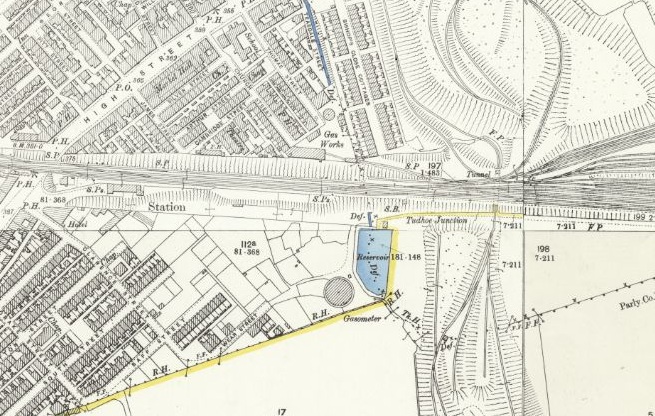
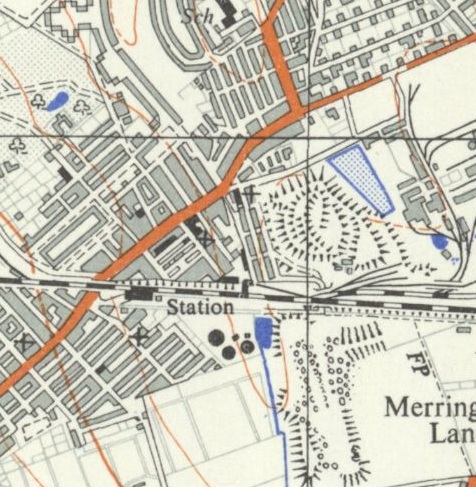 Reservoir Rescue Thrill - Spennymoor Man Saves Woman.
Although he could not get her out of the water because of an infirmity, an LNER signalman named Nicholls, saved Elizabeth Swalwell (24), of Bessemer Terrace, Mount Pleasant, Spennymoor, from drowning in the gasworks reservoir last night.
Nicholls was coming from his cabin, which overlooks the reservoir, when he heard moans and a cry. He rushed to the water’s edge, but at first, in the darkness, could not see anything.
Later he saw the woman in the water, but, as he suffers from an infirmity, he could only drag her to the side and hold her head above the surface until a man passing along the footpath nearby came to his assistance and hauled the woman to safety. After attention she was taken to her home suffering from shock. (18th February 1931 Newcastle Daily Chronicle)
A Railway Hero.
Mr Harold Nicholls, railway signalman, of 6 Bryan Street, Spennymoor, who rescued a woman from the gas works reservoir on Tuesday is being transferred to Smeafield, near Berwick. Mr S Smith, chief booking clerk at Spennymoor, is organising a presentation. (26th February 1931 Illustrated Berwick Journal)
Fireside Explosion. Dean Bank Woman Burned by Flying Embers.
While Mrs Longstaff, wife of a deputy overman at Dean and Chapter Colliery, Ferryhill, was poking the fire at her home at Newton Street, Dean Bank, an explosion took place among the coals and she was severely burned about the face and head by flying embers.
The explosion is believed to have been caused by a detonator having accidentally been placed among the coal.
Mrs Longstaff had to receive medical attention.
(4th February 1931 Newcastle Daily Chronicle)
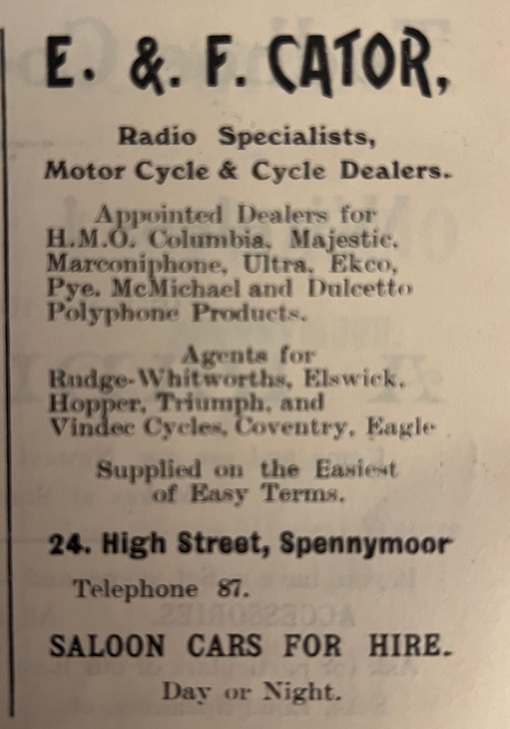
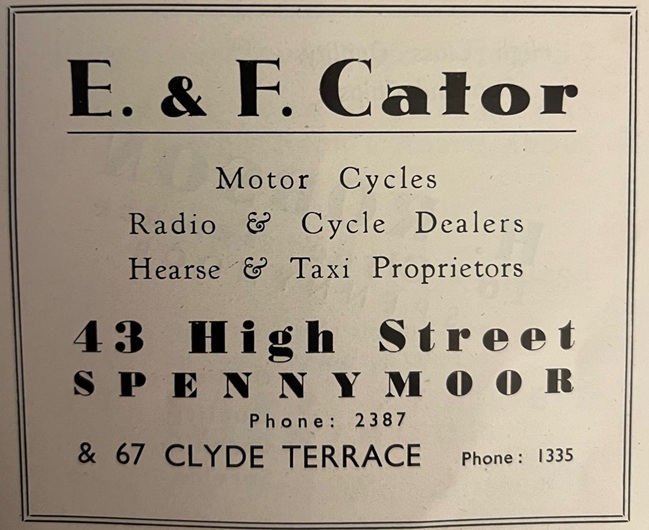 Three Cars Burnt Out
Garage Destroyed in Spennymoor Blaze.
Petrol Explodes.
Men Driven Back by Fierce Flames.
A serious fire occurred at Spennymoor about midnight on Saturday resulting in the destruction of a garage and three saloon cars, the property of Ernest Cator, of Burn House, Wear Street, Spennymoor, who carries on a car hire business.
The fire was discovered by a man named Richard Snowball who was in some gardens at the rear of the premises. He ran to the house of Thomas Petch who lives next to Burn House, behind which the garage is situated, and asked him if his property was on fire.
Petch looked out of the back door and saw flames issuing from the garage and immediately he informed Cator.
Cator and Petch got the garage doors open and dense volumes of smoke came out. They tried to retrieve the cars and had got hold of one when there was a loud explosion of a petrol tank and flames spread in all directions, reaching a height of 70 to 100 feet.
Menace of Explosions
Further explosions kept recurring and the fire was so fierce they were compelled to abandon their attempts to recover anything from the garage.
The Spennymoor Fire Brigade arrived but owing to a poor supply of water were unable to prevent the premises being destroyed. Fortunately the direction of the wind prevented the fire spreading to adjoining premises.
The fire was all burnt out within an hour, but while it lasted the heat was so terrific that the glass of the saloon windows had melted and remnants were laid in misshapen mass upon the framework of the burnt-out cars.
The cause of the fire is unknown.
Mr Cator had only returned from a journey a short time previous to the discovery of the fire, and when he locked the garage everything was then apparently in order.
(16th February 1931 Newcastle Daily Chronicle)
In 1921, aged 16, Ernest is a tea deliverer for Northern Tea Company, Spennymoor. He is living with his parents at 94 Upper Church Street, Spennymoor. He married Leslie Copeland in 1929. In 1939 Ernest is a cycle and radio dealer and a taxi proprietor living at 67 Clyde Terrace, Spennymoor with his wife and children, Leslie, Ernest G and Yvonne.
Victims of New Act - Lorry Driver and Cyclist at Spennymoor Court.
John Thomas Parkin (23), of Teesdale Road, Bethnal Green, London, was fined 20s. at Spennymoor, today, for an offence under the Road Act, 1930, by leaving his lorry in a dangerous position on the highway.
PC Bell said that about 1.45 am on Dec 13 he saw the lorry standing in a dangerous position near the top of a hill. He looked inside and found Parkin and a relief driver asleep under some rugs.
Asked why they were standing there Parkin replied that they had run short of petrol, but subsequently he took a tin of petrol from the side of the lorry and proceeded on his journey.
Edgar Foster (25), of Upper Church Street, was ordered to pay the costs on a charge of riding a cycle and holding on to a lorry. The case was brought as a warning that this is an offence under the new Act. He was ordered to pay costs.
(3rd February 1931 Newcastle Evening Chronicle, 4th February 1931 Newcastle Daily Chronicle )
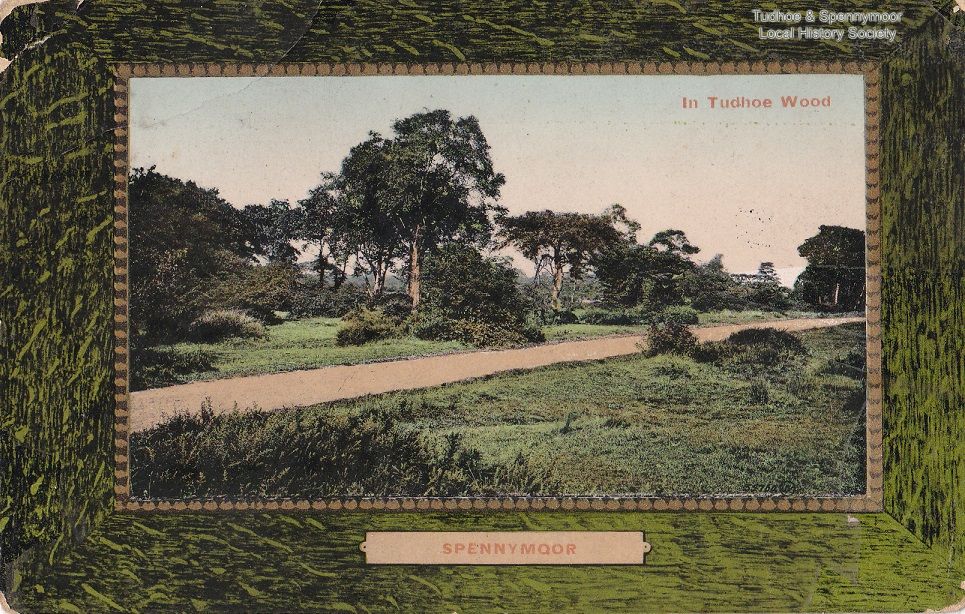 Keeper Strikes Man with Gun - 20s Fine for Tudhoe Wood Assault
Victim Out for Walk.
A remarkable story was related to the Spennymoor Bench yesterday in a case in which Cecil H Page (48), of Partnership Cottage, Tudhoe Grange, was charged with assaulting an unemployed miner, Thomas Worthy (22), of Tudhoe Grange, and was fined 20s and two guineas costs.
It was alleged that Page, who is a gamekeeper, struck Worthy violently on the head with his gun, and set his dog on Worthy’s companions.
For Worthy, Mr J E Brown Humes submitted that counter-charges against his client and three companions – John Moore (29), Ambrose Hood (21), and Harold Barrett (26), all of Tudhoe Grange – by Page, were merely a counterblast to the main charge by Worthy against Page.
There was, he contended, no suggestion that the four young men were poachers, although they were charged by Page with trespassing in pursuit of game and with alleged assault.
Went for Walk
The men had “signed on” at the labour exchange that day, and decided to go for a walk afterwards. They went through Tudhoe Wood to the River Wear. So far as they knew this was a public footpath, used by hundreds of people during the summer.
Page approached and asked them what they were doing, and Worthy replied that they were having a walk. Then, his client alleged, Page gave Worthy a blow on the head with his gun and cut his ear very badly.
Mr Stokoe (Gateshead), for Page, submitted that the Bench would find difficulty in believing that a gamekeeper would attack four young men. Page saw then loitering, and asked them what they were doing on the land.
One of them replied; “That has nothing to do with you.” Page was then struck by one of the young men with a stick, and, said Mr Stokoe, a struggle ensued for the gun.
The Bench dismissed the counter charges by Page, and ordered him to pay costs.
(4th February 1931 Newcastle Daily Chronicle)
Coal Stealing at Spennymoor.
At Spennymoor Police Court to-day, Richard Etherington (34), Jonathon Bestford (23), and Stanley Bestford (16), all of Thomas Street, Spennymoor, were each fined 15s for stealing coal, the property of the Spennymoor Gas Company.
Inspector Cook said the coal stealing had become so serious that he had been compelled to put officers on special observation duty.
Mr T Forrest, secretary of the Gas Company, stated that they estimated their minimum losses from coal stealing at £100 per annum.
(24th February 1931 Newcastle Evening Chronicle)
 Tudhoe Colliery Primitive Methodist Sisterhood held their anniversary services yesterday, when Sister Jessie, of North Shields, was the preacher, and the members rendered the service of song “The Torn Bible”.
(2nd February 1931 Newcastle Daily Chronicle)
Ferryhill Primitive Methodist Concert Party gave an entertainment at the Rosa Street, Spennymoor, schoolroom, last night, the Misses Sybil and Jennie Bussey, Miss Taylor, Miss Hodgson, Mr Maddison and Mr A Bussey taking part.
(11th February 1931 Newcastle Daily Chronicle)
Mr and Mrs I Wainwright, who are well-known Methodists at Spennymoor, recently celebrated their golden wedding. Mr Wainwright has been a local preacher for 48 years. He has filled all the offices open to a layman in the Mount Pleasant Church, and is keenly interested in the Sunday School and the welfare of the children.
In 1903 Mr Wainwright organised a mission in a barn at Ferryhill Village, the success of which was the origin of the present church at Dean Bank.
(14th February 1931 Newcastle Evening Chronicle)
Isaiah Wainwright was born at Kingswinford, Staffordshire in 1856, the son of William, (b1816, a puddler), and Ellen (b1818 Lye, Worcestershire). In 1861 they are living at Kingswinford with two sons and two daughters. In 1871 they have moved to 110 Mount Pleasant where William is a plate shearer at the ironworks and Isaiah is an ironworker aged 15.
In 1881 Isaiah has married Mary Alexandra Knowles and they are living at 70 Half Moon Lane, Mount Pleasant. They later move to Weardale Street and have six children, with four surviving, Lottie, Ellen, Alfred and Samuel. Isaiah is a signalman for the Weardale Coal and Coke Company. Isaiah died in 1931 and Mary in 1934.
 Peculiar Protest in Court - J.P. Objects to Bench “Making Exhibition of Themselves”.
A remarkable protest was made from the bench at Bishop Auckland Brewster Sessions to-day following an application for an extension of permitted hours in respect of public-houses in Bishop Auckland on market day (Thursday) of each week.
The bench were considering the application, when Mr John Reavley J.P. of Spennymoor, rose and said “I object to the Bench making an exhibition of themselves. What right have we to hold our hands up. Other times we have retired. Simply because there is a majority in favour of this application, those who are against it have to be dragooned into it. I am compelled to make this public protest.”
The chairman (Dr T A D Kane) pointed out that it was desirable not to drag a crowded bench out of court.
“They can walk out and walk in,” retorted Mr Reavley.
The magistrates deferred their decision and later, following a retirement, the chairman announced that the application was granted.
(5th February 1931 Newcastle Evening Chronicle)


Upturned Plans Passed - Why Spennymoor Bridge is so Narrow!.
Coun. John Reavley, of Spennymoor, gave a further instalment of his lecture on “Peeps into the history of Spennymoor”, at the Presbyterian Guild Hall, Mount Pleasant, Spennymoor, last night.
Dealing with the railway bridge which crosses the street in the centre of the town, Mr Reavley said one of the “crimes” laid at the door of the old Local Board was the narrowness of the bridge.
In connection with this Mr Reavley related an interesting story.
Plans had been passed for widening the railway, but the board overlooked the more important matter of widening the span across the street. This was not discovered until the foundations were being laid. A protest was made, but the Railway Company reminded the Board that they had passed the plans.
It then transpired that the Board had been looking at the plans upside down when they had considered them.
(26 February 1931 Newcastle Evening Chronicle)
John Reavley JP, (1868-1941) author of "History of Spennymoor" published in 1935, this updated Dodd's "History of Spennymoor 1897". A Member of Spennymoor UDC for over 35 years and Chairman on 3 occasions and for several years represented Spennymoor on Durham County Council. He became a JP in 1918 and was a Methodist Minister for 40 years, managing a newsagents and stationery business for almost 50 years. He died in 1941, aged 73, and was buried in Rock Road Cemetery.
Dodd in his History of Spennymoor 1897 commented on the error
“There was nothing for it but to appeal to the generosity of the directors. The Company, however, had already been put to a great deal of expense and they demanded a very moderate compensation, whereupon the Board, with its penny-wise policy, refused to accept their terms, and the work was allowed to proceed.
The High Street of Spennymoor would have been a really fine thoroughfare had the span of the Bridge been carried back to the frontage of the Station Hotel. As it is, the town appears mean and ugly to anyone entering in for the first time, and all because of the hideous obstruction that forms the gateway to the business portion of the town. It is to be hoped that before long something may be done to make it a thing of beauty. The widening of the span would be a costly undertaking, but it might be possible at a moderate expense to redeem its ugliness by building a gateway of medieval type on both sides of it. Even a gateway in stucco would be preferable to the present arrangement.”
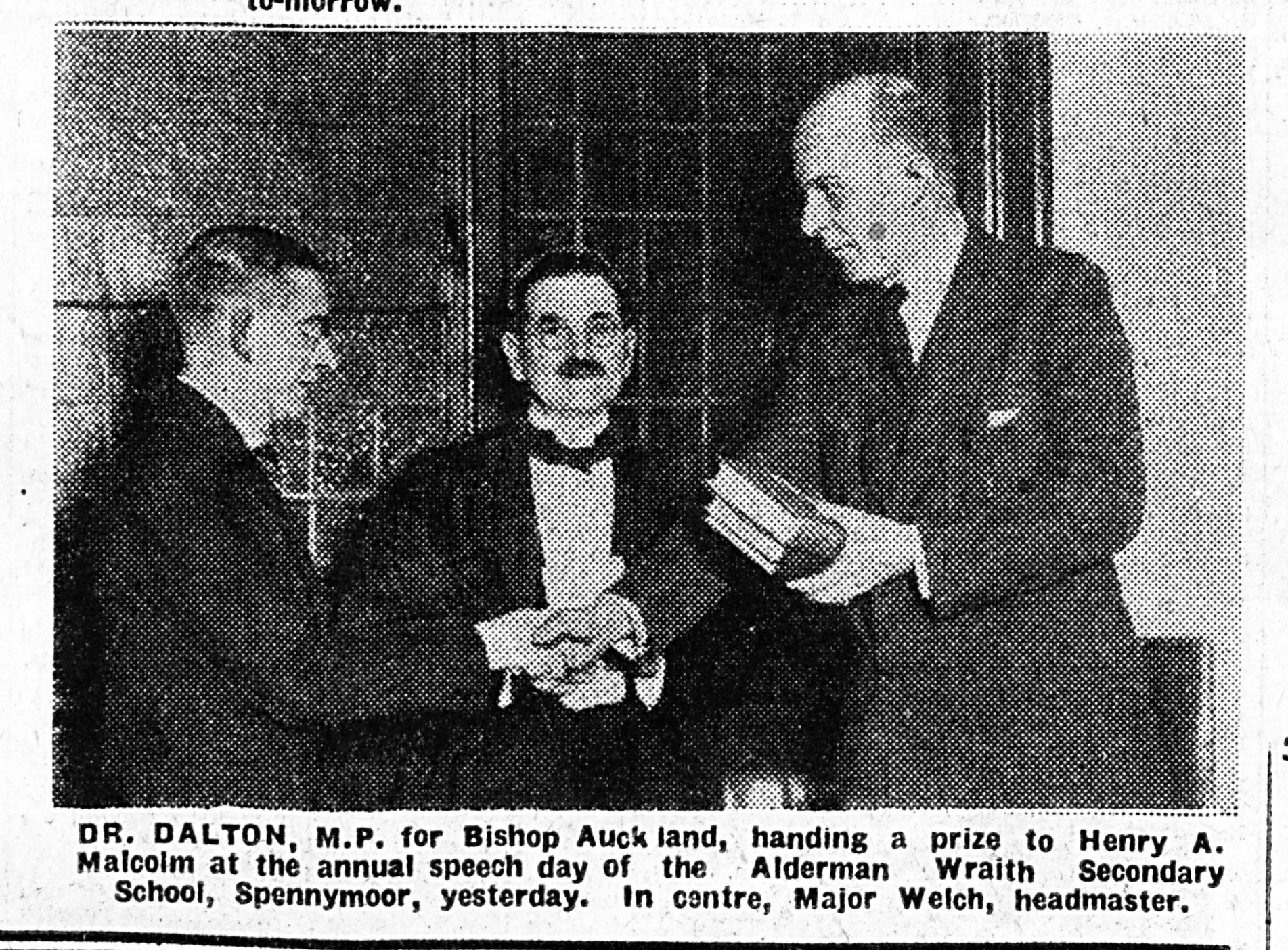 Test of Teaching - Spennymoor Headmaster on Value of Examinations.
The importance of examinations was commented upon by Major T Welch, headmaster of the Alderman Wraith Secondary School, Spennymoor, at the school speech day, yesterday.
Major Welch said they found examinations a fairly accurate gauge of ability and understanding, where intelligent methods of teaching produced better results than of cramming.
In the Oxford certificate examination 60 pupils were successful out of 69 – 22 with honours.
Nine pupils passed the Higher School Certificate examination out of 13 pupils who entered. Five distinctions were obtained.
(28th February 1931 Newcastle Daily Chronicle)
World Citizenship - Problems for the Rising Generation.
Speaking on the future aims of education at the annual Speech Day of the Spennymoor Secondary School (County Durham) last night, Major T Welch, the head master, said that the vital problems with which pupils of to-day would be confronted with to-morrow would not be local, or even national, but world problems. To be good Britons they would have to be good Europeans, and to be good Europeans they would need to be good citizens of the world.
Dr. Hugh Dalton MP, Under-Secretary for Foreign Affairs, who presented the prizes, said that the aim of education was to explode ignorance and ancient prejudices, and to stir the earth of national life to render it more fertile for the planting of the trees in the future. Ours was a wonderful country, and had an even more wonderful future if the rising generation did their duty. The trend of modern thought and scientific development was towards the removal of national barriers, and the establishment of a wider sense of citizenship which acknowledged neither race nor colour.
(28th February 1931 Yorkshire Post and Leeds Intelligence)
Broom Cottages Council School.
From 101 applications for the position as caretaker of the Broom Cottages Council Schools at Ferryhill, Mr Mark Peacock, of Bede Terrace, Ferryhill, has secured the appointment.
(24th February 1931 Newcastle Daily Chronicle)
Relief Work Protests - Sedgefield Want Own Workless on Schemes.
“A Disgrace”.
Strong protests on the method of selecting men for Durham County Council relief work in the Sedgefield district were made at a meeting of Sedgefield Rural Council, yesterday.
“Here we have thousands of men unemployed,” declared Councillor J P Berry, “but daily one can see bus loads of men brought into the district on this work from as far away as Bishop Auckland and Spennymoor.”
“It is a disgrace to the district” he added.
Councillor Walton also bitterly complained of this and a deputation was chosen to meet the County Council on the matter.
(14th February 1931 Newcastle Daily Chronicle)
Mr Mark E Steel, retired undermanager of Tudhoe Colliery, was on Saturday presented with a gold snuff box and a wallet of notes, and Mrs Steel with a gold brooch with opal stone, from the officials and workmen of the colliery.
(16th February 1931 Newcastle Daily Chronicle)
Two ex-officials of the Dean and Chapter Colliery, Ferryhill, were honoured by their colleagues last night.
Mr E J Eland, who retired after 60 years’ service, received a gold watch, and Mr John Dodd, who resigned after 30 years’ service to take up another post, was the recipient of a three-valve wireless-set.
Mr J Rutherford, manager of the Dean and Chapter Colliery, presided, and Mr E G Grace, handed over the gift to Mr Eland, and Mr R W Heslop that to Mr Dodd.
(28th February 1931 Newcastle Daily Chronicle)
Dean and Chapter Colliery
Ferryhill Colliery - Good Hopes of Reopening on Monday.
After prolonged negotiations between the management and the men’s representatives, an agreement has been formulated by which it is hoped that Messrs. Dorman, Long, and Co.’s Dean and Chapter Colliery, Ferryhill (Co. Durham) will be reopened on Monday next.
The agreement lays down new working conditions, and one important point gained by the colliery management is that they will strictly adhere to their proposal to engage only those workmen whom they think are most suitable for the work available. This is one of the first instances of te departure from the system of cavilling (casting lots) for jobs by the men themselves for many years.
Under the agreement it is proposed to resume work in the Brockwell and the Harvey-Busty seams, but the Harvey seam proper will not be reopened for the present. Dean and Chapter Colliery closed down 14 weeks ago, having regularly employed over 2,500 men and boys for many years before that. It is one of the largest collieries in County Durham.
(10th February 1931 Hartlepool Northern Daily Mail)
Re-Opening of a Pit - Ferryhill Miners Interview Management.
Several of the new conditions proposed by the management of Dean and Chapter Colliery at Ferryhill for the restarting of the pit, which has been idle for 15 weeks, have not met with the approval of the workers.
Deputations of the men headed by Mr Peter Lee, have had interviews with the colliery officials, without obtaining the result desired.
Further interviews are to be sought by the miners.
(25th February 1931 Newcastle Daily Chronicle)
Ferryhill Pit Re-opens Next Week - Dean and Chapter Men Accept Owners’ Terms.
The Dean and Chapter Colliery, Ferryhill, owned by Messrs. Dorman, Long and Co. Ltd., and normally employing 2,500 men, is to re-open at the beginning of next week after four months idleness.
A mass meeting of the men in the Dean Bank Miners’ Institute yesterday decided to accept the working conditions which the owners made the condition of re-opening, and which have been the subject of protracted negotiations.
Only one part of the colliery will start at the beginning of next week, the Brockwell Seam, when the first batch of 100 hewers with datal hands will take up their duties.
(28th February 1931 Newcastle Daily Chronicle)
Finding Jobs for Durham Youth - Mrs C Headlam’s Work Recognised by Grant.
Residents in the County of Durham will rejoice to hear that the splendid work done by Mrs Cuthbert Headlam, C.B.E., of Holwell, Durham, in finding employment for boys and girls from the distressed areas in domestic service, has been recognised by the Pilgrim Trustees, who have made a grant to enable her to carry on her work.
Since 1928 Mrs Headlam had found employment for about 3,500 people, and she is now placing about 25 every week.
From Spennymoor alone, to take only one example, more than 500 boys and girls have been sent to good situations.
Prince’s Commendation
It may be recalled that when the Prince of Wales visited the distressed areas in 1928 he went specially to Holywell to inspect Mrs Headlam’s office, and expressed his appreciation of the fine work she was doing.
The grant from the Pilgrim Trust has come at a most opportune moment, as without it Mrs Headlam would have been compelled to close down. So far she has struggled on mainly with the help of private subscriptions from friends.
At Christmas, Mrs Headlam received hundreds of letters from boys and girls whom she had placed, telling her how happy they were and how grateful for the opportunity she had given them of making good.
All the girls have their fares and outfits provided, and the greatest care is taken to send them only to suitable situations. In London a paid secretary is employed to help Mrs Headlam to keep in touch with the girls.
(1st January 1931 Newcastle Daily Chronicle/1st January 1931 Shields Daily News)
Growing Army of Workless - Spennymoor M.P.’s Tilt at Lord Londonderry
Mr Joseph Batey, MP, for the Spennymoor Division, addressing a crowded meeting in the Crook Council Schools last night, said that the unemployment figures seemed to be galloping towards the 3,000,000 mark.
Lord Londonderry had stated that the present trade depression was not due to economic causes, but to the fact that the Socialist Party was ruling the country.
He had gone so far as to say that with a Government in power which the people trusted the present volume of unemployment would disappear.
That, declared Mr Batey, was a disgrace to any employer of labour, particularly as Lord Londonderry had closed his colliery at Seaham and thrown over 2,000 men out of work.
Why Rates Are High
Referring to the suggested economy campaign by the Conservative Party, he asked the audience not to heed the statement that reduced local expenditure would have the effect of reducing rates. The rates in Durham were high, but this was due to providing employment for men who otherwise would be in receipt of relief.
It had also been suggested that the unemployed should be divided into two classes – those insurable and those whom the State would have to maintain. He was greatly afraid that if this suggestion was adopted those in the latter category would ultimately come to be dependents on the Public Assistance Committee. He assured his constituents that the Socialist Party would fight this suggestion as hard as they possibly could.
(8th January 1931 Newcastle Daily Chronicle)
Bus in Collision - Three vehicles Involved at Spennymoor.
Although one vehicle was torn open and the others slightly damaged, no one was hurt when three buses were involved in a crash on the frost-bound road near the railway bridge in High Street, Spennymoor, last night.
A Unity bus running between Spennymoor and Coxhoe had just left the bus stand when an A1 service bus travelling to Sunderland attempted to pass it as a United bus containing about 30 passengers was coming up the street.
The A1 bus skidded, and although the United driver swerved and mounted the pavement in an attempt to avoid a crash it was in vain.
Windows were shattered, but none of the passengers suffered injury.
A hole was ripped in the A1 vehicle and the passengers had to complete the journey in another bus.
(3rd January 1931 Hartlepool Northern Daily Mail)
Fog Crash Sequel
How two motor-cars crashed on the main road near Middlestone Moor in a fog on December 17 was described at Spennymoor Police Court, yesterday, when the drivers of both vehicles were charged under the new Road Traffic Act with driving carelessly.
For the defence it was urged that atmospheric conditions were responsible for the accident and the drivers – Thomas P Brady (52), of Nuns Moor Road, Newcastle and William Raine (22), of Durham Road, Tudhoe Grange, were each ordered to pay costs.
(28th January 1931 Newcastle Daily Chronicle)
Spennymoor Crash Echo
How a motor-van reversed from a side street and crashed with another vehicle was described at Spennymoor Police Court, yesterday, when a charge of careless driving under the new Road Traffic Act was preferred against Stanley Maughan (20), of Norman Place, Newcastle.
Superintendent E Headen, who prosecuted, said that in view of the large amount of traffic which travelled up and down the High Street, Spennymoor it was dangerous to reverse a motor vehicle and run right across the road. A fine of 20s, including costs, was imposed.
(28th January 1931 Newcastle Daily Chronicle)
Little Girl Gives Alarm - Serious Shop Fire at Spennymoor Averted.
The prompt action of a little girl named Harris prevented what might have been a serious fire, at the premises of Mr H Parr, draper and grocer, of 69, Dean Road, Low Spennymoor.
She was passing the shop last night when she noticed flames in the window. She gave the alarm and neighbours quickly on the scene found that the shop was locked, the proprietor and his wife being away attending to a fried fish business which they run in another part of Low Spennymoor.
The door, however, was broken open, the window knocked in, and the fire put out.
The cause of the fire is unknown and the damage is estimated at £30.
(10th January 1931 Newcastle Evening Chronicle)
 Ladders to Fight Fire at 2a.m. - Neighbours’ Bid at Low Spennymoor.
Neighbours attempted to fight a fire which broke out at 2am in a shop at Low Spennymoor with buckets of water and ladders.
The fire occurred at the premises of Watkinson and Sons, wholesale bakers and confectioners, in Coulson Street, which were unoccupied at the time.
Mr and Mrs Goundry, who have a general dealer’s shop next door, were roused by the smell of burning, and Mrs Goundry saw flames bursting out of the adjoining premises.
They gave the alarm, and neighbours climbed to the windows of the upper storeys with buckets of water.
The fire, however, had obtained too firm a hold and as the bakery at the back of the premises and the adjoining property were in danger a call was sent to the Spennymoor Fire Brigade.
They soon had the fire under control and confined it to the storeroom in the upper storey, which was burned out. Part of the roof fell in but the shop below suffered damage only from water.
(19th January 1931 Newcastle Evening Chronicle)