Tudhoe & Spennymoor Local History Society
If anyone can help please email tslhs@btinternet.com Click on the photos to enlarge.
We have had a request from George for images of Westerton Tower in the late 1920s/early 1930s. He would also be interested in contacting any families from the village or parish councillors, as the Tower was used as the Parish Council meeting room, to "paint a picture" of the village at that time.
 Robert Stevens Ross was born in 1869 at the Free Church Manse, Abernethy, Scotland, to Walter Ross, (b1835), a Minister of the Free Church, and Margaret Stevens (b1842). Robert was a medical practitioner and in 1901 is visiting 23 Hillside Crescent, Edinburgh. In 1910 Robert Stevens Ross marries Marie Elizabeth Lowe (nee Brewer b1868, Cornwall) at Morningside Edinburgh.
Marie Elizabeth Brewer
In the 1880s John Adamson was licensee with his wife Mary Adamson at the Shafto Arms in Spennymoor High Street. John died in 1888/9, in 1891 Mary is innkeeper with her son James Adamson and Edmund Robert Lowe, b1857 a widower, is living with them as barman.
In 1894 Mary and Edmund marry and he becomes licensee, they have a son Thomas E Lowe (bc1883). Edmund is very involved with the local community, in politics, fur and feather shows, and the Spennymoor Horse Racing Co.
Mary died in 1898 and on the 1901 census Edmund has recently married Marie Elizabeth Brewer, living with them are Edmund and Mary's son Thomas E Lowe and a son of Mary's, James Adamson from Mary's first marriage.
Edmund Robert Lowe and Marie have a son Edmund Augustus Lowe born 12th May 1907, sadly Edmund Robert died in 1907 aged 50.
Death of Mr E R Lowe, Spennymoor
We regret to record the death of a prominent Catholic of Spennymoor, Mr E R Lowe, proprietor of the Shafto Arms Hotel, which occurred on Wednesday of last week after an illness of long duration. Deceased was well known, and had resided in the Spennymoor and Tudhoe district for over thirty years. For a number of years he was the Catholic representative on the Spennymoor Urban Council, and was also secretary of the Spennymoor Race Company. Deceased, who was fifty-one years of age, was a native of Old Cornforth. In politics he was a staunch Conservative. The remains were interred in the presence of a very large gathering of mourners in the churchyard attached to St. Charles’ mission, Tudhoe. (8th November 1907 Catholic Times and Catholic Opinion)
In 1910 Robert Stevens Ross and Marie Elizabeth Lowe (nee Brewer) are married. On 1911 census they have a son Walter Robert Ross (1910-2003), half brother to Edmund Augustus Lowe, the family are living in King Street, Spennymoor with a cook and a nurse.
In 1921 they have another child, John Stevens Ross, and are living at 25 King Street, Spennymoor.
Robert Stevens Ross, died in 1933.
In 1939 Marie Elizabeth and her son Walter Robert are living at Green Bungalow, Tudhoe. Walter was an assistant surveyor at Spennymoor Urban District Council, later to become architect for the town. In 1947 Walter Robert married Ann Gray, (1906-1995), a sister of Anthony Gray of Gray’s (Soft Drinks) Ltd. For more details see below.
Walter died in 2003 and was buried at Tudhoe Cemetery with his father and his wife.
John Stevens Ross joined the merchant navy in the 1930s, he married Margaret Ann Worthy in 1940 and they had a daughter Sheila M Ross in 1941, sadly this was shortly after John was lost at sea on 11th Sep 1941 when his ship sank, he was chief officer. For more details go to
North East War Memorials - John Stevens Ross.
Anthony Gray (b1837 Etherley) married Mary Ann (b1843 Washington) about 1860 and they had at least 8 children -
George 1863 Chilton, Anthony 1867 Usworth, Robert 1868 Wingate, John 1870 Spennymoor, Naisbit 1875 Tudhoe, Ann 1877 Tudhoe, Wastle 1880 Tudhoe, and Dorothy 1883 Tudhoe.
In 1871 they are living at Oxclose, Spennymoor where Anthony is a miner.
By 1881 they are at 38 Front Row, Tudhoe Colliery and Anthony is a check weighman.
In 1891 Anthony and Mary Ann are living on Durham Road, next door to their son George.
George Gray b1863 marries Mary Ann Rowcroft in 1887, they have 9 children -
Anthony 1888, Hannah 1890, Robert 1891, James 1895, Naisbitt 1900, Jacob 1901, Elizabeth 1904, Ann 1906 and Richard 1909.
Naisbitt Gray enlisted in DLI and died on 27th May 1918 in WW1, aged 18.
Ann Gray, b1906, married Walter Robert Ross in 1947. See the Ross family above.
In May 1939 Anthony Gray, b1867, aged 72, a retired colliery engineman, of 2 The Green, Tudhoe Village became the oldest ARP warden recruited in Spennymoor UDC. (16th May 1939 Newcastle Evening Chronicle)
George Gray, b1863.
In 1891 George and his family are living at Tudhoe Lane, George is a machine fitter, by 1901 they are at Durham Road.
In 1897 a Patent application was supplied by Mr T J Watson (H Hadrian and Co. Registered Patent Agents), 32 Grainger Street West, Newcastle.
24th September, 21,872, Anthony Gray and George Gray, 7, Tudhoe Lane, Spennymoor, Durham, improvements in ratchet-wheel drilling and boring machines. (4th October 1897 Newcastle Journal). Was the patent application approved?
 The Pickup family were farmers in Lancashire, in 1871 Abraham Pickup had seven sons and two daughters. Edmund was 15 years old and Richard was 6 months. Edmond had several children who started Pickup Bros. Botanical Brewers. They traded at many places including Bristol, Pontypridd, Low Grange Road, Spennymoor, Bishop Auckland and Hartlepool. Fred Pickup established the F Pickup Co. in Leeds in 1911.
In 1911 Richard Pickup (b1870) Botanical Brewer was living at 15 Diamond Terrace, Spennymoor, George Gray and his family are living at 17 Diamond Terrace, George is an electrical fitter for the Electric Power Company. His son Robert Gray was a cartman for his neighbour the Botanical Brewer. Anthony b1888 also worked for them as he is the driver of the Pickup Brothers’ steam-powered Mann lorry in 1905 (see picture, the lorry was originally identified as a Foden but a member of the National Traction Engine Trust has assured us it is a Mann). By 1911 Anthony was an electrician at the Picture Co. in Spennymoor, in October 1912 he took over as operator of the Town Hall Picture Co. (10th October 1912 Kinematograph Weekly)
 In 1921 George is still at 17 Diamond Terrace and Anthony is at 113 Diamond Terrace, they are in business together as pickle manufacturers. The Gray family probably took over the Pickup company during this period as by 1921 Richard Pickup had moved to Bradford and was foreman at his nephew’s, (Fred Pickup), Mineral Water Works. For more details of the Pickup family go to Pickup Bros.
By 1939 Anthony, a mineral water manufacturer, Evelyn, his wife, and their two children Joseph, a motor mechanic, and Marjorie, a secretary, are living at 119 Durham Road.
The following newspaper article from 1965 gives more details of Grays (Soft Drinks) Ltd.
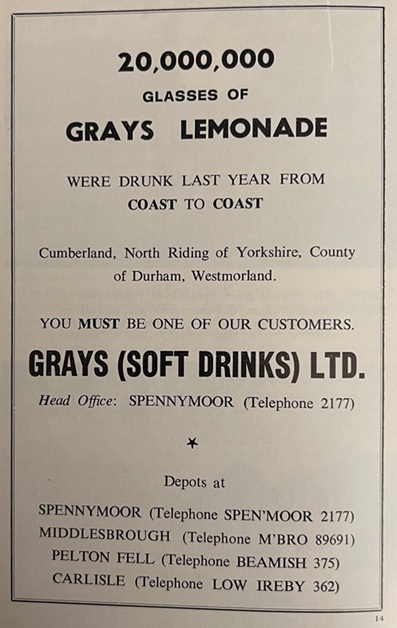 1965 Sunday Sun, Newcastle 04 July 1965
Mr Gray (in his steam lorry) - Certainly Started Something.
Out went the drink in brown stone jars.
Now they sell 240,000 bottles of soft drinks each week.
When Anthony Gray trundled off in his old steam lorry 40 years ago, with a load of sarsaparilla and ginger beer in brown stone jars, he never dreamed what a thirst he would uncover. But Anthony’s doorstep sales talk sent people dashing for the glasses – and, in a merry gurgle, one of the North’s biggest home sales soft drink businesses was born.
Now, three years after his death, the family business of Grays (Soft Drinks) Ltd. From Spennymoor Co. Durham, sells 240,000 bottles of “pop” and cordials every week.
The firm’s fleet of 50 red painted lorries serves 100,000 homes in an area from Annan and Alnwick to Whitby and York. And, as the firm’s 150 employees are told: “Every household is a potential customer.”
Children are the biggest customers. Said Mr Keith Kerwood, one of the three managing directors: “Children would drink every drop of lemonade they could get their hands on.” “The only drawback is the parent’s pocket.”
Grays produce 20 varieties of soft drinks at their ultra-modern £150,000 Spennymoor factory, which is less than a quarter of a mile from Anthony Gray’s sarsaparilla plant.
 But lemonade is still the best seller, and last year accounted for one third of the 500,000,000 gallons of soft drinks consumed by the United Kingdon.
People staying at home to watch television boosted Gray’s sales, but Bingo did not help at all.
But lemonade is still the best seller, and last year accounted for one third of the 500,000,000 gallons of soft drinks consumed by the United Kingdon.
People staying at home to watch television boosted Gray’s sales, but Bingo did not help at all.
The managing directors, Mr Kerwood, Mr George Gray and his brother, Mr Joe Gray, headed by Anthony’s widow, Mrs Evelyn Gray, who is the company chairman, are confident that the pressure on the driver not to drink alcohol, will give sales a further fillip in the future.
Mr Kerwood said: “The habit is catching on. Even among my own friends, more people are turning to sodt drinks in hotel bars when they are out for the evening.””The numbers will spiral when tougher legislation is introduced”.
It hasn’t reached the stage yet where the soft drinks people plunge into producing new varieties for the masculine palate, but the experts don’t shrug off the idea.”
 For the moment, however, Grays are too busy with their present lines. It takes a returned empty bottle jist 20 minutes to pass along the production lines and to get topped up again and ready to leave the factory once more – including 10 minutes spent in the washing plant.
From there the drinks go to depots at Middlesbrough, Chester-le-Street and Carlisle, where the door-to-door lorries take over.
The Grays’ success story would have been written earlier but for the Second World War. In 1940 Anthony Gray’s factory in Low Grange Road, Spennymoor, was taken over by the Government as a food store, and his fleet of eight vehicles were requisitioned by the Army. It was six years before the business was re-started. Then in 1951 the go-ahead brothers George and Joe Gray formed an independent company in Middlesbrough and traded as Gray Bros. They amalgamated with their father’s firm in June 1962, and made plans for the new factory, which is now one of the most modern drinks plants in the North. The factory has its own repair garage, just like grandfather Gray’s plant where he built his own vehicle bodies. Even the present managing directors’ cars are identical, to smooth out maintenance problems – three 120 mph Jaguars, a far cry from Anthony Gray and his old steam lorry.
Grays (Soft Drinks) Ltd. from 1968 Spennymoor Official Guide.
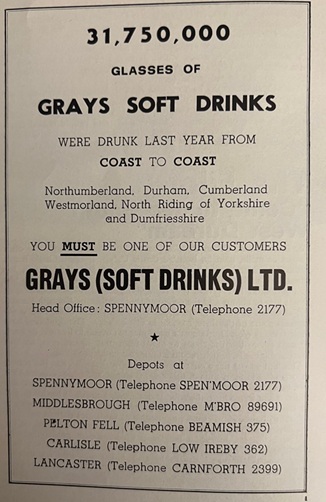 Grays (Soft Drinks) Ltd. Grays and Lemonade have been synonymous since the First World War when the late Mr Anthony Gray established a company as salt and pickle manufacturers. In the early 1950s, they concentrated entirely on the production of soft drinks, a reputation for quality and service being established which was famed throughout the county.
In 1951, two of Mr Gray’s sons started a new business at Middlesbrough, and the inevitability of the amalgamation followed in 1962 – by this time there were three factories-Spennymoor, Middlesbrough and Chester-le-Street. It then became desirable to build one new factory at Spennymoor to cope with the whole of the production, retaining depots at the other towns.
In March 1964, therefore, Gray’s moved to new premises at Barnfield Road and today employ more than 160 persons and cover the whole of the northern section of England extending over five counties, with branches at Middlesbrough, Chester-le-Street, Lancaster and Carlisle. The new factory is unique in design with its modern cedar-board front, standing in pleasantly landscaped gardens and has become one of the more attractive sites in the area. In the interior lay-out is some of the most up-to-date machinery, capable of producing up to 60,000 bottles per day and a fleet of nearly 70 vehicles delivers the current range of twenty drinks throughout the northern counties from coast to coast by direct supply to the consumer.
Jones Soft Drinks Ltd. - 1982 Spennymoor Official Guide
 Jones (Soft Drinks) Ltd. Is probably one of the oldest established family businesses still remaining in the Spennymoor area. The original company, formed shortly after the First World War under the name of Grays was established in direct supply soft drinks, and many years later in 1970 they acquired Jones of Bishop Auckland, itself a company established some 85 years ago.
The company still retains its local identity, employing all local staff, and its sales profile now includes a complete range of soft drinks in glass, plastic and concentrated syrups for the specialist trade. The company recently spent nearly three quarters of a million pounds on extensive development and is now geared to fully mechanised production for the eighties and its sales are mainly through the North-East.
Gray's Soft Drinks Photos For more pictures go to Youtube - Grays (Soft Drinks) Ltd.


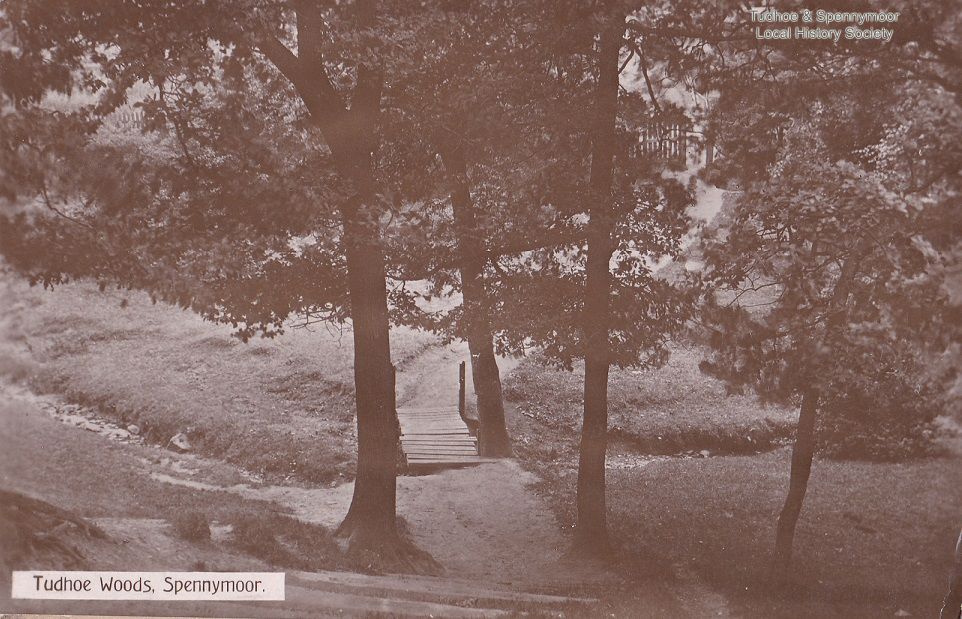 In 1896 there was great excitement in Spennymoor as a boy, James Cairns aged 12, found treasure in Tudhoe woods.
Treasure Trove at Spennymoor - Singular Discovery (28th July 1896 Northern Echo)
Gossip at Spennymoor has received great stimulus by the accidental discovery of a hidden hoard of gold. It appears that on Saturday James Cairns (13), a pitman’s son, saw a bee enter a hole on the side of the beck which divides Tudhoe from Spennymoor. Boy-like, the went for the hole, with the result that he came across a box containing ninety sovereigns of recent date.
A miner named Richard Knight was present, and was quick to not the treasure, which was soon handed over to Inspector Elliott. At present there is no clue to connect the treasure with either person or event. The supposition- a reasonable one- is that it is not a case of stolen money. The inferences are that the cash had been temporarily stored away in its novel hiding place for reasons which rendered concealment for a time advisable if not absolutely necessary.
In August 1896 an inquest was held, the Northern Echo reported on 20th August 1896.
Treasure Trove - Inquiry at Spennymoor
An inquiry into the recent find of 90 sovereigns at Spennymoor was opened yesterday at the Angel Hotel by Mr Coroner Proud. The sovereigns were poured in tempting abundance upon the table and counted. They bore dates from 1844 to 1894, 1892 being represented by thirteen. Sixty-eight coins bore the impress described in the police enumeration as “flying horses,” two were Australian, and twenty Victorias. It had been known that a claimant to the money – Mr Robert Smith, confectioner – would bring up certain accounts in support of his case, and accordingly a jury had been empanelled, Mr J H Simpson being foreman. Mr Smith was represented by Mr F Badcock, solicitor; the boy-finder had his father with him. Several curious townspeople took seats in the spacious chamber.
The Coroner said they had not cast upon them the unpleasant duty of going to view a body, but had to inquire as to a quantity of gold found in a wood. If the money had been hidden, and no one claimed it, then it became treasure trove, and was forfeited to the Crown. The Coroner then directed the jury as to the points they must consider and find upon.
James Cairns (12), schoolboy, was the first witness. He lived at 23, Bryan-street, Tudhoe Grange, and his father was a coalminer. On July 25th he went down the beck side about three in the afternoon and followed a bumble bee down the beck, which ran in Tudhoe Wood. Witness saw the bee enter a hole in a tree root, and he scraped the sod away. The sod seemed a loose one put over the hole. Witness then saw the tin (produced) about four inches down. He rattled it, then knocked the lid off, and saw the money.
Witness put the can and money back in the hole, and went and told Thomas Lowe, a boy, standing near. Both told Richard Knight, a miner, who was lying on the grass forty or fifty yards away. Knight said “Go away; there isn’t any.” Witness then fetched the box, and Knight looked at the money, and eventually took the box and the money to the police station. Witness also went, Knight on the way showing the box to several persons. The money was left at the police station with Inspector Elliott, who counted the money. By jurors and others: Whilst Knight had it a little girl took a few sovereigns out of the tin, but put them back again. Only Inspector Elliott counted the money.
Inspector Elliott: Scores of persons followed Knight and others to the door.
The coroner and jury said the boy had told a straight and intelligent story.
Richard Knight, of Mount Pleasant, said he was lying near the sewage works. Cairns said: Mr Knight I’ve found a dishful of sovereigns. I said, “get away”. Witness further corroborated Cairns. Witness told someone to run and tell Mr Robt. Smith his money had been found. Witness knew Mr Smith had been robbed. When Cairns could not find Smith witness then said to the lad “Let’s take it to the police station.” Witness showed the money to several persons on the way. By Mr Badcock and others; I knew Mr Smith’s house had been robbed. Smith’s house was the nearest to the place except Oxclose Farm- as near as any other place. Witness fetched Mr Smith to the police station. He acted like a gentleman, and said he had had the same kind of box on his premises. Knight asked “If I had not been there what would have become of the money?”
The Coroner: I don’t know; I think you acted very honestly. Mr Proud added that probably the Treasury might see a way for Knight to be rewarded for his honesty.
Inspector Elliott gave formal evidence.
Robt, Smith, confectioner, was sworn, and described the robbery at his house in December last. His bank-book was also produced, which showed that something like the amount of money found must have been stolen from the house.
A letter was also put in by Inspector Elliott from an unknown tramp claiming the money, as he put the box and the money there.
The Coroner then summed up the evidence, and said that probably when the facts were laid before the Treasury they might see a way for Knight to be recompensed for his honesty.
The jury, after deliberating in private, found that the money was hidden, but by whom there was not evidence to show, and that the ownership of the money had not been proved. They also found that the boy Cairns found the money and did not conceal it, and the jury recommended that the miner Knight deserved recompense for his honesty. The matter will be reported to the Treasury.
The money was sent to the Treasury, but it was later returned to the coroner to await a claimant.
The Decision was made at Auckland County Court, reported in the Northern Echo on 11th November 1896.
The Spennymoor Treasure Trove
The end of the romantic story of treasure trove at Spennymoor, which is now a matter of local history, was reached at Auckland County Court on Tuesday, when an action was heard by His Honour Judge Meynell, brought by Mrs Mary Ann Wright (72), a widow, living at Spennymoor, against Jacob Cairns [father of James], the finder of the lost money, amounting to £90. Mr J E Joel, barrister, instructed by Mr W Wilkinson, appeared for Mrs Wright, and Mr Gawan Taylor, instructed by Mr J J Dodd, for the youth Cairns.
Counsel in his open statement dealt minutely with all the facts of the case, and called witnesses in support of the plaintiff’s version, which was that she was residing in Thomas-street, Spennymoor, and left on June 22 for a few weeks’ visit to Danby, Yorkshire. She had then £340 locked in a tin box in a cupboard. On returning in August she missed £140, and when she had seen the newspaper report of the Coroner’s inquest on the treasure trove with the anonymous letter received by the police stating that a house in Thomas-street had been broken into by the writer, she reported her loss to Inspector Elliott.
Mrs Marshall, the woman with whom Mrs Wright lodged, came through to Bishop Auckland to see the Coroner, and there identified the box in which the money was found as one in which she had kept salts, and which tin she missed from her house, which had been locked up during Mrs Wright’s absence in Yorkshire. This box Mr Wilkinson, acting for Mrs Wright, sent off to the County Analyst for analysis.
Mr Stock gave evidence in support of the theory as to salts in the box; and other witnesses were called to prove the ownership of a leather bag found near the spot where the money was found, and this closed the case for the plaintiff.
Mr Taylor urged that his title was as finder, and His Honour remarked, in giving judgement for Mrs Wright, that there were strange facts connected with the case, and which had been proved in evidence, that could not possibly be got over, and he did not think Mrs Wright could have manufactured the story as a rogue.
In finding for the claim, however, His Honour could not allow any costs against the boy or his father. He commended the way in which the boy and the man with him had acted. His Honour said he had no power to allow taxed costs against the boy, he had no power, and he was only sorry he could not allow a reward.
Mr Joel said he would endeavour to convey that to his client as well as he could.
The case had occupied several hours.
Click for further details of the Cairns family, their links to the Tudhoe Colliery Disaster and letters to the Children's Circle.
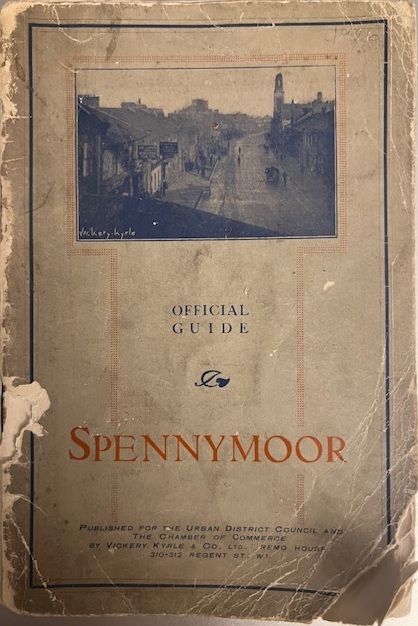 The 1926 Spennymoor Official Guide, published by the Urban District Council and the Chamber of Trade, provides a description of the Chamber of Trade's objectives.
This Chamber of Trade is still in its infancy, but it has already proved of great assistance to the trading community of the town and also to the general public.
An Association of this kind not infrequently confers incalculable benefits upon its members, but it is not generally appreciated of what value it is also to the general public.
The chief objects and aims of a Chamber of Trade are to safeguard the interests of its members; firstly, by decreasing the number of bad debts, and secondly, by bringing pressure to bear upon the railway companies and cartage contractors to reduce the costs of carriage. In unity is strength; and collectively the traders of a town incorporated in one Association are enabled to obtain many concessions and advantages denied to the individual. These are reflected in the prices of goods and commodities for sale, and so ultimately benefit the purchasing public.
In the past, many towns have found that their local Chamber of Trade has had a measurable influence in reducing the costs of living, and also in obtaining concessions from the railway and bus companies in the matter of fares operative on market days, half-holidays and special occasions.
It is to be earnestly hoped that the membership of the Spennymoor Chamber of Trade will soon include all the traders of the town.
The first Hon. Secretary was Mr R Hornsby, who in the first two years worked hard and diligently to ensure the success of the Association. Mr T N Walls was the first president, and during his term of office most of the traders of the town were enrolled as members.
The President in the second year was Mr G W Scott, and during his Presidency the Chamber rendered valuable service to the town by its weekly contributions to the Relied Fund, which did much to alleviate the distress caused by the coal strike.
The good work was ably carried on under Mr W H Snowdon, who succeeded Mr Scott in the third year.
The fourth year of the Chamber’s existence saw Councillor Jas. Beckwith as the popular President, and the fifth President was Councillor S J Knowles, who was instrumental in adding to the Chamber’s activities and increasing the membership.
The sixth and present President was elected in November, 1925, and in Councillor J Reavley, JP, the Chamber have a leader who can be safely trusted to enhance the already great reputation which the institution enjoys in the town.
The Hon. Secretary is Mr J W King, who will be pleased to give any information to intending members.
Amongst the members of the Chamber are to be numbered several gentlemen with civic honours, who have a wide experience in public affairs and render valuable service in important matters affecting the general good of the town and district.
A cup, to be competed for by the bands of the county, was presented by the Chamber of Trade in July, 1925.
10th January 1925 Newcastle Daily Chronicle
Spennymoor Shop Holidays - Complaints at Chamber of Trade
The failure of certain Spennymoor tradespeople to observe the Christmas and New Year holidays fixed by the Spennymoor Chamber of Trades, together with the general lack of unanimity as regarded hours of closing, was the chief topic of discussion at the monthly meeting of the Chamber.
Mr J Reavley drew attention to the fact that several tradesmen, some of whom were members of the Chamber, had remained open on Boxing Day and Jan 2, contrary to the decision of the Chamber.
He considered that these private tradespeople were setting a bad example, now that the majority of multiple shops had fallen into line, and their action had created dissatisfaction. If it were found impossible to have a uniform system of closing, the Chamber should drop arranging holidays altogether.
The President (Mr S J Knowles) said those of their members who kept open were not acting loyally towards the Chamber, and their action would have a detrimental effect in the future.
Mr J Beckwith maintained that no adequate enforcement of the Shop Hour Regulations could be possible when the responsibility lay, as at present, with the Food and Drugs Acts inspectors. Many shops remain open until 10 o’clock, and no one said anything to them. He was of opinion that the powers should be regulated to the local police, who were in a position to detect offenders.
In accordance with these suggestions, it was decided to send a recommendation to the annual conference of the Durham and North Yorks Federated Chambers of Trades, to be held at Bishop Auckland on January 28.
The President and Vice-President and Messrs J Smith and J Beckwith were appointed representatives to attend this conference.
13th November 1926 Newcastle Evening Chronicle
Spennymoor Protest - “Shop-House” Assessments and Opening Hours
Spennymoor Chamber of Trade, at its sixth annual meeting last night in the New Town Hall, decided to write the Assessment Committee and and Durham and North Yorkshire Chamber of Trades on the question of side street shop-houses being assessed as dwelling-houses only and to acquaint colliery companies of people living in their houses rent free and using part of the premises as a shop.
It was also decided that the shops inspector be informed that many side-street shops were serving customers at all hours of the day and night.
The Secretary (Mr J W King) appealed for a better attendance at the meetings.
The Treasurer’s report showed an income of £34 2s 1d and an expenditure of £13 16s 9d.
Officers were elected for the forthcoming year as follow:-
President Mr J Reavley; vice-Presidents, Messrs T Miller and A J Smith; treasurer, Mr J G Hall;
Secretary, Mr J W King; assistant secretary, Mr A J Smith; auditors, Messrs S Bakewell and A Watchman;
committee, Messrs G W Scott, R Hornsby, J Beckwith, W H Snowdon and J Watkinson.
25th January 1930 Newcastle Evening Chronicle
Apathetic Traders - Spennymoor Threat to Close Down Organisation.
Lack of enthusiasm by traders in Spennymoor led to a vigorous discussion at a meeting of Spennymoor Chamber of Trades as to whether the organisation should continue or close down. The Chamber is in a good financial position.
It was eventually decided that the Chamber should carry on for another 12 months and that the meetings be held quarterly instead of monthly.
Officers were elected as follows: President, Mr F Dodshon; vice-president, Mr A P Hunter; secretary, re-elected, Mr J W King; treasurer, Mr J G Hall.
At the close Mr King was presented with a fountain pen and pencil in recognition of his service as secretary.
29th December 1939 Daily Gazette for Middlesbrough
Spennymoor Shop Hours Change
Friday night as the late closing night for shops in Spennymoor area has not been a success. It was reported at Spennymoor Urban Council meeting last night that letters from various retailers and from the Chamber of Trade had been received protesting against the fixing of Friday as the late night.
The council decided, therefore, to make a new order fixing the closing hours, with Saturday as the late night, at 6pm on Mondays, Tuesdays, Wednesdays and Thursdays, 7pm on Fridays, and 7.30pm on Saturdays. These hours are, of course, subject to the weekly half-holiday.
Councillor T W Marley pointed out that Friday night had merely been fixed as the late night as an experiment and, since it did not meet with approval, the council had decided to revert to Saturday.
29th August 1927 Newcastle Daily Chronicle
Spennymoor Carnival – Band Contest Cup Won by Leasingthorne Colliery.
The second annual carnival promoted by the Spennymoor and Whitworth Town Band contained the best procession ever seen in Spennymoor.
The brass band contest for the Spennymoor Chamber of Trade Cup (value £20) was won by Leasingthorne Colliery (conductor E Smith), Brancepeth Colliery ( J B Wright) being second and Hetton Colliery (W M Aighton) third.
15th September 1928 Kington Times
In connection with the Spennymoor and Whitworth band carnival on Saturday a band contest for the Chamber of Trade Challenge Cup drew a record entry from Durham county, 18 bands competing.
Cargo Fleet ironworks were the winners.
5th October 1931 Newcastle Daily Chronicle and Hartlepool Northern Daily Mail
Band Contest at Spennymoor
The Spennymoor Silver Medal Band held their annual brass band contest for the Chamber of Trade £50 Challenge Cup in the new Town Hall, Spennymoor. The adjudicator was Mr W K Straughan, of Hetton, who in making his awards commented upon the high standard of the playing of the competing bands.
The results were:-
Selection Contest (Test Piece “La Favorita”):
1, £8, cup and trombone medal, Cargo Fleet ironworks;
2, £3 10s and cornet medal, Brancepeth Colliery;
3, £2 and euphonium medal, Thornley Colliery;
4, £1, Eldon Silver Band
March Contest: 1 Brancepeth Colliery; 2, Eldon Silver band.